Fermer
Retour
Accédez aux ressources médiatiques officielles de l'OTAN. Un contenu de qualité professionnelle, diffusé sur les dernières actualités. La référence pour les professionnels des médias.

Accédez aux ressources médiatiques officielles de l'OTAN. Un contenu de qualité professionnelle, diffusé sur les dernières actualités. La référence pour les professionnels des médias.
Désormais, vous pouvez télécharger des versions complètes ou partielles de nos vidéos depuis notre site Web.
Si vous souhaitez également vous abonner à la newsletter et recevoir nos dernières mises à jour, cliquez sur le bouton ci-dessous.
Entrez l'adresse e-mail avec laquelle vous vous êtes inscrit et nous vous enverrons un code pour réinitialiser votre mot de passe.
Le mot de passe doit comporter au moins 12 caractères, sans espaces, inclure des lettres majuscules/minuscules, des chiffres et des symboles.
Cliquez sur le bouton pour revenir à la page sur laquelle vous étiez et connectez-vous avec votre nouveau mot de passe.
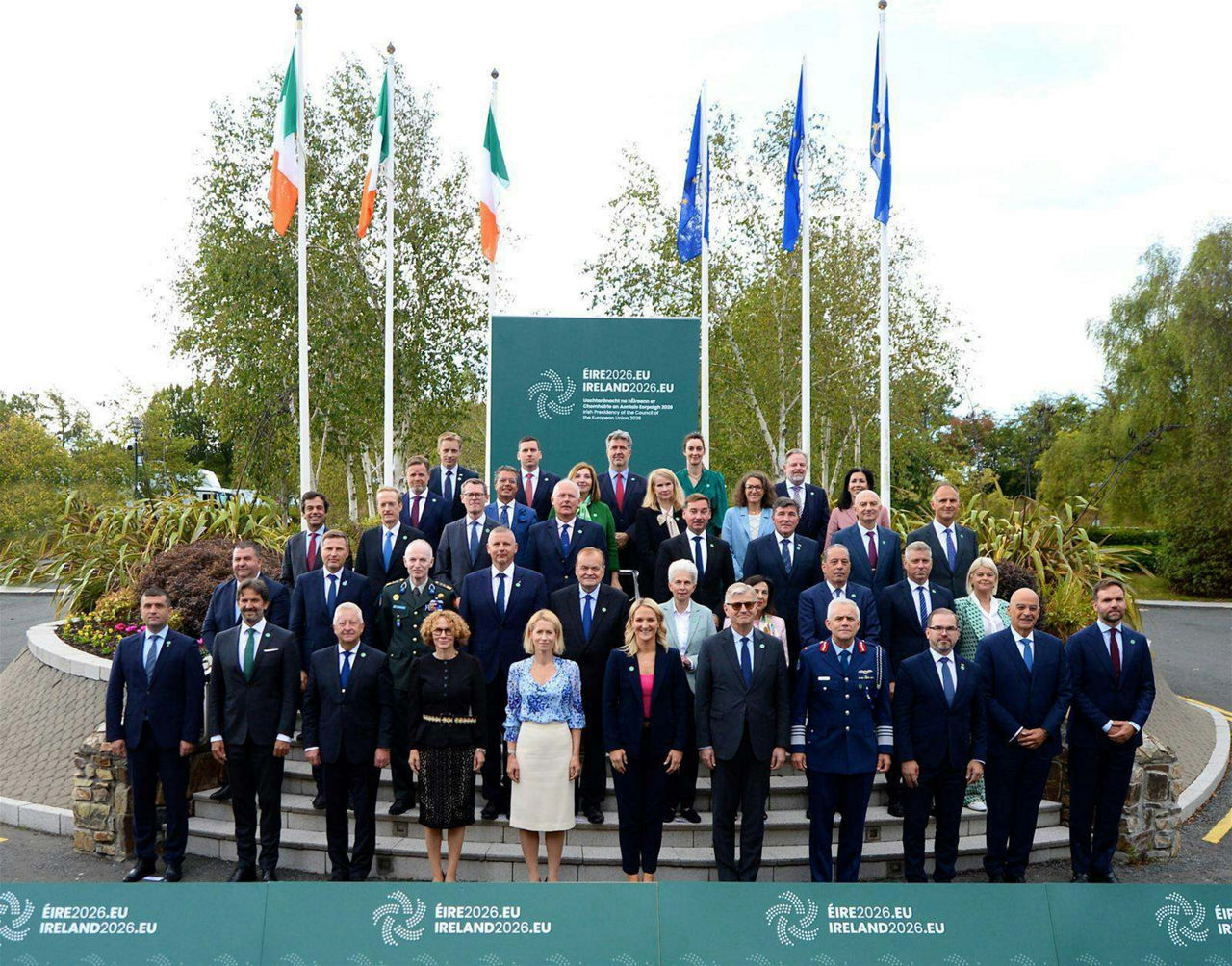
Thank you so much for the invitation, and good afternoon. Welcome. It's an interesting format to actually have a debate like this before some of the official meetings, but let me start by saying why I am first and foremost in Dublin on behalf of NATO. I will join Defence Ministers of the European Union that meet here under the Irish Presidency in order to discuss a number of issues. But the reason why I'm joining them is that one of them, one of those issues, will be supporting Ukraine, and this is definitely one of the areas where NATO and EU cooperate very well. And our cooperation has really been, to a certain extent, the only game changer at Ukraine's disposal, to help them in their justified fight for independence and for sovereignty and the territorial integrity.
And this was very high on our agenda when leaders of the 32 Allies met just more than a month ago in Ankara. In the last two years, we have had two Summits, and, as some people say, with every Summit we claim that the Summit is historical. I do believe that both Summits were very important for the North Atlantic Treaty Organisation and for the Alliance, because The Hague Summit last year really allowed all 32 leaders to agree that we need to reinvest in our security. You know, I have not been only a Defence Minister, so I know how money is scarce in every budget with every discussion. And I would always prefer to say, “Oh, we would be able to increase spending in other areas”. But you know, I also come from the Balkans, and I have seen the price of undermining security. And this is what we discussed last year when we met in The Hague.
War is back in Europe. We see not only a revanchist but very aggressive Russia, and the only way a defensive Alliance can really deter aggression is to invest in its own security. If someone would have said a few years ago that 32 democracies can agree to such an ambitious target – to increase defence investment to 3.5 percent for core defence, an additional 1.5% points of GDP for defence-related, a broader sense, resilient, cyber, infrastructure elements – many people would have said “no way”. But this is why The Hague Summit was so important. It allowed us to reach this decision. And in Ankara, just one year afterwards, we were able to say “we have committed, but we are also delivering”. And in Ankara, it was clear that there is a real change, especially in Europe and Canada. European Allies and Canada have increased their defence investments initially by 20% - which was 139 billion U.S. dollars just for one year, and for 25, 26, an additional 250 (billion U.S. dollars). And this is an investment especially in countries that have been underinvesting in security because we were all enjoying the peace dividend. But what Europe has shown is that, when confronted with a challenge of a completely changed security environment, we do what is rational, and this is we rise up to the challenge. And what we have seen is not only a focus to increase our security, to increase our capabilities, but also to continue and sustain our support to Ukraine. And I can go more in details if there is interest on these issues. But generally, it was a big sign that it's not just words; that Europe is becoming more serious about its security, and, in today's world. That's good news. Thank you.
Orlaigh Quinn, Interim Director General of the Institute for International and European Affairs (IIEA)
Thank you for the opening comments, and it leads very much, I think, into the first question that I had, which was about the war in Ukraine, and in particular, I suppose, the growth in hybrid activity. And maybe just to kick off on that question, what does NATO – where would you see the biggest threat then to European security today? And maybe just to add to that, is Europe adequately prepared? And you've touched on some of that already.
NATO Deputy Secretary General Radmila Shekerinska
Well, the discussions, even before Ankara, but very much the discussions on The Hague were very clear. We have a shared threat assessment, and we have seen that the biggest threat to European security, Euro-Atlantic security, actually comes from this revanchist and aggressive Russia.
The forms of this threat can be different. I mean, the most visible part is, of course, what we see in Ukraine. I repeat this because sometimes it takes me also… it is difficult for me to assess that, five years – we have war in Europe, a traditional territorial conquest, which we thought belonged to the past. And at the same time, we see Russia challenging also European security in different ways. Some people call it hybrid threats. I remember some colleagues said, “these are no longer hybrid threats; these are hybrid actions”. Their reckless behaviour is very visible throughout the eastern flank. You see it in a number of airspace violations, be it drones, be it jets. But then we see the number of arson attempts, the sabotage attempts, not to mention the intelligence and even assassination attempts. So, what we see is really a behaviour that shows a very increased appetite for risk, a lot of aggression, and definitely this is something that we sense as a changed security environment in Europe.
I have no doubts – no doubts – that the Alliance (and within it, European Allies and Canada) is definitely stepping up. I have mentioned some numbers in total, but I will mention that a number of Allies have already invested more, or around 5% of GDP into their security. And, of course, the picture depends on geography. Unfortunately, the threat assessment, of course, is very visible and very clear as you move closer to the to our eastern borders, and you can see all the Baltic States – Poland, but also the Nordic states – some of them actually reaching 5% for core defence, not 3.5 plus 1.5, but 5% solely dedicated to these defence capabilities. And if they can do it, others can do it.
Of course, there is a different pattern in the defence spending, but just in the course of one year – let me go back a bit to the so-called Hague pledge. In The Hague, we have agreed that we will reach the 5% of GDP pledge in the course of 10 years. So, because we know that it's not an on-off switch, it's very difficult to go from lower – traditionally, historically lower spending – suddenly to 5%. So, there is a curve, but even one year afterwards, in total, we are very close to 4%. So, this shows commitment, and I have no doubts that when we put our mind to it, when we see the challenge, we rise to the challenge. And I think this was very visible in some of the pledges of support to Ukraine.
We agreed in Ankara that we will match a certain amount of aid, both for this year and next year, that will allow them to negotiate from a position of strength, but also survive. You're all witnessing the terrible death toll that every night and every day, Russian aggression is causing in Ukraine, and this is why we especially focus on air defences in Ukraine, because we really know that the challenge of this winter will be A) the severe humanitarian losses – now the recent attacks have been really terrible in terms of civilian losses – but also the losses to critical infrastructure, especially energy. So, these are all things that I think will require our focus.
Orlaigh Quinn, Interim Director General of the Institute for International and European Affairs (IIEA)
And you touched there on the role of the EU, and, clearly, they have been stepping up to the mark through the ReArm Europe and other initiatives, SAFE Instrument, etc. Where would you see, from the NATO perspective, complementarity? And is there also a risk of duplication? Just maybe touch on that, if you would, please.
NATO Deputy Secretary General Radmila Shekerinska
If you ask me, “how is the cooperation generally between NATO and EU?”, I would say that it's a very good partnership, and it is growing, and that's because we see each other's roles not as competing but as complementary. And when Secretary General Rutte was elected in his position, his, let's say, managerial vision was: let's not try to do everything, you know, that can be security related, but focus on really the things that we know the best. And this is how he approached also cooperation with the EU on certain issues.
We count on EU leadership. You know, how do you increase the financial instruments at disposal? How do you support defence industry base? How do you work on issues such as increasing our resilience? All these things, we believe that the EU has a lot of expertise, and then we support their decisions. But we focus on what we do the best: standards, how to be interoperable, how to create the capability targets, how to do the traditional deterrence and defence.
And when approaching support to Ukraine, we were equally pragmatic and complementary. This is why, at all of our meetings in the North Atlantic Council, focused on supporting Ukraine – we have a special NATO-Ukraine Council – we always have EU very high-level representative, usually Kaja Kallas. Whenever there is a meeting of EU Foreign or Defence Ministers, it's always one of us supporting. We have focused on the military, let's say, equipment, supporting also Ukraine with advice, supporting them with necessary logistics. We have a whole centre in Wiesbaden focusing on supporting Ukraine since day one. And then we have our teams in Kyiv. But we also have created a special centre in Poland that works… it's practically the only entity of that kind between NATO and a partner country, where we don't believe that we are giving something to Ukraine, but we are actually working together on lessons learned from the war in Ukraine. A very clear partnership. And we focus on these things.
So, for example, 99% of all the military equipment support going to Ukraine comes from NATO Allies – not NATO, but NATO Allies. We focused, especially in the last year, on providing the necessary air defences. 90% of all the Patriot interceptors come through a programme that we have envisaged, the so-called PURL programme, Prioritised Ukraine Requirements List. It is Allies that finance it. It's predominantly equipment that is only available in U.S. stockpiles. We have called European Allies to use interceptors also from their stockpiles. But interestingly enough, we also have worked on a model in which part of the Ukrainian Support Loan funds can be used to finance part of these packages. So, I think, when you are confronted with a with a tragedy and a war of this magnitude, you have to learn to be really very practical and come up with solutions that save lives, and this is how we have worked together with the EU on supporting Ukraine.
Orlaigh Quinn, Interim Director General of the Institute for International and European Affairs (IIEA)
Thank you, thank you for that. Can I touch then on, in terms of Ireland and Ireland's relationship – as people in this room well know, we have a very long-standing policy of military neutrality, but also maintaining an established relationship with NATO. How does the Alliance view that relationship, and again, how might it develop in the light of the changing circumstances in Europe?
NATO Deputy Secretary General Radmila Shekerinska
If I'm not mistaken, this partnership started back in 1999 when Ireland joined Partnership for Peace as a partner country, and we have valued very much our partnership, fully respecting your policy and your choices, sovereign choices, that you have made on military neutrality. And this is how partnerships with NATO work. We respect each other, and we agree whether there are areas in which our cooperation can benefit both sides. I know that lately one of the areas in which there is more of an even interest and raison d'être, to cooperate, is of course maritime security, and especially the threats that we have witnessed with regards to our undersea cable infrastructure. 75% of all the transatlantic cables pass through Ireland. So, there is an interest for you. There is also an interest in us to protect this.
And what we have seen, especially in the Baltic Sea – but what happens there can happen elsewhere – is that Russia's actions, the so-called hybrid actions, are not just with military capabilities, but they can harm us even more by stopping energy transfer, by stopping data transfer, by undermining critical infrastructure, so this was very much a challenge for us at the beginning of last year, when we saw a number of ships from the Russian shadow fleet, with the aim of breaking sanctions, but probably even also causing damage, breaking many of these cables, using false flag ships, which are not only a challenge for our infrastructure; they can also be a huge environmental threat. And what we have seen is that our decision in the Baltic Sea to start – we call it – (enhanced) Vigilance Activity Baltic Sentry, with more of a presence there, did change Russia's calculus. The initiative of the French President Macron to tackle the Russian shadow fleet for a number of reasons, among other these kinds of… also changed their calculus, and it did allow us to protect our critical infrastructure better. So that element is something that all countries who are worried about maritime security have in common.
We have appreciated the fact that Ireland has supported KFOR presence in Kosovo, which has been really instrumental in maintaining peace in the Balkans. And I remember that we have also been profiting from trainings by Irish Defence Forces on dealing with explosive devices, etc. etc.
Every year, we discuss with Irish counterparts what are the interests of Ireland. We discuss our interests and we formulate the plan for this partnership. So, it's very much a two-way street. I come from a country that, until 2020, was a partner country, so I know how interesting, challenging, but for us very useful this partnership can be, and I do hope that we play the same role in our relationship with Ireland.
Orlaigh Quinn, Interim Director General of the Institute for International and European Affairs (IIEA)
Very good, thank you. And indeed, here in the Institute, we have done some work on cybersecurity and undersea cables, and I've had a most recent seminar on that. And for those of you who have a particular interest in that, there's a very good report on our website that you might like to access after this session. Maybe just before I turn over to the audience for questions, do you think NATO and its Allies are acting fast enough to counter the new threats?
Deputy Secretary General Radmila Shekerinska
We always we always talk about acting with the speed of relevance, and of course, if you translate this nice, three words, it means you know, if yesterday is feasible, it's better than today. But actually, we have to be very clear about this. We are a defensive Alliance. We were created to preserve peace and to protect the members and citizens. This is why sometimes our behaviour is seen as reactive, because the only thing we want to do is to protect, and this is why some people might challenge: Are we are we quick enough? Of course, we have to do everything, this this huge ramp up, increase of investment, increase of production, it has to happen much quicker.
But I'm really impressed by a number of Allies that have made practical U-turns in their policies, not because they desired, but because they were confronted with a very bleak reality, probably an area where we need to be faster, is of course, production, defence production.
After decades of peace and well, enjoying peace dividend, the defence industries have become really weak and their production capacity very low. And this is why it was really staggering to see that there is a significant increase in their potential, in their capacity.
We saw it in Ankara, in parallel to the Summit. We did a Defence Industry Forum, and we have seen that Allies have invested, increased their defence industrial production by 38 billion U.S. dollars. Some of it just extending old production lines, and some of them in creating new production lines.
But especially on these issues, air defence, we have to produce more. And especially as we are confronted with too many theatres, too many crises globally. This is probably the big urgency that everyone senses.
Orlaigh Quinn, Interim Director General of the Institute for International and European Affairs (IIEA)
Okay, thank you so much for that, Radmila. I'm going to open up to the audience, and I just, if I ask people, just give me a show of hands so I get a sense of. Okay, so I'm going to ask people, because we have so many hands up. I'm going to ask people to be short in their questions, if they would please, and I'll start on this side of the room. Gentleman there, and another gentleman behind too, and then we'll work our way across.
Question,
Thank you very much, Senator Tom Clonan is my name. I'm a member of the Joint Directors Committee on Defence and National Security. I have two very quick questions for you: With regard to Putin's reprehensible and criminal invasion of Ukraine, Belgorod in Russia is approximately 80 kilometres from Kharkiv. In almost five years of attritional combat, the Russians have not managed to get 80 kilometres down the road to Kharkiv. So, in what you termed your shared threat assessment, what is the evidence that Russia is capable of mounting conventional offensive operations against other parts of the European Union or NATO member states? What evidence is there for that?
The second question I wanted to ask you was, in relation to Ireland's relationship with NATO, we currently have six counties in NATO, and 26 counties outside of it. Notwithstanding Prime Minister Burnham's recent comments about Irish unity, an all-island settlement of some sort is definitely on the political horizon. It's going to happen within the next 10 to 15 years. So, how does NATO view that? Will NATO be a part of that all-island settlement? If not, how will the Republic provide the necessary security guarantees to replace NATO's presence? Thank you very much.
Deputy Secretary General Radmila Shekerinska
On the second one, we try to steer away from domestic political issues as much as we can. Sometimes it's difficult. The politician in me tries to avoid the, let's say the perimeter of… But let me go to your first question, which I find extremely important because I hear it in different forms. But the echo. I think that when we analyse Russia, we very often make the mistake of assessing their decision making based on our premises, and we say it doesn't make sense, right?
And this is why many people, many colleagues of mine, during our discussions in 2020, in 2021, end of 2021, beginning of 2022, a huge number of my colleagues and security experts said, “No way he will attack Ukraine,” because it did not make sense, because the risks were huge, and because there were certain cards outside of his hands. He did it anyway. Why? Because he believes that he can always win over us in a contest of suffering. That the fact that he is willing to sacrifice so many people. There was this comment by a security expert who said that when a Russian, a young Russian soldier joins the troops at the battlefield, the probability is that he would be dead in 20 to 30 minutes. This is the reality that Putin pushes his young men to, but he says, “I'm willing to pay the price. Are you?” And this is what he believes is his advantage.
At the first part of the year, we have had analysis by most of Ukraine officials saying that for the first time, the casualties on the Russian sides are exceeding 30,000 per month. Well, let me tell you, our analysis shows that now they're exceeding 40,000. Is he changing his course? On the contrary, he's actually pushing the pedal, the gas pedal, even more, and continuing both with the, you know his presence on the on the battlefield, but very much increasing his air attacks on Ukraine because this is where he sees less risk for him, but more pain towards Ukraine.
So, if we do an analysis, does he have the resources? He has limited resources. That's true because Russia is the economy of Italy, right? It has 1/3 of Europe's population, but that does not mean that he is not willing to risk it because what we have seen in Ukraine and at our eastern flank is that he is willing to take much more increased risks than in the past. [Inaudbible] goal is really to invest in our deterrence so that we can prevent a war, so that we can convince him that even according to his calculus, this risk is too much to take. But if you go back and analyse the numbers in in the Russian economy, especially the production of missiles, the production of ammunition, this is not someone preparing to stop with Ukraine.
The numbers when it comes to ballistic missile production, the pact that he did with North Korea, yeah, we fail to even mention these days. We don't we not only have North Korean soldiers fighting on behalf of Russia, we also have their technology and their missiles used against Ukraine, so the threat assessment that we did before 2022 showed that there is a possibility for a Russian attack to Ukraine, and as we move towards February, it grew stronger, and it proved to be correct. So, this is why I would rather be safe than sorry, and this is why the investment is there really to deter Putin from testing our unity and testing our strength.
Orlaigh Quinn, Interim Director General of the Institute for International and European Affairs (IIEA)
Thank you, Senator. And if people will identify themselves as well, just when they ask their question, thanks.
Question,
[Inaudible]. Chief economist here at the Institute. You mentioned production defence industry. A question specifically on Europe: You mentioned production within the member states has increased, but not increased enough. Could you maybe explain a little bit more why that's happening? Is it because governments, while they've increased spending, are not increasing it enough, or is it because the defence companies are not able to raise the money they need to increase their production capacity? Just to try and understand better what's happening in the defence industry in Europe, in particular. Thank you.
Deputy Secretary General Radmila Shekerinska
Well, it's different reasons to a certain degree. There is there is no one silver bullet for this, and what we tried in our discussions with Allies, but also with industry in the last two years, was to try and understand the challenge and try to be supportive to overcome it. Initially, our defence industry has been, because we have been underinvesting in security, our defence industry was neither very active in terms of producing, nor very innovative.
And I think that if there is one big wake-up call that came after the Russian attack was that those who do not innovate, they fail. So there was first a big push at the defence industry to innovate and produce more. And sometimes these two things are not easily combined. Secondly, there were a lot of regulations that made investment in new additional production, in increased production, in new products very more complicated. Part of it was lack of access to financing instruments. Some of the commercial banks were not able actually to loan money to defence companies. I remember one of the first speeches that Secretary General Rutte did after being elected was he actually had a very blunt sentence saying, “I cannot accept that we treat defence industries in times like this as we treat pornographia and drug smuggling,” because there were so many limits to financing increased defence production that it became impossible.
Thirdly, some companies were saying we see that everyone is pledging higher defence investment, but we are still not getting contracts. That was very much last year, the first year. Of course, when you start talking about a new defence investment pledge, the money does not materialise overnight. You need the budget cycle. You need to put the money in the budgets, and then you need very difficult and complicated procurement processes. We actually advocated in favour of making these processes more practical, and calling Allies to procure more together, because we saw the advantage of multinational procurement, which would bring economy of scale, which would allow companies a certain kind of predictability, and which would convince them to invest more, but of course the big challenge was what are the capabilities that countries need today. Some people would say, you know, with the drones, the battlefield has been changed beyond recognition. So, some people have advocated against investment in what they see as legacy systems.
But everything that we have heard from Ukrainian experts and our own NATO experts is that we need all these things. We do need the legacy systems. We need air defences. We need deep precision strikes, but we also need drones integrated in our doctrine, and we have to also think about the implementation of AI in our part, in our world.
So, it took us a while. I think now the demand signal is there. It was clear that the governments are changing, but of course the defence investment shift is not equal everywhere. The closer you are to the Russian threat, the increased defence spending is easier politically as well. So you see that in certain countries, defence industry was able to deliver much sooner than in others because of this. So no silver bullet, but I think that the list of challenges was very clear to our Allies, and we have seen that when there is a political will, companies and governments found a way.
Orlaigh Quinn, Interim Director General of the Institute for International and European Affairs (IIEA)
Thank you. I'm going to take two here in the front, and then I'm going to take a couple because our questions are coming in fast on online. So again, as I say, if you would identify yourself and please keep your comments short. Thank you.
Question,
[Inaudible], a member of the Institute. First of all, I must say I was very heartened by the fact that you kept the focus firmly on Ukraine and the immediate issue of Ukrainian civilians being mercilessly and relentlessly and brutally bombed regularly by Russia in absolutely indefensible war crimes, because that's the nature of that whole campaign that Putin launched. It was illegal under international law, and the speed with which Sweden and Finland gave up their neutrality is a reminder to all of us of the real threat that this new world places on all of us.
But there's one question I think is really I have to put it to you. that the enhancement, the reform, the development of international law is as important as increasing defence expenditure, there's a complete, you've said it yourself, the whole battlefield is completely changed. You know what? How do you deal with drones in international law? Hybrid warfare, even the action you've taken against the shadow fleet. There's no mechanism international law to do that, and it's a classic example how it failed.
And finally, Madam Chairman, I must say this because it is seared into my heart and soul, having worked for so long on Syria. I firmly believe because Putin got away with merciless carpet bombing in Syria, bombing hospitals, precisely the way the Israelis are doing in Gaza. That it fundamentally gave them the confidence. What I'm really saying to you is, unless we take international law seriously and enhance and develop it, we're not really going to do much good for our long-term security. Given the way AI is going to make your own conference even more. Thank you, Madam Chairman.
Orlaigh Quinn, Interim Director General of the Institute for International and European Affairs (IIEA)
Thank you, and I'm going to ask the two people behind for their questions if I can take them together. Thank you.
Question,
Thank you very much, [inaudible] a former director general here. I've a Russian friend who lives here and who's in contact with her family back in Russia. They're in Siberia, and she tells me that there is a growing feeling within Russia amongst the mothers of the dead, not dissimilar to what happened in Afghanistan, and which put certain pressures on the Russian government then, and she feels there may be some pressures coming on the Russian government now.
That's the first question, and the second one is that she also hears now and again that there are ordinary Russians who are asking themselves or telling themselves that the only way to bring this war to an end is to what the Americans did in Hiroshima and Nagasaki. Do you think there's a possibility that the Russians will use nuclear weapons?
Question,
Hello, my name is Kevin O'Reilly. I am a semi-skilled European citizen. My question is: Had we not made the decision to bring Ukraine into NATO in April 2000 or 2008, or had we backed off seeing Russian opposition would Ukraine still be inside its pre-2014 borders? And my second part is, do you think Vladimir Putin's 2007 Munich speech had good political foresight and warnings? And this question I ask rhetorically to the room.
Deputy Secretary General Radmila Shekerinska
Let me let me say that we understand and believe that international law continues to play a very important role in the world, and you are absolutely right that as the battlefield changes, there will be a need for changes in in this domain.
But what we try not to do is to discuss what other organisations should do better. But definitely, we have always been as an organisation stating that our actions, that our policies reflect our view and the value given to international law. The question of pressure that Putin feels is discussed through different lenses. You have the anecdotes that you have mentioned. There are some opinion polls which are difficult to trust in in an environment like Russia, but you see an increased dissatisfaction with how the war is going. It was offered and promised as a special, how do they call it, special military operation.
People in Russia believed that it will take days and that the suffering will be on Ukrainian side. These days, the country that has already lost around one million men, and that is usually one of the biggest producer of energy, is struggling to get gas to their pumps. Is struggling to get energy to their citizens. There is no reason why people would be would be satisfied with this. The Ukrainian deep precision strikes have brought war home. Otherwise, many Russians believe that they can only watch this war on television.
But the problem with autocratic one man/one leader autocracies are that it's very difficult to predict how will this dissatisfaction unfold. But we have watched nuclear threats coming from various Russian officials throughout the last five years, and we have seen every time they struggle with the situation at the battlefield. They don't see breakthroughs. They see attacks on their critical infrastructure. That's when they raise up the nuclear rhetoric. We will not be rattled by it. What we have seen is definitely a rhetoric that they use, aimed at both Ukraine to undermine their bravery, their resolve to fight, but also to undermine our support to Ukraine.
And this is exactly what was behind some of the hybrid actions. They count on us giving up on Ukraine, they count on us saying, “Well, maybe if we don't help them,” you know, this has not worked. So what we have seen in Estonia, what we have seen in Poland, you know, the hybrid, the air incursions, the reckless behaviour by Russia, we always said it will be followed by a calm response from our side, which will mean we continue and strengthen our support to Ukraine.
And this is exactly what we are doing as we now meet defence ministers. This will be the main call as we gather ministers for the so-called UDCG meeting on supporting Ukraine, our call will be again: we need more air defences for Ukraine, and the threats will not will not destroy that resolve. When it comes to what if. These are not the questions that we dare answer directly.
But there are many analyses who say that everyone should have been more careful in 2008. Probably the alarm was there with Georgia. The alarm was there, you know, these were all kind of early announcements, and this probably justifies an old saying that you know when autocrats like this get away with aggression and with conquest, they don't stop. They're emboldened by their success, and they continue. And this is why it is so important when we talk about supporting Ukraine and sanctions to Russia that we say that we have to be there in the for the long run. We have to make sure that Ukraine negotiate from a position of strength. For this they need our support. And that this, when they sit down for peace negotiations, and Putin doesn't seem very eager to negotiate peace, but when this happens, that this leads to a lasting and just peace.
Otherwise, it will be a pause, and not an end of hostilities. So yeah, many lessons learned, but some cynical people said the only thing we learn from history is that we never learn from history. But that's that's the cynic view.
Orlaigh Quinn, Interim Director General of the Institute for International and European Affairs (IIEA)
That echoes a question now online coming in from Conor Daly, who's a research fellow, and he talks about a growth in populist political parties, and then how to stop Russia from exploiting our electoral systems to frighten Europe's citizens into withdrawing support for Ukraine. So that was one, and I have a couple of questions coming in online as well about the role of the U.S. and if there is a declining support? I think Darren McMahon has raised that online, and I have somebody else here as well. Colin Reed, I think mentioned that as well. So maybe just if you would let me, just comment the role of the U.S.
NATO Deputy Secretary General Radmila Shekerinska
We just had the Under Secretary of War, Colby, join us at the North Atlantic Council meeting, and it was really a very good meeting. A meeting that reflected an important statement that Secretary General and others used few months ago. He said: The U.S. is committed to this Alliance, but this commitment comes paired with an expectation, and it's a fair expectation that European Allies and Canada do more. I was a defence minister, 2018, of a country that was still not in NATO, but I would join the discussions with regards to Resolute Support Mission, which was the mission we had in Afghanistan, and I would sit around the table of more or less the same defence ministers.
And although it was a session dedicated to the mission in Afghanistan, it would always have a comment from the U.S. saying European Allies and Canada need to invest more, and European Allies’ and Canada's ministers would say yes, we agree, but maybe we start next year. And in a way, it has been a decade-long issue. If you go back to comments by President Eisenhower, you will see the same logic that what was to be expected after the Second World War, when Europe was in ruins, cannot be the status decades afterwards, because this is a rich continent, and instead of having an overdependency on just one Ally, we need a fairer Alliance, and this is why our focus was very much on creating what we call NATO 3.0.
It's basically the third or the second transformation of NATO. Post Cold War, post out-of-area operations, focusing again on collective defence, on deterrence, on defence, on the key threat, which is Russia and terrorism, not to forget. So basically, what we said is that European Allies and Canada will support the Alliance becoming fairer, and this is exactly what we are seeing these days. I've mentioned the numbers; it's 139 billion US dollars just for one year, to more than 250 billion US dollars for two years, and the path is upward.
And the goal is really to create a stronger Europe within a stronger Alliance, because as European capabilities grow, it means that the Alliance capabilities grow. So, we really see the need to pair these two processes. We are strengthening the Alliance, but within the Alliance, Europe has to take the primary role for conventional deterrence, while on nuclear deterrence we count on the U.S. nuclear deterrence.
And you see it in budgets, you see it in defence production, you also see it in leadership. Even as we speak, we have nine Forward Land Forces on our eastern flank. Seven out of nine are led by European commanders. One is by a Canadian, and only the last one is by an American. The three joint force commanders in the next iteration of change will be Europeans, while the component theatre commanders will be Americans. So, it's not only just change in the budgets; it's also change in leadership. We need more Europe. We need stronger Europe within a stronger Alliance.
Orlaigh Quinn, Interim Director General of the Institute for International and European Affairs (IIEA)
Okay, thank you. There were a few hands at the back of the room. You have a question. Yes, please go ahead.
Question,
Thank you very much. My name is Cian FitzGerald. I'm a senior researcher here at the IIEA. My question is actually related to your statement about Europe needing to do more for itself. There's a little bit of a fault line emerging as we look towards the medium and long term, in that Europe increasingly, especially being led by many EU member states, but I'm thinking about this from the EU perspective, that Europe should look at developing its own high-end capabilities, its own fighter jets, its own kind of exquisite systems, and I think this is clearly a fault line that's emerging in that perhaps the United States.
I've heard officials in the United States publicly say that Europe should be focusing on buying American systems, especially we already have the F-35. It's a perfectly adequate system, and I'm just interested on the role of NATO in terms of addressing this specific question around the medium to long term capability planning. That if you have Europe, who's looking to become more independent and have its own systems designed for its own way of thinking about how it might deter Russia conventionally, and a United States that increasingly is concerned about this. So, thank you.
NATO Deputy Secretary General Radmila Shekerinska
This is why in Ankara and even before, we mention both, we do need a stronger Alliance. We need stronger Europe in a stronger Alliance. And for this, having in mind the bottlenecks in terms of defence production, we have advocated very strongly on actually diminishing the barriers in the trade, in the defence industry between Allies, because even if we look at the totality of all our industrial bases within the Alliance, we still don't have the capacity that we need - not we wish for - that we need.
If we start creating barriers, it will get even worse. So, look at the success stories within the Alliance today. You will see that successful products always have a very mixed production process behind. You have an American; it could be an American producer, but lots of the parts actually created by European companies, or vice versa. And we have managed to protect that technological edge because of this cooperation, and we have championed it, and we will continue championing it. Whenever we meet defence companies, actually, that's the line we get from most of them. Even in terms of ownership, you will see quite a lot of cooperation between them. So, we, as an Alliance, we define what are the necessary capabilities. Then we give capability targets to Allies. Then it's Allies who procure.
But the more we cooperate in the procurement, the more we cooperate on the production, better delivery time, better price, better success rate, and we keep the technological edge. If you look at the industry, how it changes as we speak - and it's not just drones, I think that drones draw most of the attention - but actually the data-centered decision making, everything happens because our defence industries cooperate. And we see huge benefits of maintaining what we do well, instead of focusing on creating walls and creating something for us. We need to maintain the technological edge. What the war in Ukraine showed again and again is that war is really a Darwinian environment. It changes. The battlefield never stays the same.
Who is learning quickly, prevails, and this is what our industries know how to do it, if we don't make their cooperation impossible or too difficult. So, that was the call that we have made in Ankara. 50 billion U.S. dollars were signed or announced in Ankara, and they were all multinational projects. It was not just NATO procuring. It was either several Allies or NATO delivering something for a number of Allies. A lot of informal coalitions, but it was a clear signal that when there is cooperation, there is benefit for everyone.
Orlaigh Quinn, Interim Director General of the Institute for International and European Affairs (IIEA)
And then moving slightly into a slightly different area, Radmila, two questions here online. One from Andrew Dunn, who has asked: Could you comment on widely reported U.S. intelligence that Russia is preparing to intensify hybrid actions in the Baltics, and a similar related from Claire Duffy, who's a consultant with the ESB, who has asked: Under its partnerships with EU countries, what role does NATO play in counterterrorism and the grey zone against Russian, Chinese, and Islamist attacks? So, focus on hybrid, really. Thank you.
NATO Deputy Secretary General Radmila Shekerinska
Some of the intelligence experts in our Allies are reporting it, but it's also if you turn on television, you get online and you get visible proofs that Russia is becoming more reckless. That they are willing to take the risk and they're not even hiding it. Of course, the drones, but also the jets, easily passing our borders, they show this risk tolerance on behalf of Russia. But I think the big news is that we have seen Allies reacting and holding people and groups accountable.
Just recently, we have had this example in Estonia, where there was an attack on, if I'm not mistaken, a robotics production. In cooperation with Latvia, they have managed actually to find the perpetrators, and there is an ongoing process with regards to this. We have seen attacks to certain arson attacks, but also some sabotage attempts, and we are still waiting for Germany to come up with the assessment and the analysis of the events in Leipzig.
So, it is true that Russia's hybrid activities are getting worse. It is also true that our knowledge, expertise, and institutions are also responding and holding these people accountable. Part of it is the cooperation that we have among Allies. So, we have done a lot on jointly countering hybrid threats and activities, and this is very much the focus for the Alliance in the months ahead. So, this is an issue that we not only follow but respond to.
Orlaigh Quinn, Interim Director General of the Institute for International and European Affairs (IIEA)
Okay, we're coming to a close. I have to say, you have been a role model for women all your life, and yet when I hear the discussion, and I have always at the top, make sure we have gender balance in our questions. And we haven't heard it today, and we really haven't heard a huge amount of it in this discussion. For you, as a woman in such a powerful position, how do we get other women?
NATO Deputy Secretary General Radmila Shekerinska
Yeah, I started more or less in an environment very similar to today's room when I started politics, and politics can be sometimes more ruthless than defence and security and even the military domain. When I started, I was just one of the seven women members of parliament, so it wasn't a very welcoming environment, to say the least.
And then you just move on. And whenever I meet, sometimes we have meetings with some of our younger colleagues in NATO, so this is the question I usually get from younger women.
I said, you know, nobody will give you the, you know, we have to chair, sit, and do our best. But I've seen, in the Balkans very much because this is not only where I come from, but this is how I was shaped politically, you know, I cannot escape my political beginnings. When people ask me why do I feel that security has a role, the Alliance has a role, the EU has a role, it's because I was politically raised in the '90s in the Balkans. And I have seen the potential when EU, NATO, European Allies, U.S., when they work together, they succeed. And they can really change. Balkans is far from perfect, but it is much better than in the '90s. The same with women around the table. It's not where we want to be, but it's much better from 20 years ago. It might be a bit not ambitious enough, but I do see strong ministers in many of the Allies. I do see strong leaders, and we all have a role to play.