
Fermer
Retour
Accédez aux ressources médiatiques officielles de l'OTAN. Un contenu de qualité professionnelle, diffusé sur les dernières actualités. La référence pour les professionnels des médias.

Accédez aux ressources médiatiques officielles de l'OTAN. Un contenu de qualité professionnelle, diffusé sur les dernières actualités. La référence pour les professionnels des médias.

Désormais, vous pouvez télécharger des versions complètes ou partielles de nos vidéos depuis notre site Web.
Si vous souhaitez également vous abonner à la newsletter et recevoir nos dernières mises à jour, cliquez sur le bouton ci-dessous.
Entrez l'adresse e-mail avec laquelle vous vous êtes inscrit et nous vous enverrons un code pour réinitialiser votre mot de passe.
Le mot de passe doit comporter au moins 12 caractères, sans espaces, inclure des lettres majuscules/minuscules, des chiffres et des symboles.
Cliquez sur le bouton pour revenir à la page sur laquelle vous étiez et connectez-vous avec votre nouveau mot de passe.
04 September 2024
2 MIN READ
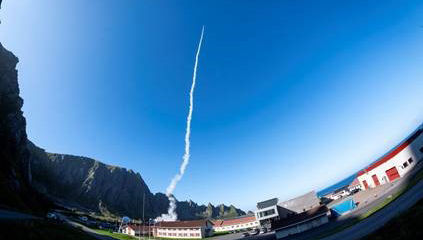
Scientists at the Andøya Space Center in Northern Norway have been examining the challenges posed by unidentified weather patterns at high altitudes for satellite launches, re-entry procedures, and new hypersonic systems.
On 2 September 2024, a hypersonic sounding rocket was successfully launched from the Andøya Space Center as part of the project “Boundary Layer Transition 1B” (BOLT-1B). The objective of this mission is to experimentally investigate the hypersonic boundary layer transition mechanisms from laminar to turbulent flow on a special aerodynamic design of the rocket. (Copyright: Andøya Space)
The “Dynamics above the Epicentre of Climate Change (DECC)” project, supported by NATO’s Science for Peace and Security (SPS) Programme, is led by research institutes in Germany, Norway, Sweden and Finland.
It aims to explore the direct operational impacts of these weather patterns, develop strategies for accurately predicting atmospheric hazards, identify measures to enhance the resilience of launches and infrastructure, and improve the resolution of high-altitude measurements in the Scandinavian north.
The successful launch of a hypersonic sounding rocket with Mach 7.2 (~ 8.800km/h) on Monday (2 September 2024) was a highlight of the gathering.
Above the High North, the Polar Night Jetstream sees winds reaching speeds of up to 500 km/h. Along with gravity waves, intense turbulence, and severe wind shears, this can significantly influence the ability to control, manoeuvre, and navigate.
As the frequency of satellite launches increases, so does the urgent need for a deeper understanding of atmospheric hazards at high latitude bands. Andøya Space Center, with its unique location, provides an ideal environment for exploring these largely uncharted phenomena.
The insights gained from these studies will help shape future strategies for satellite operations, space vehicle launches, and the development of resilient infrastructure in response to the evolving challenges posed by climate change.
By funding scientific cooperation, the NATO SPS programme supports research and academic communities to address shared security challenges.
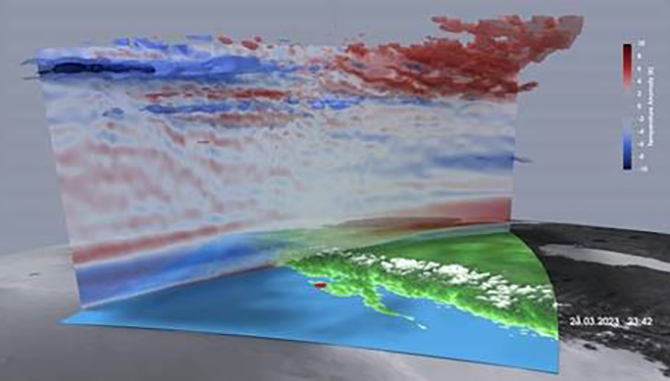
The Leibniz Institute of Atmospheric Physics performed a high-resolution simulation of atmospheric conditions in the transition to space to accompany a scientific rocket launch at Andøya Space Center (marked by the red dot). Strong waves combined with wind shears and turbulence are visible in the temperature field (blue and red colours). These waves are generated by the steep coastal terrain.(Copyright: Claudia Stephan (IAP) and Michael Böttinger (DKRZ))