Fermer
Retour
Accédez aux ressources médiatiques officielles de l'OTAN. Un contenu de qualité professionnelle, diffusé sur les dernières actualités. La référence pour les professionnels des médias.

Accédez aux ressources médiatiques officielles de l'OTAN. Un contenu de qualité professionnelle, diffusé sur les dernières actualités. La référence pour les professionnels des médias.
Désormais, vous pouvez télécharger des versions complètes ou partielles de nos vidéos depuis notre site Web.
Si vous souhaitez également vous abonner à la newsletter et recevoir nos dernières mises à jour, cliquez sur le bouton ci-dessous.
Entrez l'adresse e-mail avec laquelle vous vous êtes inscrit et nous vous enverrons un code pour réinitialiser votre mot de passe.
Le mot de passe doit comporter au moins 12 caractères, sans espaces, inclure des lettres majuscules/minuscules, des chiffres et des symboles.
Cliquez sur le bouton pour revenir à la page sur laquelle vous étiez et connectez-vous avec votre nouveau mot de passe.
29 November 2017
2 MIN READ
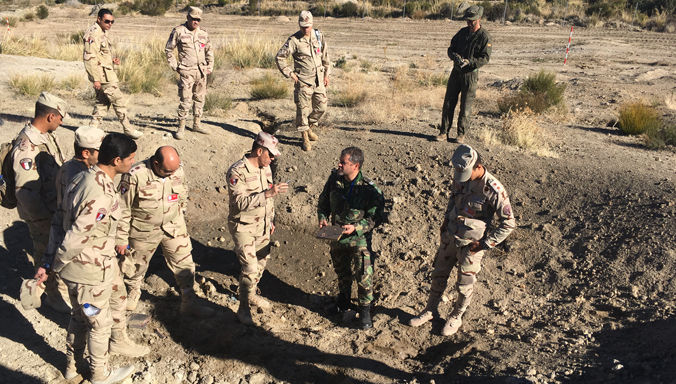
Fifteen experts from the Egyptian Armed Forces took part in a training from 13 to 23 November 2017 at the Counter-Improvised Explosive Device (C-IED) Centre of Excellence (CoE) in Madrid, Spain. Participants enhanced their skills in collecting, assessing and disseminating information and intelligence on improvised explosive devices that kill both soldiers and civilians.
“Conducting a course for partner soldiers is always a challenge, due to the fact that every time we need to tailor to each nation’s need. This training was quite easy for our team, and that was possible because of the Egyptian students. You proved yourselves to be very pro-active, open minded and with great experience in the exploitation field,” said LTC Gheorghe Dragoș of the Romanian Armed Forces.
At the end of the course, the participants were equipped with IED evidence recovery and processing skills. “Everything which has a start has also an end. But the end of the course should be the beginning of an increasing cooperation between NATO SPS, C-IED COE and Egyptian Armed Forces in the C-IED field,” said the Director of the C-IED CoE, Colonel Gomez Martin.
Through this SPS Programme initiative, NATO addresses a critical capacity gap of the Egyptian Armed Forces in explosive ordnance disposal. The Alliance contributes to bolstering Egypt’s C-IED capabilities in the field of exploitation of IED events, and assists in developing a more robust national and operational-level programme capable of addressing the IED threat during a period of sustained violence.
“It was a really excellent course, providing a complete basic training in the exploitation field. We met here friendly, well-educated and polite teachers and trainers. I, personally loved to attend it. Thank you once again for all your great effort,” added Brigadier General Tarek Taha Ahmed of the Egyptian Armed Forces.
This training complements NATO’s wider efforts to support Egypt in the area of mine and unexploded ordnance (UXO) detection. The SPS Programme previously supported a project that trained the Egyptian Armed Forces in detecting landmines quicker and more accurately. It equipped Egypt with minimum operational capacity on demining, and considerably reduced the duration of demining operations in the Egyptian Western Desert.
The SPS Programme launched a follow-up project in 2015 providing Egypt with enhanced operational explosive remnants of war (ERW) detection and clearance capability. This ongoing project trains engineers from the Ministry of Defence of Egypt on selected mine detection systems, and provides the country with landmine clearance equipment. Once complete, this initiative is expected to have a positive impact on the civilian population living in the Egyptian Western Desert.