Fermer
Retour
Accédez aux ressources médiatiques officielles de l'OTAN. Un contenu de qualité professionnelle, diffusé sur les dernières actualités. La référence pour les professionnels des médias.

Accédez aux ressources médiatiques officielles de l'OTAN. Un contenu de qualité professionnelle, diffusé sur les dernières actualités. La référence pour les professionnels des médias.
Désormais, vous pouvez télécharger des versions complètes ou partielles de nos vidéos depuis notre site Web.
Si vous souhaitez également vous abonner à la newsletter et recevoir nos dernières mises à jour, cliquez sur le bouton ci-dessous.
Entrez l'adresse e-mail avec laquelle vous vous êtes inscrit et nous vous enverrons un code pour réinitialiser votre mot de passe.
Le mot de passe doit comporter au moins 12 caractères, sans espaces, inclure des lettres majuscules/minuscules, des chiffres et des symboles.
Cliquez sur le bouton pour revenir à la page sur laquelle vous étiez et connectez-vous avec votre nouveau mot de passe.
06 February 2024
2 MIN READ
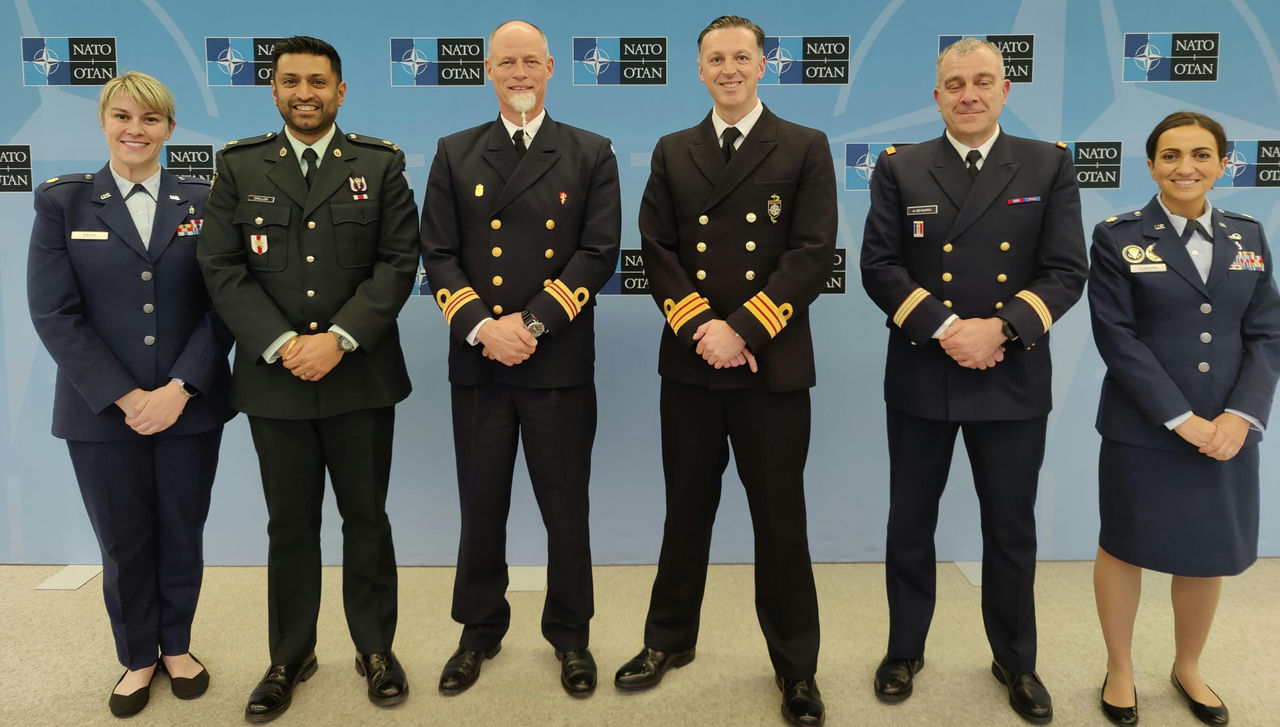
From 31st January to 2nd February 2024, the Interallied Confederation of Medical Reserve Officers (CIOMR) organised their Mid-Winter meeting at NATO HQ, in Brussels. The meeting was not only a showcase of technological advancements; it was a testament to the Alliance's commitment to embracing innovation for the betterment of allied military medical services. The overarching theme of the CIOMR Scientific Committee was the exploration of telemetry, AI, and 'big data' in enhancing military medical capabilities.
As the field of military medicine continues to evolve with technology playing a pivotal role in enhancing operational capabilities, the work of the Scientific Committee, under the leadership of Surgeon Commander Stuart A. G. Roberts (UK) as Chair and Major Paul Dhillon (CAN) as Vice-Chair, sets a high standard in the field of military medicine. The recent Mid-Winter meeting of CIOMR marked a significant milestone, with the committee presenting and leading sessions focused on the integration of telemetry, artificial intelligence (AI), and 'big data' in military medicine.
The Scientific Committee's work emphasized the transformative potential of these technologies in streamlining medical logistics, improving patient care, and facilitating real-time decision-making in the field. “The journey of integrating telemetry, AI, and big data into military medicine is just beginning, and the insights gained from this meeting will undoubtedly pave the way for further advancements. As we move forward, the focus will remain on harnessing these technologies to enhance the effectiveness, efficiency, and reach of military medical services, ultimately saving lives and improving the well-being of those who serve”, noted Surgeon Commander Roberts in his remarks.
The event, which for the first time saw Australia participating remotely, also brought together junior medical officers from the UK, USA, and France, through the CIOMR Junior Medical Reserve Officer Committee, offering a unique platform for knowledge exchange and collaboration. The participation of international partners such as Australia highlighted the global dimension of the committee's efforts. This collaborative approach not only enriches the pool of knowledge and expertise but also ensures that the benefits of technological advancements in military medicine are shared widely across the NATO alliance and its partners.
The sessions underscored the committee's commitment to leveraging cutting-edge technologies to enhance medical support in military operations. A highlight of the meeting was the augmented reality (AR) demonstration by the Kognitiv Spark Team, which showcased the potential of AR in transforming military medical training and field operations. The AR round robin featured three different scenarios centred on:
These demonstrations not only highlighted the practical applications of AR in military medicine but also underscored the importance of immersive technologies in training and operational support.