Fermer
Retour
Accédez aux ressources médiatiques officielles de l'OTAN. Un contenu de qualité professionnelle, diffusé sur les dernières actualités. La référence pour les professionnels des médias.

Accédez aux ressources médiatiques officielles de l'OTAN. Un contenu de qualité professionnelle, diffusé sur les dernières actualités. La référence pour les professionnels des médias.
Désormais, vous pouvez télécharger des versions complètes ou partielles de nos vidéos depuis notre site Web.
Si vous souhaitez également vous abonner à la newsletter et recevoir nos dernières mises à jour, cliquez sur le bouton ci-dessous.
Entrez l'adresse e-mail avec laquelle vous vous êtes inscrit et nous vous enverrons un code pour réinitialiser votre mot de passe.
Le mot de passe doit comporter au moins 12 caractères, sans espaces, inclure des lettres majuscules/minuscules, des chiffres et des symboles.
Cliquez sur le bouton pour revenir à la page sur laquelle vous étiez et connectez-vous avec votre nouveau mot de passe.
18 January 2021
2 MIN READ
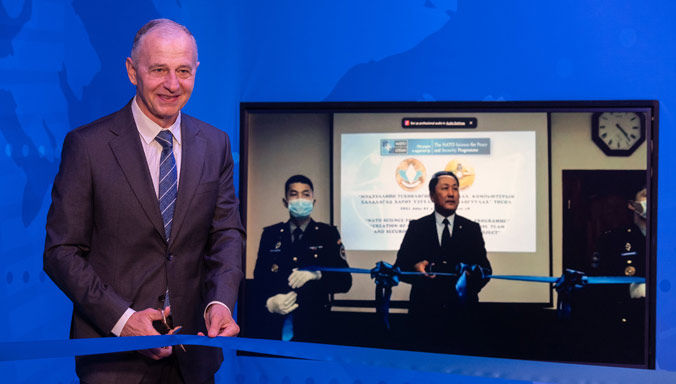
Today (18 January 2021), NATO marked the successful conclusion of a multi-year project designed to bolster the cyber defence capacity of Mongolia, one of NATO’s partners across the globe. The project ran between 2017 and 2020 and was supported by NATO’s Science for Peace and Security (SPS) Programme. It entailed the establishment of a Cyber Security Centre for the Mongolian Armed Forces and the provision of specialized training and equipment. It also featured technical support from the NATO Communications and Information Agency.
The inauguration of the new Centre and Cyber Incident Response Capability for the Ministry of Defence and General Staff of the Mongolian Armed Forces was celebrated with a virtual ribbon cutting ceremony. NATO Deputy Secretary General Mircea Geoană and Mongolia’s Minister of Defence Saikhanbayar Gursed joined from Brussels and Ulaanbaatar, respectively.
The NATO Deputy Secretary General highlighted the importance of this project to enhance the resilience and security of Mongolia’s information technology systems. “The successful completion of this project means that Mongolia is now better equipped to prevent, mitigate, and respond to cyber challenges that seek to threaten its institutions,” he pointed out. The Mongolian Minister of Defence stressed that “not only network engineers and technicians are benefitting from the equipment and software provided by the project, but also all the users of Armed Forces network.” He further remarked: “This project is a complete package, with the inclusion of effective cyber training for the cyber security team and provision of the equipment with the latest technology and official licensing.”
At the event, the Chief of Staff of the NATO Communications and Information Agency Major General Göksel Sevindik said: “This new capability will be both a national hub for responding to cyber-attacks and a focal point for collaboration with other nations on cyber security.”
The NATO Science for Peace and Security Programme has played an important part in boosting the practical cooperation between NATO and Mongolia on issues of common concern; and it has contributed to the consolidation of this partnership. “The wide range of activities supported by the NATO Science for Peace and Security Programme helps to create a thriving community of scientists, experts and policymakers across the world - from NATO and partner countries - who share knowledge and develop innovative ideas to address the security challenges of today and tomorrow,” Dr Deniz Beten, Senior SPS and Partnership Cooperation Advisor pointed out. Since 2012, the Science for Peace and Security Programme has cooperated with Mongolia not only to tackle cyber security challenges, but also to support efforts towards the establishment of a database to track the rehabilitation and restoration of former military sites in the country.