Fermer
Retour
Accédez aux ressources médiatiques officielles de l'OTAN. Un contenu de qualité professionnelle, diffusé sur les dernières actualités. La référence pour les professionnels des médias.

Accédez aux ressources médiatiques officielles de l'OTAN. Un contenu de qualité professionnelle, diffusé sur les dernières actualités. La référence pour les professionnels des médias.
Désormais, vous pouvez télécharger des versions complètes ou partielles de nos vidéos depuis notre site Web.
Si vous souhaitez également vous abonner à la newsletter et recevoir nos dernières mises à jour, cliquez sur le bouton ci-dessous.
Entrez l'adresse e-mail avec laquelle vous vous êtes inscrit et nous vous enverrons un code pour réinitialiser votre mot de passe.
Le mot de passe doit comporter au moins 12 caractères, sans espaces, inclure des lettres majuscules/minuscules, des chiffres et des symboles.
Cliquez sur le bouton pour revenir à la page sur laquelle vous étiez et connectez-vous avec votre nouveau mot de passe.
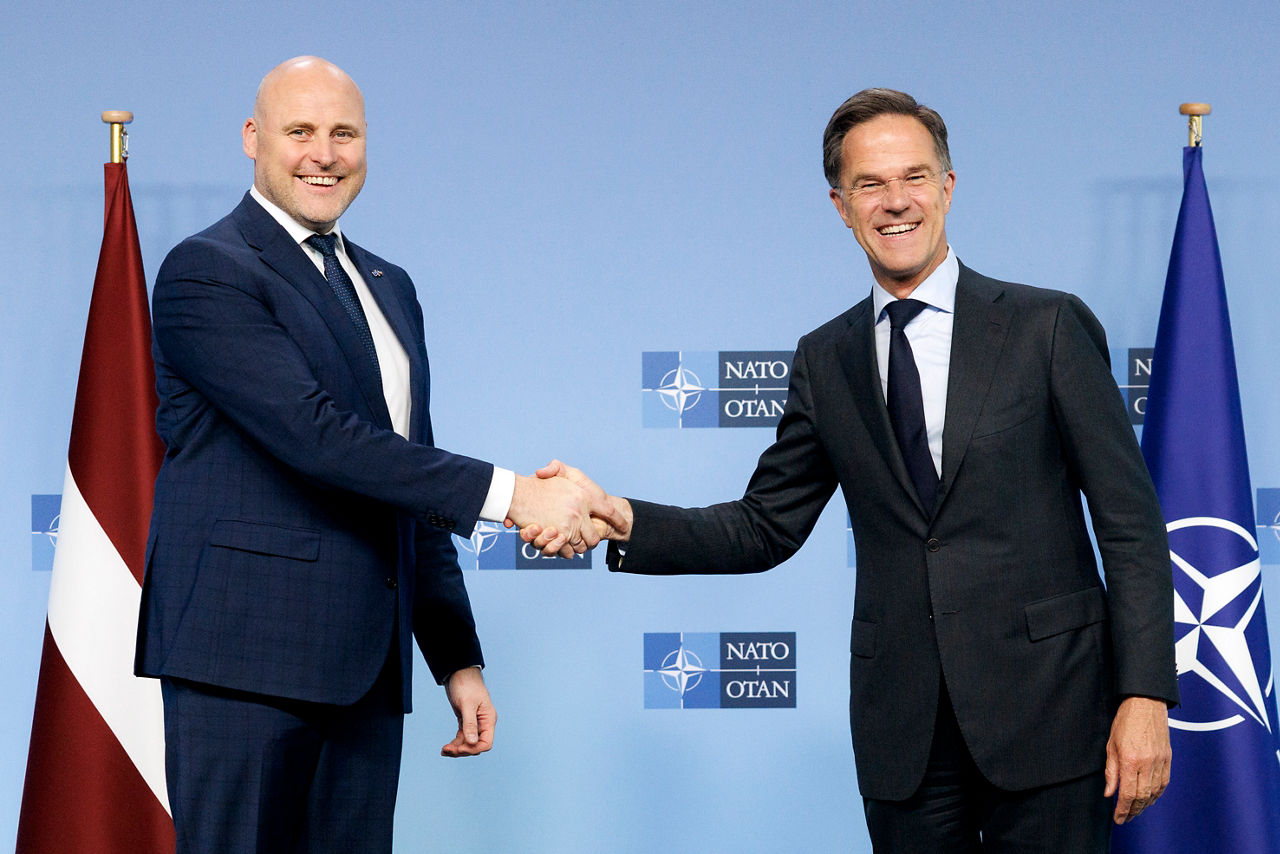
Prime Minister Kulbergs, dear Andris,
Again, congratulations on your appointment! It’s a great pleasure to welcome you to NATO Headquarters.
And let me say this. Latvia is a highly valued Ally.
And every day since Latvia joined NATO, which is now 22 years ago, the Alliance has protected of course your sovereignty and security.
As we saw just last week, French jets deployed for NATO Baltic Air Policing intercepted and destroyed a drone that entered Latvia’s airspace.
And such drone incidents on NATO’s eastern flank show Russia’s dangerous and reckless actions. But it also shows once again NATO’s determination and ability to deter and to defend.
No Ally stands alone in NATO.
Latvia hosts NATO Forward Land Forces, a brigade led by Canada with troop contributions from 12 other Allies. That is NATO solidarity in action.
Latvia leads by example on defence investment, with core defence spending due to reach almost 5% of GDP this year.
And you are also strengthening your defence industrial base, with a focus on drone technology and counter-drone systems. You have become a true hub for innovation in this critical area.
Latvia is a staunch supporter of Ukraine. It continues to provide essential support, including through its co-leadership of the International Drone Capability Coalition. That has already delivered contracts for 30,000 drones, many produced in Latvia.
And just last week, you signed a defence cooperation agreement with President Zelenskyy to share expertise.
Prime Minister, today we discussed the priorities for the NATO Summit in Ankara that is only three weeks away.
And the Summit will be about delivery.
Delivering increased defence investment, more defence production, and of course, our strong support for Ukraine.
Latvia is already showing how it’s done.
I expect other Allies to demonstrate how they are turning extra spending into combat-ready capabilities, and how they are scaling up their defence industries.
I count on Allies to go further and faster. Because we face a more dangerous world.
Latvia’s resolve is an example to us all. And we are all safer and stronger when we stand together in NATO.
Prime Minister Kulbergs, dear Andris, the floor is yours.
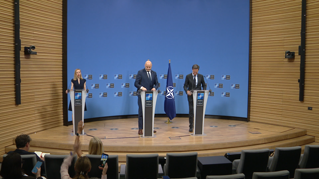
NATO Spokesperson Allison Hart
Okay, we now have time for questions. Let's start here in the front row.
Ilze Nagla, Latvian Television
Good afternoon, my name is Ilze Nagla, from Latvian Television. Secretary General, if I may, drone intrusions in Latvia have become a weekly action. So, do you think it's still viable to use expensive fighter jets to shoot drones down, cheap drones? And is there some sort of a limit, like how many drones per week should we expect in order to look for more sustainable solutions?
NATO Secretary General Mark Rutte
Yes, on your first question, I totally agree with the Prime Minister that obviously long-term we cannot continue by shooting down drones with very costly interceptors, so we have to find interception techniques which are of the same costs as the drones, so counter drone technologies. And this, of course, is where Ukraine comes in. This is also where innovation comes in. And I can assure you that NATO is laser-focused when it comes to delivering cutting-edge counter drone defences at speed. That's why, late last year, we launched a package of measures to expand and accelerate NATO's counter drone measures, and I expect more initiatives like these at the NATO Summit in Ankara. What we are doing now is turning rapid experimentation, rapid experimentation I underscore, because this has to be done speedily, so we're doing that but also turning this into capabilities that deliver, as you said, at a low cost the counter drone techniques, so that we defeat low-cost drones and swarms before they can threaten our forces, before they can threaten our skies, our countries. And NATO recently has conducted ground-based interceptor exercises, including the Counter Unmanned Aerial Systems Initiative Project Flight Trap, which was part of Sabre Strike 26 in Lithuania. So this is just one example of where we are doing everything to make sure that we have what we need, but also to speedily morph from the experimentation into the real thing. And this is a bit new, because in the past NATO would really only want to deploy something when it had been totally tested from every angle, but here we have to make sure that we are there at speed.
NATO Spokesperson Allison Hart
Okay, next question, second row here.
Galyna Ostapovets, Novyny.LIVE
Thank you so much for this opportunity. My name is Galyna Ostapovets. I'm Ukrainian journalist. Thank you so much for your support of Ukraine, first of all. And my question will be about, do you expect President Zelenskyy here to visit NATO in the coming day?
NATO Secretary General Mark Rutte
Well, as always, we announce whoever is visiting when they are visiting and never in advance, so you will see. Sorry.
NATO Spokesperson Allison Hart
Okay. Next question, let's head over here on the second row.
Virginia Pintea, TVR Moldova
Hello, Virginia from TVR Moldova.
NATO Secretary General Mark Rutte
Hi, good to see you.
Virginia Pintea, TVR Moldova
In the light of increased frequency of Russian drone incursion into Moldova airspace, including incidents involving armed drones, Moldova President Maia Sandu has called for legislative amendments in order to allow the development and domestic production of interceptor drones, as part of the large effort to strengthen Moldova air defence capability. How could NATO and Allied countries support Moldova in building up its counter drone capacity and improving its ability to protect its airspace overall? By technology transfer, training, financial, and industrial cooperation?
NATO Secretary General Mark Rutte
There is really a strong cooperation between NATO and Moldova, for example, that comes to cyber and counter cyber techniques initiatives. The President, Maia Sandu, and myself, we are in regular contact, but also more broadly, we are really working together, not only as NATO and Moldova, but also Moldova with Ukraine, Moldova with individual Allies. Obviously, we don't want to make our adversaries too much informed on what we exactly are doing, but I can assure you that there is a strong cooperation with the EU, of course, when you look at Moldova, but also when it comes to NATO, on all these issues.
NATO Spokesperson Allison Hart
All right. Third row in the very centre.
Olivier Baube, AFP
Thank you, Olivier Baube from AFP. Secretary General, you mentioned the technology and the innovation needed for NATO to be able to counter drones, not using jet fighters, but you didn't give any timeline. How long will it take for NATO to be able to replace these costly fighters? And if I may, another question, how do you see your role one year after The Hague? I mean, is it still to make Donald Trump happy or is it more now to try to help the European Allies to build this European pillar everybody wants to build now? Thank you.
NATO Secretary General Mark Rutte
Yeah, well, The Hague was not there to make anyone happy. What I think happened in The Hague, committing to the 5%,. what I said is that of course this had to be done. Because when you look at the plans NATO has and the capabilities we need to defend ourselves, we need to spend the 5% - core defence spending, plus the defence related spending. The good news is that it also equalises what Europe is spending with what United States is spending. United States is completely committed to NATO but they also have this expectation. Expectation is that Europeans will spend the same as they do, which is totally fair. But the first reason to do this is to defend every inch of NATO territory, and that is deeply rooted in the capability targets. And my argument was, and is, that both getting to the 2% and agree on the 5%, President Trump's, let's put it, encouragement here, I believe has been very helpful. But again, it is deeply rooted in our plans, this is why we need to do it. On your first question, it's difficult to say there is a sort of moment when we move from the one to the other. Of course, this is an ongoing process. Over time, we will get more and more systems in place to make sure we have these counter drone technologies working, so that you are less and less dependent on the very costly traditional interceptors.
NATO Spokesperson Allison Hart
All right, coming here to the second row.
Uliana Krychkovska, European Pravda
Yeah. Hi, Uliana Krychkovska, European Pravda. So, my question is for Prime Minister of Latvia, what is your view in Ukraine's role of helping you to shooting down drones that go into your aerospace because of Russian aggression?
NATO Secretary General Mark Rutte
Could I just, in one addition, totally agree, and Eastern Sentry, which was launched by the Supreme Allied Commander last year [in] September, in reaction to some big drone incidents in Poland and Estonia, is exactly there to make this happen. From Finland, from, let's say, from the Black Sea up to the High North, so from Türkiye, Romania, Bulgaria up to Finland, to make sure that we work together, that we make maximum use of the existing resources we have, but also exactly to the point the Prime Minister is making, to know where the gaps are and to fill those gaps. But Latvia is taking leadership here when it comes to applying the latest on technologies within NATO, and that helps us as an Alliance to become better at it.
NATO Spokesperson Allison Hart
All right, that's all we have time for this afternoon. But thank you so much for joining us.


NATO Secretary General Mark Rutte meets with Andris Kulbergs, Prime Minister of Latvia
NATO Secretary General Mark Rutte meets with Andris Kulbergs, Prime Minister of Latvia
NATO Secretary General Mark Rutte meets with Andris Kulbergs, Prime Minister of Latvia
NATO Secretary General Mark Rutte meets with Andris Kulbergs, Prime Minister of Latvia
NATO Secretary General Mark Rutte meets with Andris Kulbergs, Prime Minister of Latvia
Joint press point by the Secretary General Mark Rutte and Andris Kulbergs, Prime Minister of Latvia
Joint press point by the Secretary General Mark Rutte and Andris Kulbergs, Prime Minister of Latvia
Joint press point by the Secretary General Mark Rutte and Andris Kulbergs, Prime Minister of Latvia
Joint press point by the Secretary General Mark Rutte and Andris Kulbergs, Prime Minister of Latvia
NATO Secretary General meets the Prime Minister of Latvia