Fermer
Retour
Accédez aux ressources médiatiques officielles de l'OTAN. Un contenu de qualité professionnelle, diffusé sur les dernières actualités. La référence pour les professionnels des médias.

Accédez aux ressources médiatiques officielles de l'OTAN. Un contenu de qualité professionnelle, diffusé sur les dernières actualités. La référence pour les professionnels des médias.
Désormais, vous pouvez télécharger des versions complètes ou partielles de nos vidéos depuis notre site Web.
Si vous souhaitez également vous abonner à la newsletter et recevoir nos dernières mises à jour, cliquez sur le bouton ci-dessous.
Entrez l'adresse e-mail avec laquelle vous vous êtes inscrit et nous vous enverrons un code pour réinitialiser votre mot de passe.
Le mot de passe doit comporter au moins 12 caractères, sans espaces, inclure des lettres majuscules/minuscules, des chiffres et des symboles.
Cliquez sur le bouton pour revenir à la page sur laquelle vous étiez et connectez-vous avec votre nouveau mot de passe.
Good afternoon. We have just concluded a very good meeting of NATO Foreign Ministers.
But first, I want to thank the King and Queen and the Prime Minister, Prime Minister Kristersson, and of course the Foreign Minister of Sweden for their hospitality here in beautiful Helsingborg.
This is the first meeting of NATO Foreign Ministers hosted by Sweden, which joined our Alliance two years ago. And the location says a lot.
Today, all Nordic countries, including Finland that joined in 2023, are together in the NATO Alliance, sharing common commitments to our collective defence and making the Alliance stronger.
And a stronger NATO is what we have been discussing here in Helsingborg today.
Because the threats we face are real.
And we are committed to ensuring that NATO remains ready and able to address any challenge today, tomorrow, and well beyond.
To ensure NATO remains ready, we need to invest in our defence, produce the capabilities we need, and continue our support for Ukraine. These are our priorities for the upcoming NATO Summit in Ankara, and that is exactly what Foreign Ministers have been working to prepare.
Last year in The Hague, Allies, as you know, made a historic commitment to invest 5% of GDP in defence. The need for this investment is clear, and we are seeing real progress as Allies make major increases to their investments.
In 2025, defence investment from European Allies and Canada was up by 20%. This trend will continue.
Today, Ministers discussed how their countries are charting a credible path to the five percent. This means steady and sustained increase in defence investment. Ambitious and achievable.
And while increased investment is essential, it isn’t an end in itself. It is a means through which we become more capable, so that we can further strengthen our armed forces and ensure they have the equipment they need to deter any adversary and defend every Ally.
We know that today our industries are not able to produce everything we require. So Foreign Ministers addressed this urgent need to ramp up defence industrial production across the Alliance. We need to produce faster and at greater scale on both sides of the Atlantic. We do this best when we work together. And Ministers agreed that we must continue to press for continued cooperation across the Alliance to boost our defence industrial capacity.
As Allies invest more and produce more, we are also focused on ensuring that NATO is not only stronger but also fairer. And we see European Allies and Canada taking on greater responsibility for our shared security, and this is crucial. It makes the whole Alliance stronger, firmly anchored by the transatlantic bond.
I know some have been questioning that bond, and perhaps even questioning the resolve of this Alliance to remain united in the face of an adversary.
So let me be crystal clear. Allies’ commitment to Article Five is ironclad. Our resolve and ability to defend every Ally is absolute. Were anyone to be foolish as to attack us, the response would be devastating. This is a defensive Alliance.
We are strengthening NATO to deter aggression and to ensure we are able to defend it, if necessary. And this is the path we will continue to pursue.
An important part of ensuring our own security is continuing our support for Ukraine. And this was another topic of discussion among Foreign Ministers. Ukraine's Foreign Minister Andrii Sybiha joined us here on Thursday evening.
Russia continues to wage its horrific war and target civilians and civilian infrastructure. Ukraine continues to defend its sovereignty and independence with bravery and ingenuity.
And we are working to ensure that our support for Ukraine remains substantial, remains predictable, remains sustainable, and based on Ukraine's critical requirements.
The Prioritised Ukraine Requirements List, PURL, remains an important mechanism for delivering urgent support to Ukraine.
Providing crucial US equipment that makes a real difference on the front lines and helps protect Ukraine’s cities and civilians.
Allies continue to contribute through this and other means. Ukraine must have what it needs to defend itself today and deter future aggression tomorrow.
Finally, Ministers exchanged views on wider developments affecting Allied security, including in the Middle East. Iran continues to attempt to hold the global economy hostage by closing the Strait of Hormuz. This direct assault on freedom of navigation and global commerce impacts us all. It is important that countries are coming together around plans to ensure that the Strait can be open for transit, including by moving essential assets to the region.
This is another clear reminder of how security challenges are increasingly interconnected and that Allies and partners have a strong interest in working closely and proactively together.
Our discussions here in Helsingborg have been essential as we prepare for our Summit in Ankara just six weeks from now.
And the task ahead is clear.
To turn Allied commitments into concrete results: increased investment, industrial production, and continued support for Ukraine.
All of this contributes to a stronger NATO and greater security for all of us.
Sweden joined the Alliance two years ago, because the security situation in Europe had fundamentally changed. Together, all Allies are shaping NATO's response: enhanced deterrence and defence, better burden sharing, increased defence production, and consistent support for Ukraine.
In a more dangerous world, we are actively building a stronger NATO.
And with that, I'm ready to take your questions.
NATO Spokesperson, Allison Hart:
All right, let's start here with SVT in the second row.
Christoffer Wendick, SVT:
Mr. Secretary General, the Swedish Foreign Minister. Good afternoon. The Swedish Foreign Minister had hoped that this meeting in Helsingborg would mark a new start for the Alliance after a very turbulent period. How do you see it turning out, and if yes, what was key?
NATO Secretary General, Mark Rutte:
Well, a new start I don't know. I would phrase it a little bit different. I think it was a very good meeting, it was a very good meeting where we really were coming together again, and this is a democratic Alliance. We will always have debates in NATO - you've seen this - and when you look at NATO now compared to NATO only one or two years ago, the difference is huge. The spending has come up, industrial production, the support for Ukraine, the transatlantic bond. I think all of this is in so much better shape than only a couple of years ago. So, NATO is stronger, but today was important, because there are always tensions you want to discuss, and, of course, we have to make sure that the Summit in Ankara really delivers, and I have every confidence.
NATO Spokesperson, Allison Hart:
OK, just next to him.
N/A: Good afternoon. You advocate for stronger Europe in a stronger NATO. How long do you think the Europeans have to complete the shifting, and do you see it at the same time as killing two birds with one stone, a stronger NATO, and also the Europeans able to protect themselves without the US, should the occasion arise. Thank you.
NATO Secretary General, Mark Rutte:
We are not preparing for that last part of your question, so the assumption is, and this is exactly what the US wants, stay involved in NATO very strongly, but at the same time also expecting the Europeans, one, to spend the same as they do when it comes to the overall spending on defence. Europeans and Canada equalizing with the US, but also for the Europeans to take a bigger responsibility for the defence of the European part of NATO, with the US long-term still here when it comes to the nuclear, but also when it comes to the conventional. Don't forget that the defence of the US mainland starts in Norway. And why does it start in Norway? Because these huge nuclear submarines from Russia, if they can pass Norway, can come too close to the American coast would pose a direct threat to the United States. This is just one example that NATO is not only there to defend the European mainland, but also to defend the US mainland. So we are in this together. But I always felt that it is strange that a very rich part of the world, Europe is a very rich, maybe the richest part of the world, needs the support of another part of the world to defend itself against the Russians, to the extent it has now, where we are over-reliant on one Ally, being the United States. And what you will see over the coming years is a more equal, is a shift, a credible shift, where the Europeans take this bigger responsibility, with this, the United States firmly anchored in the transatlantic relationship.
NATO Spokesperson, Allison Hart:
Okay, coming over here. Fourth row.
N/A:
Good afternoon. Good afternoon, I would like to ask, has Ukraine's growing defensive capability weakened Putin's position. What is analysis in NATO of this?
NATO Secretary General, Mark Rutte:
Well, clearly Ukraine is putting up a strong defence, and when you look at the front line at the moment, it is stabilising. There are even reports that Ukraine is net, in net terms, regaining territory, not massively, but at least it's stabilising, and potentially even moving now in the right direction, and not any longer in the wrong direction. So, from the west to the east, and not from the east to the west. And this is amazing, and this is what Ukrainians are doing, and Ukrainians have been incredibly ingenuous in terms of their ability to innovate, and this is one of the things we are learning all over NATO, from Ukraine, for example, when it comes to the drone warfare and the anti-drone technologies. This is why we have JATEC, this joint organisation in Poland, where we capture all the lessons from the war, so that we can figure them in the NATO plan. So I would not be too happy if I was Putin today, but I wasn't ever happy if I was Putin, but particularly not the last couple of weeks, because things are not going in the right direction.
NATO Spokesperson, Allison Hart:
All right, coming over here, second row.
Victor Jack, Politico:
Hi, Victor Jack from Politico. Thanks so much for the press conference. I just wanted to ask, are you inviting President Zelensky to the Ankara Summit, and if so, have you sent out your invitation letter already? Thank you.
NATO Secretary General, Mark Rutte:
I never see those letters, to be honest, but I invited him already. Yes, I did. Yeah, he will be there, like in The Hague.
NATO Spokesperson, Allison Hart:
All right, in the third row here.
Kübra Akkoç, TRT World:
Thank you so much, Mr. Secretary General. Good afternoon. TRT World, Kübra Akkoç from TRT World. Are Allies today leaving Sweden more aligned than they were before this meeting? And if so, what would success look like for NATO in Ankara in that context as well? Türkiye as the host nation, how Türkiye’s role is evolving in your, in your view?
NATO Secretary General, Mark Rutte:
Yes, I think we are more aligned today than before today, because you always have discussions, and then when you come together in a ministerial meeting like this one, it always helps to align positions, and then to come out and to say, hey, in the end we all have the same goal, and let's work towards that. And I think Türkiye will put up an incredible show in Ankara. It will be a splash, very much focusing on the success of the increased defence spending, but also charting this credible path towards the 5% When it comes to the defence industrial, I am absolutely convinced that we will see huge progress. We are not there yet, not on the US side, not on the European side of NATO. We need to produce more, but clearly also the defence industrial base is now making that mind shift, mindset shift, which is so necessary. And, of course, here Türkiye, with over 3000 companies, is extremely important, and also a great example of how to organise a defence industrial base.
NATO Spokesperson, Allison Hart:
Second row on this side.
Malin Rising, Dagens Industri:
Good afternoon, Secretary General. Malin from Dagens Industri here in Sweden. You said before the meeting that you want the Allies to share the burden of supporting Ukraine more evenly. Did you achieve any concrete results on that during today's meeting?
NATO Secretary General, Mark Rutte:
I got a lot of encouraging comments on this. Of course, now we have to see whether they deliver, and I will do everything to make them deliver, but I must say that this was absolutely understood in the room, and all the comments made were very encouraging.
NATO Spokesperson, Allison Hart:
And just next to her.
N/A:
Has there been any news presented for Marco Rubio in terms of American drawdowns? You talked yesterday about you had some insight, and that there might be something this week or early next week.
NATO Secretary General, Mark Rutte:
What is playing out now, at the moment, at the level of policy directors is US contribution to the NATO force model, so that is a process now ongoing. But hey, we prepared for this, because we know that the US has to think, if you have multiple theatre threats, how can we make sure that all the capabilities and all the key enablers are everywhere where we need them. And that means that, and this will inform us where, as European Allies and Canada, we have to focus even more than we are already doing in the future. Of course, this is highly classified, because we don't want to make anyone any wiser, but this is a process in place. This is nothing new. Everybody knew this was happening, and it has nothing to do with the fact that the US wants to equalize the burden, it has to do with the fact that they cannot be everywhere at the same time.
NATO Spokesperson, Allison Hart:
All right, coming now to the front row here.
N/A:
Hi, good afternoon. I'm wondering, you said earlier that you're not preparing for the withdrawal of USA from NATO. Have you got a promise from Trump or Rubio that it won't happen in the future? And I have also now a question. Some Swedes are afraid of that our membership will make us a target for in the case of war. Can you guarantee that any Ally will not place any nuclear arms, plants or ships in Sweden?
NATO Secretary General, Mark Rutte:
The second question is a bit difficult for me to answer, in a sense that, of course, we have the nuclear umbrella, and we know that France and the UK are also nuclear powers within NATO. The UK fully participating in the NATO nuclear planning group, and France having its own nuclear capability outside NATO, but of course we closely coordinate. But on your, on your first question, I mean, this Alliance is there to protect all of us, and I gave this Norwegian example, why, for the defence of the US mainland, a safe Europe, a secure Europe, but also a secure Arctic, by the way, and a secure Atlantic is crucial for the defence of the US mainland. So, there's a direct interest you have seen over the last weeks, and particularly the six weeks after the 20th of February, thousands of US flights taking off from European air bases based on bilateral commitments, which were made over the years between the US and various nations in Europe. I mentioned the example of Romania, which had to scramble to get some of its legislation changed in a couple of days, so that they could do what the US wanted them to do. This is of course, also Europe as a platform of power projection for the United States, clearly visible in action in between the end of February and mid-April till the ceasefire, and I think that is also the reason why the US is in NATO. There are so many reasons for all of us to be in NATO, and so each country has its own reasons, but in the end it's about the defence of the collective, and that an attack on one is an attack on all.
NATO Spokesperson, Allison Hart:
All right. Fourth row.
Max Delany, AFP:
Hello, thanks a lot. Max Delany, AFP. All. Just coming back to what you were saying on the Force Model, you seem to intimate, but you didn't specify. Can you confirm then that the US has told you that it's going to cut its contribution to the NATO Force Model, and therefore there'll be less US troops immediately at the disposal of SACEUR in case of a crisis? Thanks a lot.
NATO Secretary General, Mark Rutte:
I'm afraid this is much more complicated than that, but it has not to do with the fact that the, it has nothing to do with what happened over a couple of weeks ago, when they announced the number of 5000 in with regards, then to Germany. That's totally separate from it, but I cannot say too much, because it is highly classified.
NATO Spokesperson, Allison Hart:
Second row here on the aisle.
VG:
Good afternoon, VG Norway. So, before Secretary of State Marco Rubio left for Helsingborg, his statements included deep disappointment with NATO Allies and their failure to support US efforts in Iran. Is he now leaving Helsingborg less disappointment, and were any hard commitments made from NATO Allies beyond offering support for the bigger cause of no nuclear weapons in Iran? What are the specifics?
NATO Secretary General, Mark Rutte:
Well, the specifics you have seen over the last couple of weeks, the French-British Initiative, the American initiative of freedom of navigation. Today, all Allies were absolutely clear that freedom of navigation is a key principle, indeed, that Iran cannot get its hands on a nuclear capability. This is a long-standing principle of NATO. As I said before, when I visited the White House early April, I also absolutely sensed the disappointment. It had to do with two things: one is that in some cases it took a bit of time before European countries were able to implement all the previous made commitments to using those bases in case of a US operation elsewhere, where they would need those bases. And what you're seeing at the moment is that all over Europe, and this is from Portugal up to and including Germany and Italy and France, United Kingdom, and Greece. I'm not going to mention the whole list, Romania, Bulgaria, and many others, that thousands of flights have been taking off over the course of the war against Iran, US flights, all over Europe, massively. So that was one disappointment, which I understand, but I was also, I think, able early April to explain that, massively, Europeans are doing what they committed to, and this is not NATO, these are bilateral commitments, but still very important. Then, when it comes to the Strait of Hormuz, when it comes to the next phase, you see now quite massively Europeans hearing the message from the US and prepositioning essential equipment, ships and uncrewed systems and all kinds of other important contributions to in that next phase, when it comes to the Strait of Hormuz, and this is acknowledged by the US. I'm not going to speak for Marco, how he leaves here, of course, he, he could tell you yourself, I'm, I don't think that is my position, but I think clearly European Allies heard the Americans.
NATO Spokesperson, Allison Hart:
Coming over to this side, fourth row.
Anne Vølstad:
Hi, I'm Anne Vølstad [inaudible]. I wondered if you were inspired by the lovely view and discussed the shadow fleet and a stronger joint reaction to the activities at the coast?
NATO Secretary General, Mark Rutte:
Yes, absolutely, and also last evening when we were hosted by Your Majesties, of course, we were also able, to with a beautiful view over the Øresund, it's very inspiring. And Sweden has done some great stuff there, and I was able also to speak to some of the people working on that when I visited the Coast Guard here on Wednesday night and had dinner there with the Prime Minister and some of his senior teams, so that was really very impressive. We discussed it today. Absolutely, I recalled again the initiative by the French President, starting with the European political community meeting in Copenhagen in October for the Europeans to be more forward leaning in terms of trying to do everything to pose strategic dilemmas to the Russians when it comes to the shadow fleet, and already we are seeing, and I cannot give you too much information on this, but I can assure you that the Russians take note of this and that it is a big irritant to them, including having to, for these ships to making it much more difficult. Let me phrase it like that, for Russia to keep that shadow fleet sailing, and we will constantly discuss how we can do more.
NATO Spokesperson, Allison Hart:
Okay, all the way in the back.
Tom Watkins, The National:
Good afternoon. Tom Watkins from The National, Middle East-based publication. You've outlined some generalities, but can you give us any specific asks from the US in terms of getting the Strait of Hormuz open, and are there any actions, any actions there still predicated on there being a durable ceasefire first, thank you.
NATO Secretary General, Mark Rutte: Again, these discussions are ongoing. You have seen the, of course, the French and British initiative. This is not NATO, this is the two countries working together, which I think has over 40 countries signing up to the declaration a couple of weeks ago. You see, now quite massively, for example, when it comes to mine hunting or demining equipment being pre-positioned, this is something, of course, where Europe is strong at. The US is not that big when it comes to demining, but when it comes to Europe, there are a lot of assets, and a lot of those assets are now being pre-positioned. You know that the Charles de Gaulle is now close to theatre, so the French are massively there. But, of course, this is an ongoing discussion within that coalition where NATO listens in, but, of course, is not leading that, as led by the French and the Brits, and also with Americans, the freedom of navigation construct, which is their call for arms. And what I'm saying here is that where there was disappointment, I really believe that Europeans have heard the message
NATO Spokesperson, Allison Hart: All right, standing on the aisle.
VRT:
Quickly in English, but I'll translate in Dutch. Due to budget restraints, the Belgian government, for instance, says contrary to what was promised in The Hague, we're not augmenting to 3,5 percent, but we are flatlining on 2% What would you say to, for instance, the Belgian government?
NATO Secretary General, Mark Rutte: Well, let me first of all acknowledge, do you want me to do it in Dutch or in English? [Answered in Dutch].
NATO Spokesperson, Allison Hart: Okay, we just have a couple minutes left, we'll go to the fifth row on the aisle here.
Marilu Lucrezio, RAI: Thank you, Marilu Lucrezio, Rai, Italian Public Television. President Trump talked about reducing US presence in Italy and Spain. In Italy, we have 13,000 American troops and different bases. Do you have any news about reducing in Italy?
NATO Secretary General, Mark Rutte:
Let me zoom out. And zooming out, what we are doing in Europe is taking more responsibility for the defence of the European part of NATO. This is also with the understanding that the US has, of course, also to take care of the Middle East, the Indo-Pacific, also in our interests here in Europe. So, over time, what you will see is in a structured way, step by step, the US pivoting more towards these other areas in the world, all of them closely connected, etc. So I cannot give you any specific numbers, because, of course, this is in the end an American decision, but more generally speaking, I really want to commend the US for the fact that they do this in a structured approach, step by step, and with the common understanding that whilst the US will pivot more towards other theatres, that the overall deterrence and defence in Europe has to stay the same. Because we are facing the Russian threat. We all acknowledge this, and that means that it has to be done in a structured way, but because the fact that we spend so much more, we can have a stronger Europe and a stronger NATO. Europeans doing more, which is logical, because in the end, as I said yesterday, I mean, Europe, including UK and Türkiye, you have about 600 million people. We have to defend ourselves against a country with between 120 and 140 million people. We are the richest part of the world. We should be able to do that without an over-reliance on another Ally on the other side of the Atlantic with about 350 million people. And of course, because we spend so little over the years, it takes time to get there, but with all the extra money, and gradually now the capabilities coming in, we can do more.
NATO Spokesperson, Allison Hart: Okay, I'm sorry. That's all we have time for today. Thank you so very much for joining us.
NATO Secretary General, Mark Rutte:
Thank you very much.
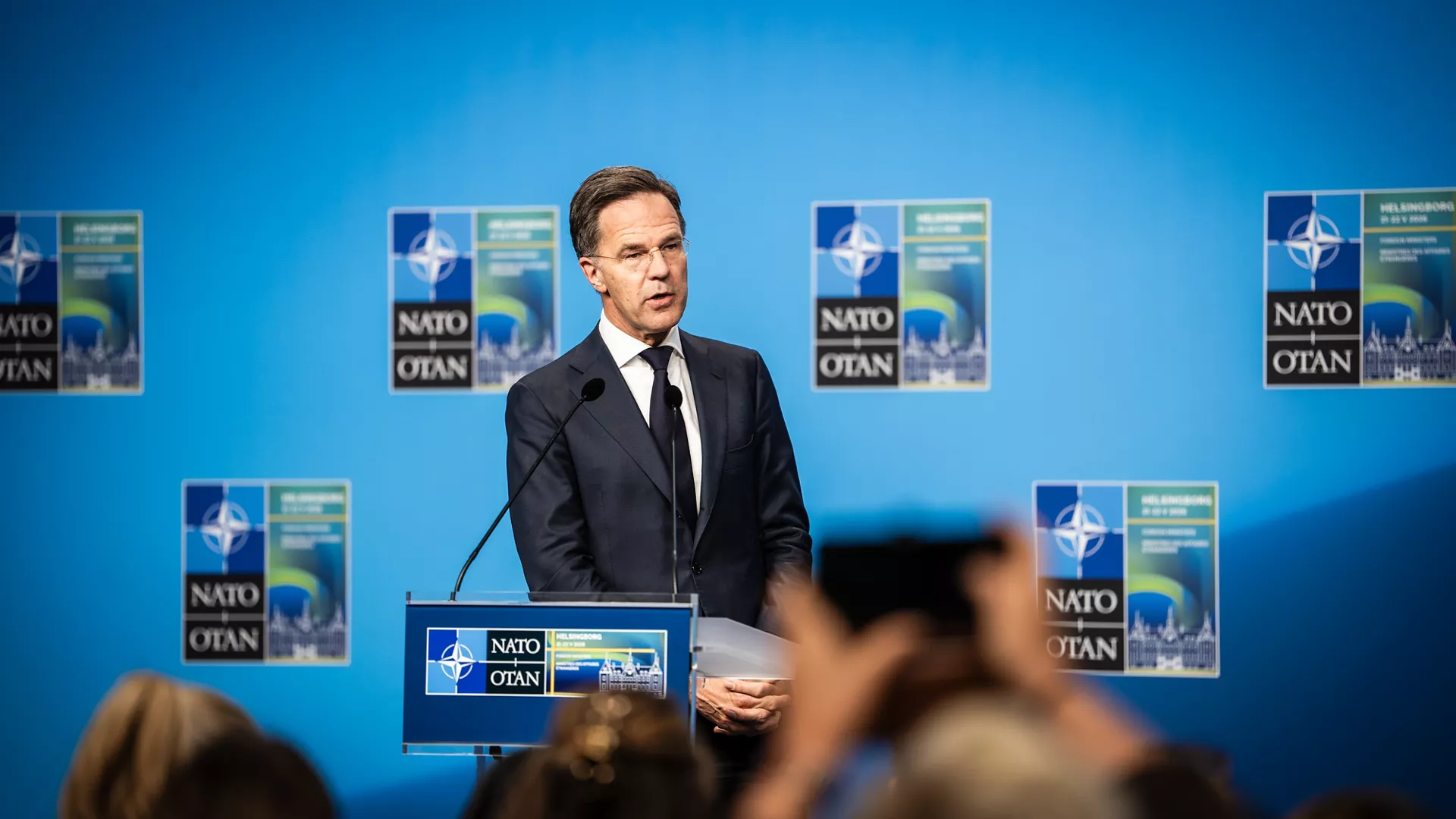


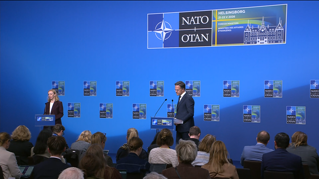
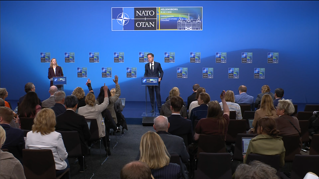
Press conference by NATO Secretary General Mark Rutte following the meeting of NATO Ministers of Foreign Affairs in Helsingborg, Sweden
Press conference by NATO Secretary General Mark Rutte following the meeting of NATO Ministers of Foreign Affairs in Helsingborg, Sweden
Press conference by NATO Secretary General Mark Rutte following the meeting of NATO Ministers of Foreign Affairs in Helsingborg, Sweden
Press conference by NATO Secretary General Mark Rutte following the meeting of NATO Ministers of Foreign Affairs in Helsingborg, Sweden
Press conference by NATO Secretary General Mark Rutte following the meeting of NATO Ministers of Foreign Affairs in Helsingborg, Sweden
Press conference by NATO Secretary General Mark Rutte following the meeting of NATO Ministers of Foreign Affairs in Helsingborg, Sweden
Press conference by NATO Secretary General Mark Rutte following the meeting of NATO Ministers of Foreign Affairs in Helsingborg, Sweden
Secretary General’s Press Conference
21 - 22 May
2026
Helsingborg, Suède