Fermer
Retour
Accédez aux ressources médiatiques officielles de l'OTAN. Un contenu de qualité professionnelle, diffusé sur les dernières actualités. La référence pour les professionnels des médias.

Accédez aux ressources médiatiques officielles de l'OTAN. Un contenu de qualité professionnelle, diffusé sur les dernières actualités. La référence pour les professionnels des médias.
Désormais, vous pouvez télécharger des versions complètes ou partielles de nos vidéos depuis notre site Web.
Si vous souhaitez également vous abonner à la newsletter et recevoir nos dernières mises à jour, cliquez sur le bouton ci-dessous.
Entrez l'adresse e-mail avec laquelle vous vous êtes inscrit et nous vous enverrons un code pour réinitialiser votre mot de passe.
Le mot de passe doit comporter au moins 12 caractères, sans espaces, inclure des lettres majuscules/minuscules, des chiffres et des symboles.
Cliquez sur le bouton pour revenir à la page sur laquelle vous étiez et connectez-vous avec votre nouveau mot de passe.
Amiral Giuseppe CAVO DRAGONE
Bonjour, et merci de votre présence.
Les plus hautes autorités militaires de l’OTAN se sont rassemblées ici pour relever le défi d’un paysage sécuritaire toujours plus complexe, et pour adapter l’Alliance à cet environnement.
Cette adaptation est déjà en cours. Et elle affiche des résultats, à commencer par un plus juste partage des charges, qui se traduit en « une Europe plus forte, dans une OTAN plus forte » ; et parfois en sa formule synonyme : « l’OTAN 3.0 ».
Chaque jour, l’OTAN s’adapte !
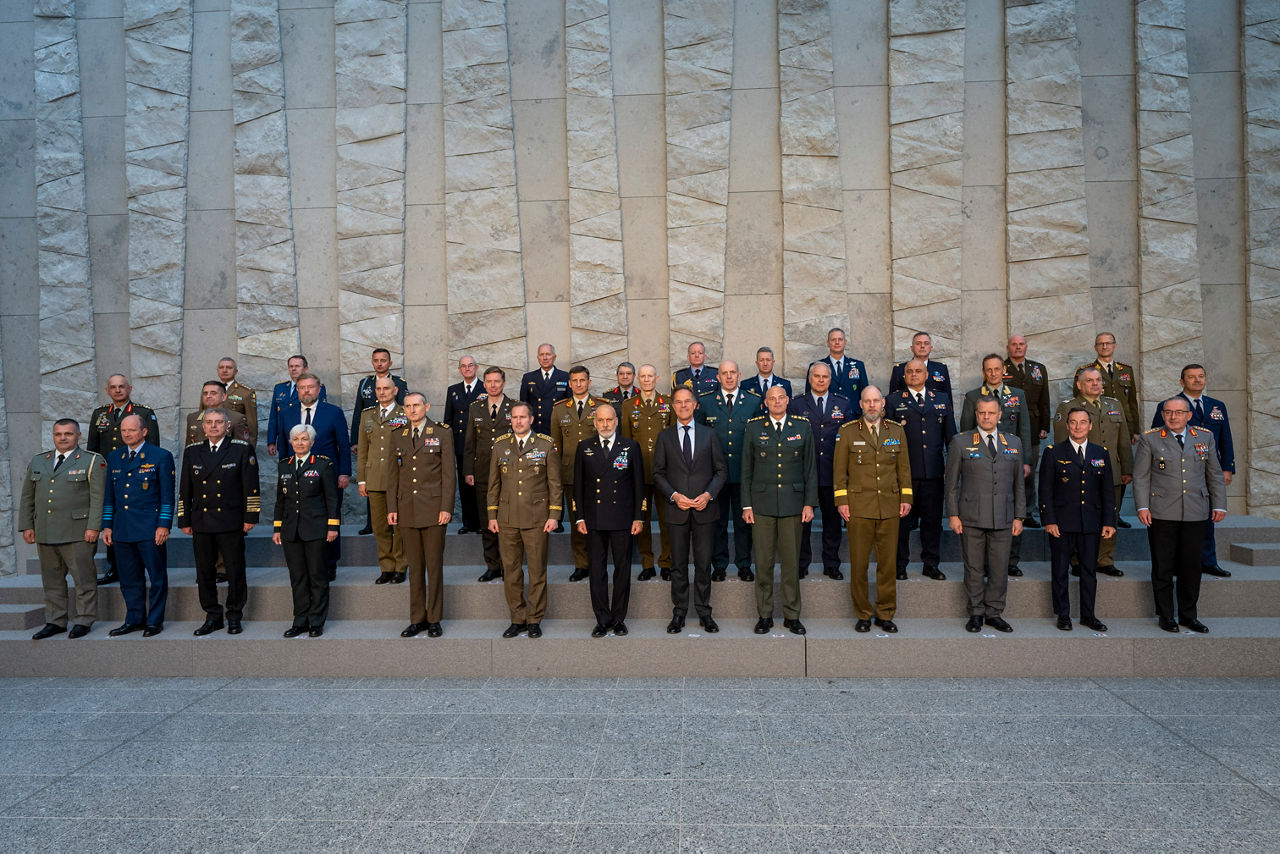
Ce matin, les 32 chefs d’état-major de la défense des pays de l’Alliance ont discuté des priorités de l’OTAN en présence de Mark Rutte, secrétaire général de l’Organisation.
Nous avons fait le point sur les engagements pris l’année dernière par les chefs d’État et de gouvernement à La Haye.
Alors que nos regards se tournent désormais vers le prochain sommet de l’OTAN à Ankara, les autorités militaires ont d’immenses attentes : voir se transformer tous ces engagements en résultats tangibles, rapidement, afin d’améliorer notre disponibilité opérationnelle et de renforcer la dissuasion.
Nous nous réjouissons des progrès des Alliés en matière d’investissement.
En début d’année, nous avons par exemple convenu d’une nouvelle répartition des hautes fonctions de leadership dans l’ensemble de la structure de commandement de l’OTAN, changement qui investit les Alliés européens d’une plus grande responsabilité.
Cette réorganisation du commandement répond à la solidité renforcée des Alliés, qui développent leurs capacités et leurs forces là où elles sont les plus essentielles.
À l’issue de nos échanges avec les chefs d’état-major de la défense, nous sommes forcés de constater qu’il faut parvenir à une livraison et à une mise en service beaucoup plus rapides et efficaces de toutes les capacités nécessaires à la dissuasion et à la défense.
Nous ne sommes pas en guerre, mais nous ne sommes pas non plus en paix.
Nous devons donc redoubler d’efforts et cibler nos investissements de défense, en agissant à la hauteur de nos engagements.
En parallèle, j’appelle instamment l’industrie de la défense à accélérer sa production et à ajuster ses modèles économiques pour satisfaire cet impératif.
Le morcellement, danger le plus sérieux lorsque les budgets augmentent, est à bannir !
Nous devons tenir notre engagement sur le long terme, avec régularité et cohérence, sans nous laisser distraire par les réseaux sociaux ou d’autres miroirs aux alouettes.
Il en va de la sécurité de nos citoyens.
Ce matin, nous avons également réaffirmé notre soutien continu à l’Ukraine et au renforcement de ses forces armées, tant pour lutter aujourd’hui que pour assurer la sécurité de demain.
Je souhaite profiter de cette conférence pour, à nouveau, rendre hommage aux soldats et au peuple ukrainiens, à leur courage, à leur résilience et à leur adaptabilité.
J’ai pour eux un message : « SLAVA UKRAINE ! »
Plus tôt dans la journée, nous avons aussi accueilli le général Seán Clancy, président du Comité militaire de l’Union européenne, avec l’ambition de faire progresser la coopération OTAN‑EU sur des questions militaires vitales et concrètes.
Nous pouvons à cet égard nous appuyer sur notre partenariat, déjà solide. Citons par exemple nos récentes visites conjointes en Ukraine et dans les Balkans occidentaux. Sachons-le, combiner harmonieusement nos efforts nous est mutuellement bénéfique : ensemble, nous pouvons faire beaucoup plus.
Merci encore. Je vais maintenant laisser la parole au SACEUR et au SACT, qui reviendront sur leurs domaines de responsabilités respectifs.
Général Alexus GRYNKEWICH
Bonjour à toutes et à tous.
Je suis heureux de m’adresser à nouveau à vous, aux côtés de l’amiral Cavo Dragone et de l’amiral Vandier.
C’est également un honneur pour moi que de revoir les chefs d’état-major de la défense et de discuter avec eux de la part de responsabilité croissante qu’assument les Alliés européens et le Canada dans la défense conventionnelle ici en Europe. Ces pays continuent de bénéficier de l’appui critique des capacités américaines qui, vous le savez, sont en train d’être remaniées.
Comme c’était à prévoir, nous avons également abordé la récente décision des États-Unis de redéployer une brigade blindée stationnée en Europe. J’aimerais souligner que cette décision n’a pas d’incidence sur l’exécutabilité de nos plans régionaux.
Nous avons aussi parlé des mesures prises par le Commandement allié Opérations pour soutenir l’Ukraine, pour atteindre un niveau de préparation au combat adéquat et pour renforcer notre posture de dissuasion.
Alors que la guerre en Ukraine en est à sa cinquième année, les forces armées ukrainiennes continuent de faire preuve d’une résilience et d’un esprit d’innovation extraordinaires. Et elles continuent de partager avec nous leur expertise de combat, en particulier en matière de lutte contre les drones et les missiles russes et iraniens.
Mais l’Ukraine a besoin d’un soutien constant et prévisible de la part de l’Alliance. C’est pourquoi l’aide que nous lui apportons, que ce soit dans le cadre de l’initiative PURL ou via d’autres canaux, demeure primordiale.
Concernant cette liste des besoins priorisés de l’Ukraine, je peux vous assurer que tout ce qui est acheté par les Alliés est envoyé aux forces ukrainiennes, et notamment les intercepteurs de défense aérienne qu’elles nécessitent de toute urgence.
Investir en Ukraine, c’est non seulement contribuer à la protection de sa population, à la défense de ses infrastructures critiques et au soutien de son combat, mais c’est aussi investir dans la sécurité de l’Europe.
Outre le théâtre de l’Ukraine, la situation au Moyen-Orient reste tendue.
Dans le détroit d’Ormuz, l’Iran a attaqué des navires de commerce, perturbé les livraisons d’énergie et entravé la liberté de navigation.
Chacun des pays de l’OTAN évalue la réponse à donner ; nombre d’entre eux, dont la Belgique, la France, l’Allemagne, l’Italie et le Royaume-Uni, ont actuellement des navires en route vers la région. Nous convenons tous, en effet, qu’il est dans notre intérêt d’assurer la liberté de navigation dans les eaux internationales, liberté qui est actuellement compromise pour les Alliés.
Si nous considérons la situation plus en profondeur et à plus long terme, nous observons que les opérations en cours en Ukraine et au Moyen-Orient sont riches d’enseignements et nous permettent d’adopter une meilleure posture et de conserver notre niveau de préparation au combat, éléments essentiels pour assurer la dissuasion et la défense de chaque centimètre carré du territoire de l’Alliance.
Je félicite tous les Alliés qui prennent des mesures immédiates pour tirer avantage de l’augmentation des budgets de défense en se procurant les capacités nécessaires au maintien d’une dissuasion crédible et d’une défense forte.
Pour ce faire, une solide base industrielle de défense est requise. Nous travaillons également avec les Alliés et l’Union européenne pour que les engagements du sommet de La Haye se convertissent en capacités de combat bien réelles.
S’agissant des activités, des opérations et des missions de l’OTAN portées par l’ACO, nous les exécutons avec précision et efficacité.
Grâce à nos activités de vigilance renforcée – Arctic Sentry, Baltic Sentry et Eastern Sentry –, nous connaissons mieux la situation, nous renforçons notre capacité de réaction et nous obtenons des résultats.
Parallèlement, les avancées notables de la mission militaire de la KFOR offrent des perspectives au niveau politique.
Enfin, en ce qui concerne la mission OTAN en Iraq, nous sommes passés temporairement à une activité de conseil à distance. Notre objectif est d’aider Bagdad à se doter d’institutions de sécurité et de forces armées plus pérennes et plus efficaces, de façon à stabiliser le pays, à lutter contre le terrorisme et à prévenir la recrudescence de Daech.
J’aimerais conclure en évoquant la passation de commandement qui a eu lieu aujourd’hui à la NMI.
C’était un réel plaisir de collaborer avec le général de division Christophe Hintzy. Je suis très fier de ce qui a été accompli sous son commandement.
Nous sommes également enthousiastes de voir le général de corps d’armée Ramón Armada Vázquez se joindre à l’équipe, alors que nous envisageons un retour à une présence militaire non combattante centrée sur les activités de conseil, lorsque les conditions le permettront.
Merci encore. Je me réjouis d’écouter vos questions.
Amiral Pierre VANDIER
Je suis ravi de vous revoir. Lors du sommet de 2025, les Alliés ont pris un engagement historique, celui d’augmenter à 3,5 % la part de leur PIB consacrée aux investissements de défense. Une promesse sonnante et trébuchante.
Il s’agit à présent de voir comment convertir nos efforts en capacités concrètes, comment les traduire en une interopérabilité et une dissuasion bien réelles pour les combats d’aujourd’hui et de demain.
Et c’est là l’objectif de l’ACT. Notre rôle est d’aider l’Alliance et, très concrètement, les chefs d’état-major de la défense, avec lesquels je me suis entretenu ce matin, à obtenir davantage d’effets militaires à partir des ressources proposées par les pays.
Nous devons garder à l’esprit que l’ennemi a voix au chapitre. La Russie et ses alliés se sont adaptés. D’autres acteurs se tiennent aux aguets et apprennent leurs leçons. La situation en Ukraine et au Moyen-Orient nous montre que la guerre brasse désormais de multiples facteurs : rapidité, masse, logiciels, drones, spectre électromagnétique, espace ou encore données. Autant de domaines dans lesquels nous avons énormément à faire.
Donc oui, il nous faut plus de missiles, plus d’obus, plus de moyens de défense aérienne, plus de capacités de pointe et plus de stocks. Ces moyens sont essentiels. Toutefois, ils ne suffiront pas à eux seuls. Nos ressources actuelles, nous devons les renforcer, bien entendu, mais nous sommes loin de pouvoir nous contenter de ces efforts.
Pour atteindre la masse et la vitesse recherchées, nous devons déterminer comment produire les moyens nécessaires rapidement et à l’échelle requise, et nous devons nous adapter sans délai, sachant qu’il nous faut obtenir un véritable effet opérationnel. Nous devons pour cela savoir quel secteur de notre base industrielle mobiliser.
Il ne peut y avoir d’OTAN 3.0 sans industrie de la défense 3.0.
Et c’est bien là qu’intervient l’ACT.
Sa valeur ajoutée réside dans la capacité de réduction des risques et d’accélération qu’il offre aux chefs d’état-major de la défense, aux pays et à l’entreprise OTAN.
Citons ainsi l’initiative de lutte anti-UAS multicouche LCI-X, que vous connaissez certainement, et la cellule innovation X, dans le milieu maritime, qui réunissent les pays, les opérateurs et l’industrie autour de vrais problèmes opérationnels. Nous réalisons des tests pour voir ce qui fonctionne et peut être mis à l’échelle, et nous examinons les étapes vers l’interopérabilité.
Le programme de renforcement de la létalité des forces, que nous évoquons parfois avec vous, montre bien que les plateformes héritées ne sont pas obsolètes. La question décisive est en vérité celle de la combinaison des forces : comment associer navires, avions, chars et systèmes de pointe avec robotique, drones, capteurs, logiciels et nouveaux effecteurs pour augmenter la létalité et mieux protéger nos soldats ?
Toutefois, disposer de capacités ne suffit pas. Il nous faut également pouvoir compter sur des forces capables de s’adapter. Cela exige, d’une part, un entraînement plus poussé et plus réaliste, et, d’autre part, des architectures « cloud », données et IA qui permettent aux pays de partager des informations, de connecter des systèmes, d’accélérer la prise de décision et de faire preuve de résilience en cas de dégradation des communications.
Il ne s’agit pas d’innover au niveau du théâtre, mais bien d’obtenir des résultats.
L’engagement pris à La Haye ne peut produire les effets escomptés que par le renforcement de nos capacités, de notre interopérabilité, de notre résilience et par là même de notre posture de dissuasion.
Telle est précisément la mission de l’ACT.
- - - - - - -
The Q&A is available in English
Lili Bayer, Reuters
Thank you very much, Lili Bayer from Reuters. I have a question for SACEUR. There's been some confusion over the past day, so I was wondering if you could clarify for us, how many troops will the US pull from Europe? Where will they be pulled from specifically? Will there be more announcements, and how much does this hurt or impact the implementation of the regional plans? Thank you.
General Alexus G. Grynkewich, SACEUR
Thanks, Emily, in accordance with President Trump's announcement, it will be 5,000 troops coming out of Europe. As I mentioned in my opening comments, a fair number of those come from the armoured brigade combat team that is returning, and the US has also already announced that the previously planned deployment of a long-range fires battalion will be curtailed and will not start occurring. There are some other additional minor elements that will be shifting as well. The planning is still ongoing for what those are for another several 100 troops, and so we can talk about that a little bit later, but the total number is 5,000. On your question of how does it impact us? You know, since the rotational brigade that is returning now, without replacement, showed up in 2022 a lot has happened in the Alliance. First off, the Baltic Allies and the Poles and many others have really built up their ground combat power, so there's substantially more capability in their ground domain than there was previously. I’d also highlight the multinational brigade that we have in Latvia, led by Canada, fully operational on the ground and highly effective. Then the Germans continue to build out a brigade in Lithuania, so again, this is as Allies build up their capability, the United States is able to pull capability back and use it for other global priorities. So, I'm very comfortable with where we are. We'll continue to work on the plan in both of my hats as Commander EUCOM on the US side and across the Alliance as SACEUR to ensure we've got the right coverage in the right places to maintain deterrence.
Terry Schultz, DW
Hi, Terry Schultz. I'm with Deutsche Welle, today. I have a question for SACT. In a recent exercise in Sweden, the Ukrainian war team killed the Swedes three times. The exercise had to be stopped, but what does this tell us about where we are, and in particular, especially on AI and high-tech methods on the battlefield? I mean, could you address both of those things? And I'm not sure if that's exactly why Sweden got killed three times, but could you talk about how AI has changed the way that NATO needs to look at the battlefield, because the Ukrainians are, and the Russians are far ahead?
Admiral Pierre Vandier, SACT
So, given to Ukraine experience, we are turning training not in a fairy tale, but something that is more realistic, and where we use training to make the system change, so as I said, we are, I think the nations are late in adopting some drones, adopting AI, and so today with the experience of the Red Team, which is given by the Ukrainians through JATEC, we are raising the level of the exercises, so the good news is that today we are more realistic about the threat, and we are working on it very hard. I think the number of trainings that will follow this path, where we have some hard time with the enemy, showed that today the nations want to be realistic. They want to make the efforts, and we have the signs, and we have the industries to overcome that.
General Alexus G. Grynkewich, SACEUR
Can I come in on that for just one second, too? So, we've had a number of these exercises where we've done this training with highly qualified opposition forces, sometimes provided by Ukraine, sometimes by others. We often focus on the beginning of the exercise, where we're learning a lot, and when you learn lessons, you're being, you know, removed from the battlefield, if you will. By the end of the exercise, by say the end of a week out in the field, facing that OPFOR you should see our young soldiers from across the Alliance and the rapid increase in their knowledge and their ability to fight back in this environment. So I just want you to know, while we often focus on that initial result, this training is having real results in terms of a capability and understanding of a modern battlefield for our troops. So, it's something we're going to continue to do.
Terry Schultz, DW
How much is that AI considered? How much is that advantage?
Admiral Pierre Vandier, SACT
So, AI is coming in the Alliance, so ACO is running Maven Smart System, and we are buying computing to make that faster and more relevant. ACT is experimenting CoPilot at the enterprise level for the staff work. We have an AI champion, which is a French guy today. France will propose an AI COE next summer, so things are going on. And back to the training we've launched with ACO a program, which is Audacious Training, where all the NATO training now is one with AI process to go faster with more free play, and so to make more relevant trainings.
Victor Jack, POLITICO
Hi, Victor Jack from POLITICO. Thanks for the press conference. My question is for SACEUR, do you expect any future redeployments, US redeployments from Europe in the weeks to come? And are you in talks with Allies about replacing some of their capabilities and the troops which have been announced so far? Thank you.
General Alexus G. Grynkewich, SACEUR
Yeah, on the second part of your question, absolutely in constant contact with Allies. I had a session today with the Baltic Three and Poland to go over what some of the options were, and how we might array capabilities on the Eastern Flank. So, absolutely constant contact with Allies, and constantly looking at what the threat is, and what do we need to adjust, or do we need to adjust. On the question of future redeployments, look, I will not get ahead of any political leadership in the United States. I will just say that the deployments that we have so far are all that's been announced, it's all that I'm expecting in the near term, but you know, over the longer term, we absolutely should expect additional deployments as Europe continues to build capability and capacity and step up to provide more of the conventional defence of Europe.
Maria Aroni, Athens News Agency and Open TV Greece,
Thank you, Maria Aroni, from Athens News Agency and Open TV Greece. I have a question for CMC and also for SACT or SACEUR. If you wish to comment, so the experience of four years of military confrontation in Ukraine has changed the way modern battles are fought, in particular with the extensive use of drones and electronic warfare. What are the lessons learned for the Alliance from this experience? And speaking of drones, I would also like to hear your views on the serious incident, which took place last week, when a rogue maritime surface drone of Ukrainian origin loaded with explosives was recovered by the Greek authorities, it was found by fishermen in a cave near the shore of very tourist Greek island in the Ionian Sea. So, my question is, if NATO is willing and also in a position to tackle such a new type of unorthodox warfare that seriously endangers the safety of navigation in maritime zones such as East Mediterranean, thank you.
Admiral Giuseppe Cavo Dragone, CMC
We will share the question with SACT as far as lessons learned, drones, so on. For the first part, what the Alliance learned from that. I mean, drones just a kind of revolutionary issue on the battlefield, they will not be the only weapon. They will be maybe the most prominent, and also influencing all the battle space, probably. They will be probably in this, and the next future could be the very first one in getting involved in a confrontation. What we basically learn is that they just shrink dramatically time among all the killing cycle, it's just a matter of maybe minutes or maybe less, seconds. They detect, they track, they analyse and discover what is it, they shoot, they got information, battle damage assessment, and then fill information to the next to the next operation, that's a matter of seconds, and that's happening with artificial intelligence and drones, and that’s the big issue. Time is becoming very short. On the other side, unorthodox warfare, well, we can call it unconventional or unorthodox, but it's I think that that's typical of confrontations, and that's typical when, let's say, a smaller country facing a bigger one, they have to exploit all the – I'm not justifying any one – but I'm just thinking in their shoes. I would try to get the most from what I am, and of course there are sovereignty all these kinds of problems we let politics deal with it, but as far as unorthodox or unconventional warfare, I'm expecting that from a smaller nation that is trying to survive that has been attacked, so any kind of solution is good if you're achieving the result. Then probably you have to justify your behaviour, but from the military point of view, that's they are trying to get the most from the field, and that's basically what I think that I would do in their shoes, and then, as far as innovation or drone, I will let Pierre take the floor.
Admiral Pierre Vandier, SACT
So, I will not go too technical, because that is a lot of things. One of the things I would say about the lessons from Ukraine, one is the whole of society resilience. We need to think about that during three decades. We thought that a war was something far from our borders made by some fighters overseas. Today, we see that Ukraine experience shows that to be residential, you need to have a strong collaboration between military instruments of power and civilian one. The example of power grid, of communication grid, transport grid, medical support, that is a common endeavour. Second question, the industry is a part of the war fighting system. We've seen a ramp up of the Ukrainian industry in a dimension that now makes them building something for the West. They have been creating all an industry which is very agile. On the Ukrainian drones, you have a QR code. The soldier can give the report of how his drone is functioning to the headquarter of the company, and they can update the software in a matter of weeks or even days. Today, Ukraine is enabled, the soldier is enabled on its own mobile phone by a suite of applications that is giving me all the tools you need, as you have in your, in your life today. And so the adaptation is maybe the most important lesson. How we have a system that has been very static, where the definition of programs was taking three, four years, and four years to deliver to a system where we can adapt in the night, and that is why it's so important to be data centric, software centric, that enables that. So, it's a big shift for the industry today to come from a platform mindset to a data mindset. Whatever the platform is. And so it's what we see in Ukraine.
Admiral Giuseppe Cavo Dragone, CMC
Just as far as orthodox or unorthodox, I mean, well, we are facing, I mean, a power who is targeting civilian infrastructure, killing civilians, crossing border of a sovereign nation, kidnapping from 15,000 to 23-24,000 to 25,000 children, and moving them. Is this orthodox?
Milda Vilikanskyte, Lithuanian National Public Broadcaster (LRT)
I have two questions, but they are very related, and I don't know if you yourself will decide who wants to answer. One is about drone, today in Estonia a drone was shot down by Romanian fighter jet who flew from a Lithuanian air base. Also, drones took off in Latvia. In the risk of drones, how would you assess with these incidents? And other question, which is related with drones, we hear Russia accusing and threatening the Baltic states, saying that Lithuania, Latvia, Estonia are giving their territory their airspace for Ukraine to attack Russia, and today specifically for Latvia, there was a threat claiming that Latvia let Ukrainian troops to come to their territory and to attack Russia from Latvia, and Russia said that because of that they could attack Latvia also. So, could we say that it is a point-blank threat to NATO Alliance to NATO country, or how we should take this Russia threat? Thank you.
General Alexus G. Grynkewich, SACEUR
I'll take the first swing of that, and then if CMC would like to weigh-in. First, in terms of the drone incident today, where the Romanians shot it down. That's exactly how our defence design is supposed to work. The authorities are delegated down to the lowest tactical level, so that we can defend every inch of Alliance territory when there's an incursion like that. So, I'm extremely proud, you know, we're still assessing the situation, but it looks at initial glance like everything worked, and we've got great integration with all of the Baltic air defence capabilities that are there. And with our air policing mission, as we make a transition to air defence over the over the coming months, in terms of our mindset and our plans, so that's kind of part one. And second, with your, with your comments on the Russian threats, look, it's a standard Russian trope, right? They constantly say that NATO is doing something in an offensive manner, but we all know – you can read the treaty – NATO is a defensive Alliance, we are not a threat to Russia, and they know we're not a threat to Russia. If they thought we were a threat to Russia, they wouldn't have emptied the Leningrad military district to go and invade Ukraine. So, I just offer that at face value, it's so obviously incorrect that there's any threat whatsoever. Last thing I'll say is, if we were allowing drones to go through Baltic airspace, in order to get to Russia, we wouldn't be shooting them down. Thanks.
Andrea Palasciano, Bloomberg News
From Bloomberg News, SACEUR, I have a question for you. You mentioned that you all agree that, in the interest of the Alliance, to secure freedom of navigation through the Strait of Hormuz, focusing on the on the Coalition of the Willing and the bilateral commitments that have been made, but could you tell us under which conditions NATO would consider participating, and if so, with which assets? Thank you.
General Alexus G. Grynkewich, SACEUR
Yeah, thanks for the question. The conditions under which NATO would consider operating in the Strait of Hormuz are ultimately a political decision, but I'll just give you a couple of thoughts from myself as an Alliance officer. Iran fired ballistic missiles into my AOR, into SACEUR’s AOR, multiple times during Epic Fury, so we've had kinetic events coming into the AOR from Iran. The stoppage of the flow that Iran has caused through the Strait of Hormuz is affecting all of our economies in a very negative way, and affecting our economies affects our military industrial capacity over the long term. We know that Iran is, and Russia are doing technology transfer and sharing lessons. We know that the increased price of energy and some of the shortage that we've read about in the news could have a military impact. So, there's a number of impacts here, from the lack of freedom of navigation in the Strait of Hormuz right now. I think that's all up for discussion at the political level as to what do those trip, and when would we politically decide to move forward.
Valentina Vasileva, TVP Polish Media
I have a question about Spanish idea to create European army. Last week, Spanish Minister of Foreign Affairs suggested that. What do you think about this idea, especially that it's coming from Spain? And in general, can you imagine that Europe can create common European army without NATO?
Admiral Giuseppe Cavo Dragone, CMC
I’ll take it. Okay this is my mantra. No, I mean, I think there is kind of misunderstanding. We need to start from two basic points. First, single set of army, second sovereignty. I mean, we, the Alliance, I mean the nations are just at one army, every nations, okay? Okay, so that's the one, and they are force providers, so they will provide SACEUR for what he needs to fulfill his mission, depending on the mission. So, we cannot think about an European army, it's an oxymoron or a nonsense, because NATO doesn't have an army, And also the single nation keep the sovereignty of their army, so I mean they are the ones who decide what to do. It and they are providing us NATO for providing what we need. We have to see, I mean, European Union as the European pillar of NATO, but again, they will be using in case they are, they will do a kind of activity, military activity, they will use the same set of armies that NATO has, so that's some, that's why we have to, we need to speak about, I mean, European pillar of the NATO. That's basically it. Of course, we should stick with the idea that that we just said that I mean European Union has some characteristic which are complementary to the NATO and NATO has a strong chain of command, operational orientation, plans, and on and on, so that the operational side of the house on the other side. On the other side, European Union has a great capability in providing financing in a great leverage on industry that we don't have. Basically, they have rules, regulation, and so that's basically it. We are, we are complementary by design, and we have, we should stick with this, just to avoid duplication, waste of money, time, and energies.
Col. Martin L. O’Donnell, SHAPE Spokesperson
A point of clarification, Sir. I don't want to put words in your mouth, but when you were talking about Allies stepping up, you had said, you had used the word “deployment” of US troops. I believe what you meant to say was “redeployment” of US troops.
General Alexus G. Grynkewich, SACEUR
Yes, absolutely.
Andrew Gray, Reuters
So, just to try to clarify this thing, just to follow up on that. So, just to be clear, you had originally said we should absolutely expect additional “deployments” as Europe continues to build capability and capacity step up. So, what you're actually saying is “redeployments”, and can you just classify and clarify why that should be expected, and if you can say anything about the kind of timeframe, how long that might happen over.
General Alexus G. Grynkewich, SACEUR
Yeah, yes, redeployments, that was a misspeak. Apologies, I guess one can dream, but no. This is resident in the US National Defence Strategy, and it's resident in the concept that some have called NATO 3.0 as CMC mentioned, and so what we're basically saying is, as the European pillar of the Alliance gets stronger, this allows the US to reduce its presence in Europe and limit itself to providing only those critical capabilities that Allies cannot yet provide, and so we should expect there to be a redeployment of US forces over time as Allies build their capacity. As for the exact timeline, I mean, it's going to vary broadly across a number of different capabilities as nations meet their Hague spending commitments, and meet their capability targets. So, I can't really give you an exact timeline. It's going to be an ongoing process for several years.
Max Delany, AFP
Thanks a lot, Max Delany, AFP. Just following up on a couple of issues. The Strait of Hormuz, you said that it's a political decision ultimately, if NATO get involved, but are you already planning for a possible NATO role in the Strait of Hormuz, if you're asked by the political leadership. And then on the troop redeployment, it wasn't so much the amount that was the issue this time, but the manner in which it was done – impulsive, without coordination, and sudden. Is that the way to do it? And can you guarantee that in future, Europe will be better informed and better able to prepare for these announcements.
General Alexus G. Grynkewich, SACEUR
Yes, so first on your question on planning for SACEUR to undertake any formal military planning requires a council planning directive that gives me guidance from the North Atlantic Council. So, the political direction comes first, and then the formal planning happens after that. Am I thinking about it? Absolutely, but there's no, no planning yet until the political decision is taken. Second, in terms of your comment, look, you know we've talked about this with the Chiefs of Defence today, and I would tell you that every Chief of Defence in there acknowledged that this type of adjustment was something that they knew should be expected. The exact timing was unknown, but when it did happen, and when it was ordered, we were quickly able to talk to our Allies and let them know what was going on and why it was happening, so you know there was coordination, there was an expectation that this would happen, and we're going to stay well synchronized with our Allies moving forward.
Maria Vasileiou, TA NEA
Maria Vasileiou, TA NEA, Greece. I would like to go back to the Ukrainian sea drone that was found in Greek waters and ask SACEUR this time, because this is actually understood, it's not just the only one, the only sea drone of Ukrainian origin that is floating around in the Med. Whether you are concerned that we could see the spilling, that the war could spill into the Med because the Ukrainians are hunting Russian shadow fleet tankers, and in this case, how could NATO react and operate? Thank you.
General Alexus G. Grynkewich, SACEUR
I'm not currently concerned that the war is going to expand into the Mediterranean, I think, as CMC mentioned, these types of tactics are common in conflicts like this, where there's an asymmetry of power. So, I don't, I don't share that concern right now. We'll watch it closely, but I'm not concerned about it. Thanks.
Captain Navy Giovanni Galoforo, NATO IMS Public Affairs and StratCom Advisor
Okay, ladies and gentlemen. Thank you very much. This concludes our press conference.


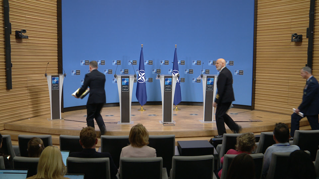
Supreme Allied Commander Europe (SACEUR) General Alexus G. Grynkewich.
Chair of the NATO Military Committee (CMC) Admiral Giuseppe Cavo Dragone.
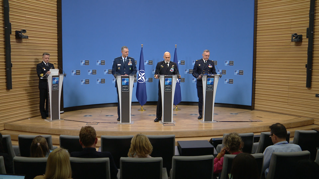
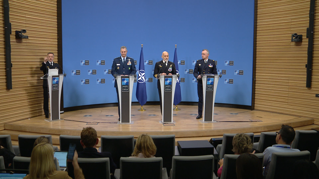
Left to Right - Supreme Allied Commander Europe (SACEUR) General Alexus G. Grynkewich; Chair of the NATO Military Committee (CMC) Admiral Giuseppe Cavo Dragone; and Supreme Allied Commander Transformation (SACT) Admiral Pierre Vandier.
Left to Right - Supreme Allied Commander Europe (SACEUR) General Alexus G. Grynkewich; Chair of the NATO Military Committee (CMC) Admiral Giuseppe Cavo Dragone; and Supreme Allied Commander Transformation (SACT) Admiral Pierre Vandier.
Supreme Allied Commander Transformation (SACT) Admiral Pierre Vandier.
Joint press conference by the Chair of the NATO Military Committee, the Supreme Allied Commander Europe and the Supreme Allied Commander Transformation