Fermer
Retour
Accédez aux ressources médiatiques officielles de l'OTAN. Un contenu de qualité professionnelle, diffusé sur les dernières actualités. La référence pour les professionnels des médias.

Accédez aux ressources médiatiques officielles de l'OTAN. Un contenu de qualité professionnelle, diffusé sur les dernières actualités. La référence pour les professionnels des médias.
Désormais, vous pouvez télécharger des versions complètes ou partielles de nos vidéos depuis notre site Web.
Si vous souhaitez également vous abonner à la newsletter et recevoir nos dernières mises à jour, cliquez sur le bouton ci-dessous.
Entrez l'adresse e-mail avec laquelle vous vous êtes inscrit et nous vous enverrons un code pour réinitialiser votre mot de passe.
Le mot de passe doit comporter au moins 12 caractères, sans espaces, inclure des lettres majuscules/minuscules, des chiffres et des symboles.
Cliquez sur le bouton pour revenir à la page sur laquelle vous étiez et connectez-vous avec votre nouveau mot de passe.
16 juin 2020
3 MIN DE LECTURE
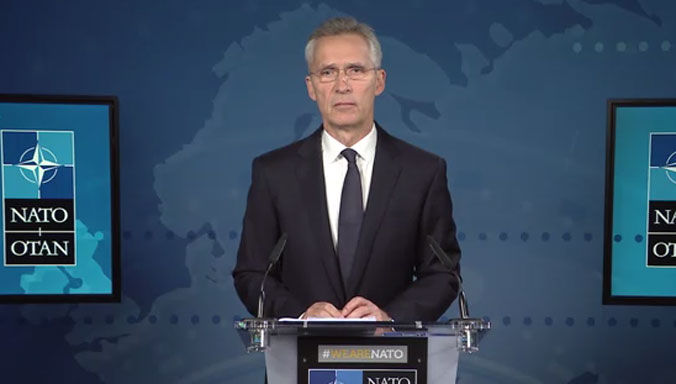
(As delivered)
Good morning.
Over the next two days, NATO Defence Ministers will take steps to ensure our security in a more uncertain world.
We face global challenges. So we must take a global approach. Keep our Alliance strong militarily, and make it stronger politically.
That is my vision for the reflection on NATO 2030, which I launched last week.
At this meeting of defence ministers we will take decisions on:
Since the beginning of the COVID-19 pandemic, NATO and Allied armed forces have played a key role in supporting civilian efforts:
All of this has helped to save lives.
Now, NATO is preparing for any future health crisis. I expect ministers will agree on three things:
These three elements together will ensure that we can strengthen our response to a possible second wave of the pandemic. So that critical assistance gets to the right place at the right time.
But COVID-19 does not mean that other challenges have gone away.
Ministers will also discuss the NATO requirements for national resilience. These cover critical sectors such as energy, transport, and tele-communications. Any vulnerability in these areas can be exploited by potential adversaries.
I expect ministers will agree updated baseline requirements for resilience.
Particularly focusing on threats from
cyber; the security of supply chains; and foreign ownership and control.
We will also discuss and address the security implications of Russia’s growing suite of nuclear capable missiles. Russia’s deployment of the SSC-8 missile system led to the demise of the INF Treaty last year. Since then, Russia has continued to modernise its missile capabilities, including with hypersonic weapons.
I expect Defence Ministers will agree a substantial and balanced package of political and military measures in response.
This includes strengthening NATO’s air and missile defences. Several Allies have announced major investments in new capabilities such as patriots and SAMP/T.
We will also strengthen our advanced conventional capabilities, for example with fifth generation combat aircraft.
And we will adapt our exercises and intelligence to address new challenges.
NATO’s response will also be discussed by Ministers at the meeting of the Nuclear Planning Group. We will continue to ensure the NATO nuclear deterrent remains safe, secure and effective.
NATO will not mirror Russia’s destabilizing behaviour. We have no intention to deploy new land-based nuclear missiles in Europe.
And NATO remains strongly committed to effective arms control, disarmament and non-proliferation, which make a key contribution to our security. So we continue to call for all actors, including Russia and China, to engage constructively.
A new arms race would benefit nobody.
And make the world a more dangerous place.
We will also discuss NATO’s missions and operations, including in Afghanistan and in Iraq. In Afghanistan, the situation remains challenging. NATO will continue to adjust our presence in support of the peace process. But for the peace to succeed, the Taliban must live up to their commitments. To reduce violence, break all bonds with Al Qaida and other international terrorist groups, and engage in intra-Afghan talks in good faith.
In Iraq, we remain committed to enhancing NATO’s training mission. And to increase our presence when conditions allow. In full coordination with the Iraqi Government and the Global Coalition. Iraqi security forces have made great strides in suppressing ISIS and other terrorist groups.
But terrorists are trying to take advantage of the COVID-19 pandemic. And their attacks have increased in recent months.
I spoke with Prime Minister al-Kadhimi recently, and underscored that NATO stands with Iraq in the fight against international terrorism.
During the meeting of defence ministers we will be joined by our colleagues from Finland, Sweden and Australia.
And by EU High Representative/Vice President Borrell. This is a clear sign of our deepening ties with like-minded countries and organisations.
With that, I am ready to take your questions.