Fermer
Retour
Accédez aux ressources médiatiques officielles de l'OTAN. Un contenu de qualité professionnelle, diffusé sur les dernières actualités. La référence pour les professionnels des médias.

Accédez aux ressources médiatiques officielles de l'OTAN. Un contenu de qualité professionnelle, diffusé sur les dernières actualités. La référence pour les professionnels des médias.
Désormais, vous pouvez télécharger des versions complètes ou partielles de nos vidéos depuis notre site Web.
Si vous souhaitez également vous abonner à la newsletter et recevoir nos dernières mises à jour, cliquez sur le bouton ci-dessous.
Entrez l'adresse e-mail avec laquelle vous vous êtes inscrit et nous vous enverrons un code pour réinitialiser votre mot de passe.
Le mot de passe doit comporter au moins 12 caractères, sans espaces, inclure des lettres majuscules/minuscules, des chiffres et des symboles.
Cliquez sur le bouton pour revenir à la page sur laquelle vous étiez et connectez-vous avec votre nouveau mot de passe.
Thank you so much.
Prime Minister, dear Ulf,
Thank you for the warm welcome. It's a pleasure to be with you in Sweden, and to be with you here today, and to see what is happening and what you are doing. It's really impressive.
I saw first-hand what Sweden's Total Defence Concept is all about, military and civilian conscripts training together to provide search and rescue, emergency care, the transport of wounded civilians, drone detection, to name only a few elements. We also saw the close cooperation between public authorities, emergency services, the armed forces, and also the private sector. It was, and it is, very impressive, and this is what, I believe, resilience looks like. And that is exactly what we need in today's security environment.
Defence is not only about armed forces, it is also about keeping society functioning, protecting people, securing critical infrastructure, maintaining supplies. In short, this is about making sure that every part of society is prepared. And Sweden understands very well that security is a whole of society responsibility.
Dear Ulf, since joining our alliance only two years ago, Sweden has become stronger, and Sweden has made NATO stronger, with advanced military capabilities, a strong defence industry, world class defence technology, and as we have seen today deep experience with resilience and total defence. Sweden is the framework nation for NATO's Forward Land Forces in Finland, and contributing to the Forward Land Forces in Latvia. This further strengthens our eastern flank and our deterrence and defence posture in the Nordic region. Sweden’s defence industry is a high-tech powerhouse, and I welcome your plans to move quickly to increase defence spending to 3.5% of GDP by 2030. I know you are doing this because it is what today's security environment demands and I hope, of course, that even more Allies follow this accelerated timeline.
When it comes to the threats to our society, we know there are many. I commend Sweden for the steps you are taking against Russia's shadow fleet – it was very impressive last night to hear the stories – vessels that help Russia evade sanctions and finance its war of aggression against Ukraine. That matters for Sweden, it matters for the Baltic Sea region, and it matters for the security of all Allies. That is exactly what NATO is for - the security of all Allies. And let there be no mistake - our ability and our resolve to defend every Ally are absolute. Were anyone to be so foolish as to attack, the response would be devastating.
Turning to Ukraine, since the start of Russia's full-scale invasion, Sweden has been a staunch supporter of Ukraine. Your military assistance includes tanks, combat vehicles, air defence, advanced weapon systems, ammunition, training, and airborne surveillance and control aircraft. You are supporting Ukraine's defence industry, including through the production of long-range drones and missiles, and you are providing direct investment in Ukraine's defence industrial base. I want to thank you. I want to thank Sweden for its contributions to Ukraine, also to PURL – the Prioritised Ukraine Requirements List – ensuring rapid delivery of crucial US equipment and munitions to Ukraine. More support is coming through PURL, and I encourage all Allies to keep contributing to this vital initiative. Because supporting Ukraine is not charity, it is an investment in our shared security.
Later today and tomorrow, NATO Foreign Ministers will meet in Helsingborg, and indeed this is the first NATO Foreign Ministers meeting hosted by Sweden. There we will prepare the ground for the Ankara summit, including on defence investment, industrial production capabilities, and continued support for Ukraine. In Ankara, we must show that we are making real progress, that we are delivering, that means producing more, strengthening our supply chains and stockpiles, producing faster, and ensuring that our militaries have what they need to deter and defend. And I know I can count on Sweden to continue leading by example and delivering on its commitment.
Prime Minister, dear Ulf, thank you for the excellent hospitality, and for Sweden’s steadfast contributions to NATO.
Moderator
With that, we'll go over to some questions in group. We can start with TT, second from the left here.
Cornelia Mikaelssen, TT
So, my name is Cornelia Mikaelssen, and I represent Sweden's national news agency - TT. You have previously referred to a ‘no surprise’ agreement with President Trump, but given the recent developments, when we have seen what some would describe as surprises when it comes to US withdrawals - or at least as very sudden - how successful do you think that that agreement has been? Or how can you guarantee that this will not continue? And, secondly, we have also seen some open conflicts between Allies, so what do you hope that Marc[o] Rubio, what key message do you hope that he will give during the meeting in Helsingborg?
Mark Rutte, NATO Secretary General
To start with the second part of the question, when it comes to Allies, sometimes having debates, we are democracies, we love to debate. But in the end, we always come together, the 32 of us, and you have seen this all over the history of NATO, 77 years almost. Always debates, always discussions, but in the end, we come together. That's the big difference with Russia or China, where one person decides what everybody should think. By the way, they think different things, but he thinks - the leader -that everybody agrees. We know it's not true. We need to debate, that makes us stronger.
To your first question, let's zoom out a little bit. Europe and Canada have ramped up their spending on defence. Last year you've seen huge increases in defence spending, the whole of the Alliance at 2%, committing in The Hague to reach the 5% and Sweden now having decided to reach the core defence spending target already by 2030. This is huge, and it is necessary because, in the end we cannot be over-reliant and keep on having the over-reliance on one Ally. It is simply not healthy and this is exactly what we agreed with the United States: that they will stay involved of course with the nuclear umbrella but also conventional but that the Europeans will take more care of their own defence. Step-by-step in a way where it will not, of course, lower the overall deterrence and defence of NATO. The rotational forces involved in the announcements do not have an impact on NATO's defence plans. The other discussion going on about the US contribution to the NATO force model, this is happening for a year. We have a process in place. This is normal business, and this is exactly what we wanted. Europeans doing more, a stronger Europe in a stronger NATO, so that the US can pivot more, for example, towards Asia over time, step-by-step in a structured approach. And this is exactly what's happening.
Moderator
We'll take the next question from the lady in red here.
Teri Schultz, DW
I have two questions. At this very moment, or within the last couple of hours, a drone has again entered Baltic airspace, I guess over Latvia this time. So, what can NATO do to deter Russia from redirecting these drones? Because it doesn't, it doesn't seem to be working. And, at the same time it's being reported that the JEF is working on creating a sort of military command structure that could operate outside of NATO if necessary. You look surprised. Read The Economist and others. So, I mean, I'm not optimistic on my answer I get from you, but if this is true, does this strengthen NATO? Because it then would be a European pillar, a decision-making pillar inside NATO, or is that a sign that the Alliances is more fractured? Thank you.
Mark Rutte, NATO Secretary General
Yeah, to your, to your first question, I mean, Ukrainian drones are there not because Ukraine wants to work with drones, they are there because of the full-scale Russian attack against Ukraine and Ukraine having to defend itself. And NATO is always prepared for every eventuality, and what happened over the last couple of days again is what we trained and prepared for, and this is a calm, decisive, and proportionate response to any threat, and is exactly what happened through the Baltic Air Policing mission from Lithuania. When it comes to Latvia, when it comes to Lithuania, so this is what people can be assured of. NATO is always there to defend every inch of NATO territory.
Teri Schultz, DW
But how do you stop it?
Mark Rutte, NATO Secretary General
Well, you stop it by making sure that anyone, of course, when it comes to Ukrainian drones, again they are not there because Ukraine wanted to send drones. They are there because of this war of aggression by the Russians. This is where this all started. And when a drone, whether it is from Ukraine or from Russia, is presenting a threat, then we are there to make sure that we do everything.
Moderator
Take the woman in the blue shirt, and then the man in the blue jacket, here.
Reporter
A quick follow-up on the drones. I saw the Polish Defence Minister today said that Ukraine must be more precise in using drones after we've seen this string of incidents – a comment to that. And then also for the Secretary General, Russia on Thursday delivered nuclear munitions to field facilities in Belarus, and we are seeing exercises there. How does NATO assess this?
Mark Rutte, NATO Secretary General
When it comes to exercises, they happen all over the place. Of course we monitor, we monitor them closely.
[Ulf Kristersson, Prime Minister of Sweden
Well, it's my firm belief that the Ukrainians are very, I mean, they certainly don't want their drones to end up on friendly territory, for obvious reasons. Sometimes it's a matter of jamming, sometimes it's a matter of other disturbances, and obviously they do not want them to happen, because it could create damage, it could create fear, of course, but I think you should also realise that there is Russian willingness to give the impression that other countries are kind of doing things that are not legitimate, and that's why we're not, we should really not be open for the Russian narrative on this, but instead, of course, help the Ukrainians as much as we can to direct, to help them direct their attacks in the right directions, of course.]*
Mark Rutte, NATO Secretary General
There was this ridiculous claim by the Russians that Latvia was somehow supporting this, totally ridiculous, and the Russians know this.
Alex Maxia, The Times
Alex Maxia from The Times. A question for both the General Secretary and Prime Minister. Mark Rutte, you mentioned asking countries to spend the 0.25% of their GDP for Ukraine. Now that it's going well in the battlefield there, do you think that this can help rebuild support for Ukraine and help Kyiv win the war? And also, an additional question, more specifically, what should these additional resources, if you get it, if the countries agree, what would they be used for?
NATO Secretary General Mark Rutte
They're not additional. Basically, what we need is about this amount of spending by Allies when it comes to the support for Ukraine. The problem is that it is not evenly distributed now within NATO. So, there are a limited amount of countries, including Sweden, which is really punching above its weight when it comes to the support for Ukraine, and other countries like Canada and Germany, the Netherlands and Denmark and Norway, and also a couple of others. But there are also many not spending enough when it comes to the support for Ukraine. This is why I made the proposal, and the proposal will not get unanimity, so it will not work, but it has at least started the debate between Allies that if we all are saying that Ukraine has to make sure that it stays in the fight as strong as possible, and to bring this fight to a, to a peace then, of course, we all have to chip in, in an equal manner. And that debate is now at least heavily taking place in NATO, and that's very good.
Moderator
Swedish Radio over there, then SVT.
Swedish Radio
Yes, a question for Marc Rutte. You keep saying that the defence industry in Europe needs to ramp up. They need to step up, deliver more. On the same time, the defence industry feels a bit insecure that once they've ramped up, that the interest for their products will decline. How can NATO, so to say, ease their mind, so they, you know, they're taking the risk of ramping up, building up?
NATO Secretary General Mark Rutte
These are commercial companies. I worked in a commercial company for 10 years, not in the defence industry, but in a commercial company. Commercial companies are there to make sure that when there are business opportunities, you grasp them. There is now a huge business opportunity, because in NATO we are spending so much more. The US is spending more, but look at Europe and Canada. I mean, getting into, on an equal footing when it comes to the overall defence spending with the US - tens and tens and tens of billions each year, hundreds of billions over the coming years coming in. Look at Germany doubling its defence spending in ‘29 compared to ‘21. Over 150 billion by ‘29. And we know that about 20-30% of defence spending goes to the defence industry. So, the money coming in massively, now we have to make sure that Sweden, the Netherlands, and all the other NATO Allies are not buying for a higher price the same. No, they have to buy more for at least the same price or lower, and that means more production lines, more production capacity.
The good news is that most defence industrial companies get this, that the financial sector gets it. I had a meeting yesterday with a wide variety of financial sector organisations and banks and companies discussing this, making sure that, what can they do to support the defence industry doing it? And it is something where we have a problem here, but also in the US. The US has exactly the same problem. You've seen the American President being very forceful with the big primes in the US, forcing them to quadruple the production. And I spoke with one of those CEOs a couple of days later, he was still trembling from that meeting in the White House. So that was good news. But I think in the end we will get there. I think you will see in Ankara, where this, this is a main issue to be discussed, that a lot is happening. And again here Sweden is helping, because you have already traditionally a very broad defence industrial base, here also discussions going on. How can we produce more for the whole of the Alliance? And that's good news.
Swedish Radio
So, in your opinion, it's not a risk for the defence industry, it's more of an opportunity?
NATO Secretary General Mark Rutte
It's a huge opportunity, and because the money is there and we know that the money has to be spent. And we can, of course, we need the men and women in uniform, first of all, but we also, for them, we need for them to have the gear necessary to fight the war. And therefore you need the defence industrial output.
Moderator
A short final question from SVT.
SVT
Tomorrow the Americans are expected to present their contribution to the NATO force model. Will this be discussed on the ministerial meeting and what do you expect when it comes to numbers and speed?
NATO Secretary General Mark Rutte
Yes, I have some insight on what might happen. It will also be discussed in other fora. It might also come up tomorrow. What I would say here is that I'm not worried. Why not? Because this is exactly what we discussed over a year now. Europe is stepping up, Canada is stepping up, spending more, taking more responsibility for our own defence, ending the over-reliance on one Ally. Don't forget, in Europe, you have about 550 to 600 million people living. US 350 million, and then we have Canada. Our main adversary has a population between 120 million and 140 million. You cannot have a situation where around 600 million people have to defend themselves against a country with 120 to 140 million people, an economy the size of the Dutch and the Belgium economy combined, and cannot do that without having an over-reliance on another country of 350 million people. So, it's right that we rebalance this for the US also to be able to pivot more towards other theatres. Being conscious of the fact that when it comes to the defence of the US mainland, also the European part of NATO is crucial. You could argue that the defence of the US mainland starts in Norway. Why? Because that's where we have to make sure that these nuclear submarines from Russia don't pose a threat to the US mainland. So, we are in this together, but this over-reliance has to stop. What will be announced later this week and next week by the US, I think, is absolutely doable, and it's exactly why we had a process in place, starting last year, then coming to conclusions in The Hague, when it comes to defence spending. So that's a structured ‘business as normal’ process.
Moderator – Thank you, and with that we will conclude this press conference.
*While we have not transcribed all of the Prime Minister of Sweden’s remarks, we have included this segment for context.


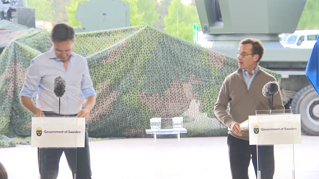
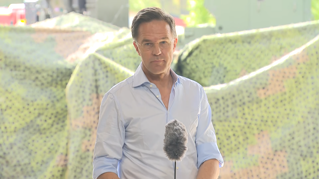
Joint press statements by NATO Secretary General Mark Rutte and the Prime Minister of Sweden, Ulf Kristersson
Joint press statements by NATO Secretary General Mark Rutte and the Prime Minister of Sweden, Ulf Kristersson
Joint press statements by NATO Secretary General Mark Rutte and the Prime Minister of Sweden, Ulf Kristersson
Joint press statements by NATO Secretary General Mark Rutte and the Prime Minister of Sweden, Ulf Kristersson
Joint press statements by NATO Secretary General Mark Rutte and the Prime Minister of Sweden, Ulf Kristersson
Joint press statements by NATO Secretary General Mark Rutte and the Prime Minister of Sweden, Ulf Kristersson
Joint press statements by NATO Secretary General Mark Rutte and the Prime Minister of Sweden, Ulf Kristersson
Joint press statements
21 - 22 May
2026
Helsingborg, Suède