Fermer
Retour
Accédez aux ressources médiatiques officielles de l'OTAN. Un contenu de qualité professionnelle, diffusé sur les dernières actualités. La référence pour les professionnels des médias.

Accédez aux ressources médiatiques officielles de l'OTAN. Un contenu de qualité professionnelle, diffusé sur les dernières actualités. La référence pour les professionnels des médias.
Désormais, vous pouvez télécharger des versions complètes ou partielles de nos vidéos depuis notre site Web.
Si vous souhaitez également vous abonner à la newsletter et recevoir nos dernières mises à jour, cliquez sur le bouton ci-dessous.
Entrez l'adresse e-mail avec laquelle vous vous êtes inscrit et nous vous enverrons un code pour réinitialiser votre mot de passe.
Le mot de passe doit comporter au moins 12 caractères, sans espaces, inclure des lettres majuscules/minuscules, des chiffres et des symboles.
Cliquez sur le bouton pour revenir à la page sur laquelle vous étiez et connectez-vous avec votre nouveau mot de passe.
02 février 2017
5 MIN DE LECTURE
(As prepared)
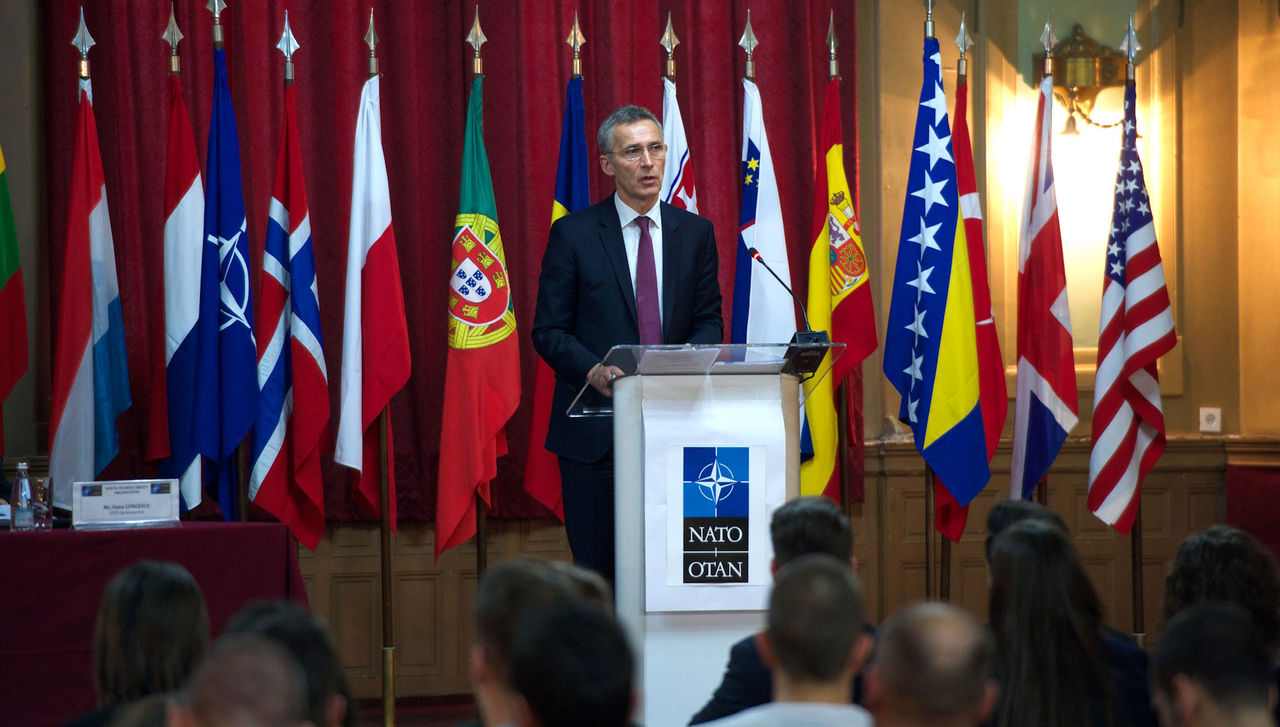
Thank you General Giselle Wilz for that kind welcome and for your great leadership at the NATO Headquarters here in Sarajevo.
It is always good to be back in Sarajevo.
I was first here as a boy in 1964 when my father was a diplomat to the former Yugoslavia.
And coming back here, surrounded by snow covered mountains, reminds me of that time, and of my home in Norway.
So thank you so much for inviting me to be with you today.
To talk about the relationship between NATO and Bosnia and Herzegovina.
And to look to the future of our relationship.
***
December marked the 21st anniversary of the Dayton Peace Agreement.
That agreement ended four years of war.
And it lifted the siege of this beautiful city, which led to death and suffering for so many people.
In the two decades since, much has changed.
This city and the country have been rebuilt.
There is democracy.
And visa-free travel within the EU’s Schengen zone.
All of this required a huge degree of political cooperation and effort by all the people of Bosnia and Herzegovina.
And by the main political parties.
NATO has been an important part of this transformation.
NATO helped to end the war.
And it helped to cement the peace.
Supporting the creation of new, unified institutions.
This is the core of NATO’s partnership with Bosnia and Herzegovina.
One of the most significant achievements has been the creation of the Joint Armed Forces.
At the end of the war, there were more than 400,000 troops, bitterly divided between three armies at war with each other.
Today, there is a single, professional army of around 10,000 soldiers and 5,000 reservists under a unified chain of command.
This is a truly remarkable achievement.
It shows what is possible - when difficult issues are tackled with ambition and a spirit of consensus.
It is a model that others can learn from.
The Defence Review, adopted by the presidency in November, will further modernise the Joint Armed Forces.
Of course, there are many challenges still to face.
But this country has come a very long way.
***
NATO’s partnership with Bosnia and Herzegovina is – fundamentally – about improving the everyday lives of the people of this country.
It’s about peace and stability.
It’s about making sure that women play their full role in society.
It’s about fighting corruption.
Ensuring that defence institutions are under democratic control.
Use resources appropriately.
And are transparent and accountable.
It is also about strengthening your ability to respond to natural disasters.
That is why, in 2014, NATO answered Bosnia’s call for help during the devastating floods.
Since then, we’ve been working to strengthen your ability to deal with natural disasters.
And this September, Bosnia will host a major NATO civil emergency planning exercise in Tuzla.
One of the areas most affected by the floods.
***
But our partnership is a two-way street.
Bosnia and Herzegovina now makes an important contribution to international security.
Bosnia is part of NATO’s ongoing support to Afghanistan, with 55 people currently on duty with our Resolute Support Mission.
I have just met and thanked some of those who have served in Afghanistan.
Bosnia and Herzegovina has also played a role in UN peacekeeping missions in Cyprus, Congo, Liberia and South Sudan.
And Bosnia has also started the process of applying for full membership in the NATO Alliance.
Membership is not easy to achieve.
It lies at the end of a long path of reform.
But Bosnia is moving forward.
The Defence Review is an important step.
Bosnia now needs to deliver, for the benefit of all of its people and its security.
This includes the registration of defence properties, placing them under the control of the state.
I urge all parties to work together with unity of purpose for the benefit of all citizens of Bosnia and Herzegovina.
Compromise can be difficult.
But it is also vital if the citizens of this country are to have the bright future they deserve.
NATO will support you all the way, but the future is in your hands.
And with unity, determination – and yes, compromise – great things are possible.
***
For centuries, the history of our continent was dominated by violence and mistrust.
But across Europe, nations like France and Germany learned to overcome that violence and that mistrust.
Even my own country of Norway, and the other Scandinavian countries of Sweden and Denmark, so peaceful and successful today, had to overcome centuries of war with each other.
We learned to overcome our past.
And in doing so we unlocked the enormous potential of our people.
We moved forward.
This year, we expect to welcome Montenegro as the 29th member of the NATO Alliance.
Croatia and Slovenia are now members of NATO, and of the European Union.
The same is possible here.
***
The future of Bosnia and Herzegovina is important to NATO.
Our histories are closely entwined.
NATO intervention brought peace to Bosnia.
But it also transformed NATO.
It was the first time that NATO had conducted an operation beyond its borders.
The NATO-led missions marked a historic shift in the very nature and role of the Alliance.
From focussing purely on defending NATO Allies.
To projecting stability beyond our borders.
Building up the forces and strengthening the institutions of our partners.
Working with the UN, the EU and the OSCE, this is what we have done in the region.
It is what we have done in Afghanistan.
And it is what we are doing in North Africa and the Middle East.
***
We live in uncertain times, with challenges from a more assertive Russia, from turmoil in the Middle East, and from terrorism in our own countries.
That terrorist threat has been felt here in Bosnia.
There have been attacks.
And, in recent years, hundreds of men and women have travelled to Iraq and Syria.
To join ISIL and al-Qaeda.
None of today’s security challenges can be dealt with by any country standing alone.
But by standing together, in common cause, through the NATO Alliance, I believe there is no challenge that we cannot overcome.
***
Ladies and gentlemen.
NATO wants a united Bosnia and Herzegovina to succeed.
We want you to take your rightful place as a member of the Euro-Atlantic community.
And we will support you on that path in any way that we can.
This is about more than meeting common standards and technical arrangements.
It is about joining a community of nations dedicated to democracy, human rights, the rule of law – and to each other.
A community that has spread greater peace and prosperity across our continent than ever before.
Joining the Euro-Atlantic community requires responsible leadership.
And that leadership has to come from you and your political leaders.
While fully respecting your democratic institutions and your constitution.
Everyone needs to come together in a spirit of unity and mutual respect to do what needs to be done.
For a confident and thriving Bosnia and Herzegovina is not only good for you.
It is good for the whole of the Western Balkans, and for all of Europe.
Thank you, and I look forward to answering your questions.