Fermer
Retour
Accédez aux ressources médiatiques officielles de l'OTAN. Un contenu de qualité professionnelle, diffusé sur les dernières actualités. La référence pour les professionnels des médias.

Accédez aux ressources médiatiques officielles de l'OTAN. Un contenu de qualité professionnelle, diffusé sur les dernières actualités. La référence pour les professionnels des médias.
Désormais, vous pouvez télécharger des versions complètes ou partielles de nos vidéos depuis notre site Web.
Si vous souhaitez également vous abonner à la newsletter et recevoir nos dernières mises à jour, cliquez sur le bouton ci-dessous.
Entrez l'adresse e-mail avec laquelle vous vous êtes inscrit et nous vous enverrons un code pour réinitialiser votre mot de passe.
Le mot de passe doit comporter au moins 12 caractères, sans espaces, inclure des lettres majuscules/minuscules, des chiffres et des symboles.
Cliquez sur le bouton pour revenir à la page sur laquelle vous étiez et connectez-vous avec votre nouveau mot de passe.
Good afternoon and it is good to see you all. Yes, let me say we have just concluded a very productive meeting of NATO Defence Ministers. Today the discussions focused on strengthening our deterrence and defence and ensuring continued support to Ukraine.
And let me tell you, what I saw and heard today is unlike any NATO meeting I have taken part in. And I have been to many, starting in 2010.
Last year in The Hague, Allies made a historic commitment to invest 5% of their GDP in defence and security, so that NATO will remain strong and so that the responsibility for our collective security is fairly shared.
The commitment was made in June, and the evidence of progress in delivering on that commitment is visible. But today we also saw evidence of something else, a real shift in mindset, a unity of vision, a much stronger European defence within NATO. Everyone around the table engaged, with a sense of urgency and ownership in how we are working together as Allies to deliver effective deterrence and defence.
We discussed the crucial progress Allies are making towards meeting the 5% defence investment plan. Allies have made clear commitments to reach their capability targets, and they are working to deliver the forces and capabilities needed to ensure our warfighting readiness.
That demands investing a lot more. And Allies are doing just that. We saw a major shift and uplift already in 2025. Some Allies, like Denmark, Estonia, Latvia, Lithuania and Poland are already at or above our investment goals, a decade ahead of schedule. Others, like Germany, are on track to double their investment from just a few years ago. These investments are vital for our security.
But as Allies invest more, it is, of course, also essential that the increased demand is met with increased supply. We need quantity, and we need quality, and we need it quickly. More air defence, more ammunition and stronger supply chains across the Alliance. This means building our own industries and increasing production lines on both sides of the Atlantic.
It also means working together, pooling demand as well as expertise, and this is something that NATO does extremely well. Take, for instance, some of the agreements that were signed between Allies today. We are stepping up multinational corporation to rapidly field new technologies, deep precision strike capabilities, and capabilities for ballistic missile defence.
For example, a year ago, we launched NATO's Task Force X Baltic, leveraging innovation to enhance the security of critical undersea infrastructure in the Baltic Sea region. As a result of this pilot initiative, eight Allies are now adopting and integrating these innovative multi-domain capabilities.
Cooperation like this helps secure the continued high demand signals that industry needs to scale up production. It allows us to make best use of defence budgets and corporation is a smart way to deliver flexible, agile approaches to capability development and acquisition.
We do this together as Allies, but we also work as partners to scale up production and boost innovation. And here, the most powerful example of this cooperation is what we are doing with Ukraine. In the midst of the continued bombardment by Russia, Ukraine is not only resilient, but remarkable in its ingenuity.
As we work to support Ukraine to ensure that they have what they need to defend their sovereignty, not least air defence, we also support their incredible innovation, including in the context of drone and counter drone technology.
Allies are working directly with Ukrainian industry, supporting what is produced in Ukraine and jointly producing with Ukraine in Allied countries as well.
Ukraine's Defence Minister, Mykhailo Fedorov, who is here today for his first meeting in the NATO Ukraine Council, has been leading the charge on this tech revolution. He and his team and the brave soldiers fighting for freedom, are at the cutting edge of battlefield innovation, and we are doing all we can to support them.
As Russia's illegal war of aggression rages on, Ukrainian people continue to face not only a harsh winter, but the brutality of Putin's persistent strikes on civilian infrastructure. Again, last night. Minister Fedorov updated us on the situation of the ground in Ukraine and outlined the urgent support Ukraine requires, support that NATO and Allies continue to provide.
We do this through PURL where critical US equipment, including critical air defence, continues to flow. Through NSATU, where we are coordinating training and delivery of equipment, including what's purchased through PURL. And through the Comprehensive Assistance Package, and through Allied initiatives, and also in many other ways, all so that Ukraine can defend today and deter tomorrow.
Earlier this afternoon, we heard important pledges of continuous support in a NATO Ukraine Council, and we will soon meet in the Ukraine Defence Contact Group, where I expect further announcements of aid. And this is vital. Ukraine needs more.
As I told President Zelensky last week in Kyiv, NATO stands with Ukraine. Our security is interlinked, and we all want to see this brutal war come to a just and lasting end. Allies are united, united in support for Ukraine and united in our commitment to defend every inch of Allied territory. Arctic Sentry, which we launched yesterday, makes this clear yet again, whatever the challenge to our security, we can tackle it best by working together.
NATO will continue to do just that, in order to keep our one billion people safe. And with that, I'm happy to take your questions.
NATO Spokesperson Allison Hart
Okay, let's start with the BBC in the fourth row.
Johnny Beale, BBC
Thank you very much, Secretary General. I think you've already addressed the question of the fact that the US Defence Secretary has decided not to come to this meeting. I'm not exactly sure what he's doing instead. Are you? I know you downplayed the significance of that. It's not a big deal, I think in your view, but there are 16 US ambassadors to NATO and former Supreme Allied Commanders who have issued a statement, a joint statement, affirming NATO's vital role to US national security. So, they're clearly worried. I just don't understand why you're not worried.
NATO Secretary General Mark Rutte
Have you read Elbridge Colby’s intervention? It's now published.
Johnny Beale, BBC
I've seen what he’s said. He's the third he's the third most senior person in the Pentagon who's come.
NATO Secretary General Mark Rutte
Elbridge Colby is the Under Secretary of Policy. He has been leading some of the current thinking in the United States for years, pivoting more towards the Indo-Pacific, at the same time acknowledging the importance of a United States firmly anchored in a NATO Alliance. You will also read this in his introduction, which he made this morning. He also acknowledges that if there will be an attack somewhere in the Indo-Pacific potentially, that it might be the case, that Russia would keep us busy here so that for the US security, it is vital to have a strong NATO. But also, for the US security, it's vital to have a stronger European presence within NATO. And that's exactly what's happening. We are ramping up the spending in Europe and Canada to protect ourselves better. So I think that presentation was exactly what was needed to acknowledge the immense progress made since Pete Hegseth’s first speech here last year, where it was warranted to give that wake up call. And now having had the Summit in The Hague, and now seeing all the defence investments coming in, not only because the US is asking it, but because we collectively assess the Russian threat, and we have to defend ourselves against that and keep Ukraine strong. So, I think what you see today is a NATO where the US is completely anchored. And at the same time a NATO where Europe is stepping up, with Canada, taking more of a leadership role. And at the same time, what you are seeing is therefore a stronger transatlantic Alliance. So yes, I think, as I said, this for me was one of the most pivotal meetings I've been part of since I have visited NATO meetings since 2010.
NATO Spokesperson Allison Hart
Okay, let's go to the third row, Frankfurter Allgemeine Zeitung.
Thomas Gutschker, Frankfurter Allgemeine Zeitung
Thomas Gutschker, Frankfurter Allgemeine Zeitung, good afternoon. My question is on PURL. So, you said last year in December that you expect Allies to spend roughly 15 billion EURO on PURL this year. As far as I know, there have not been any pledges since the beginning of this meeting? Of course, then today, we heard from Sweden and from the UK. So, the first part of the question is, are you confident that Allies will meet this ambitious target? And the second part is, do you expect the Europeans to contribute to PURL via the new Ukraine loan, which foresees the possibility, in certain circumstances, to buy weapons from the US?
NATO Secretary General Mark Rutte
I'm absolutely confident that that flow of vital US equipment into Ukraine will continue to go. As I said yesterday, it is about 90% of the critical air defence needs of Ukraine when it comes to the Patriots. And I think it is 75 overall, or this year- The other way around, so 75% of the Patriot systems, and 90% overall. So this is of critical importance to Ukraine. So, I'm absolutely confident that will continue to flow, and we will be able to raise enough money to do that. And the exact link with where we get it from and which pot of money, I mean, leave it with me. We will do our utmost to make sure that the money is there.
NATO Spokesperson Allison Hart
And just next to him. ICTV
Volodymyr Runets, ICTV
Thank you. ICTV, Kyiv. My name is Volodymyr Runets and thank you for this opportunity to ask you this question. President Macron of France has been very clear that he would like to renew some sort of dialogue, some sort of direct dialogue between him or entire Europe with Putin and Moscow in general. Obviously, the EU is afraid to be left out in this negotiation process that the US initiated and is advocating. Is there an understanding, or is there an idea that probably NATO should as well talk directly to Putin or Moscow or maybe renew some kind of cooperation as it used to have with them? Thank you.
NATO Secretary General Mark Rutte
On this, it is my conviction that we all agree that it is United States who had to break the deadlock. President Trump broke the deadlock in the peace negotiations with President Putin in February last year. That was crucial, and since then, he has been consistently driving the peace process through Marco Rubio and Jared Kushner and Steve Witkoff, they have been constantly on this. And I think that is extremely important, and it is also, I think, widespread acknowledgement that it is important that we know what's happening. It's exactly what the Americans are doing. They're constantly updating what they are doing. What is the current state of play when it comes to the peace process, where they are leading the charge with the Russians and the Ukrainians. And of course then there is a discussion, what could Europe do more here? And I think that's totally fine to have that debate, as long as also then the Europeans, and I'm sure they will and I know they will, will be completely open about their endeavours, so that all of this works together. Because we have only one aim, and the only one aim is to end this war in a way that Russia will never try to attack again. So, the war has to be ended in a way where Ukraine can go forward as a sovereign nation with security guarantees in place such that Putin will never try again to attack Ukraine. So, no repeat of Budapest, no repeat of Minsk 2014, 2015 but credible security guarantees.
NATO Spokesperson Allison Hart
Let's go to the third row here, Telegraph.
Joe Barnes, The Telegraph
Hi, thank you, Joe Barnes from The Telegraph. I am the third bearded guy from yesterday. On security guarantees again, please, would you support an Ally willing to send assets, troops through the Coalition of the Willing, if Vladimir Putin doesn't give his explicit consent that NATO troops can be based in Ukraine as part of any peace deal? Thank you.
NATO Secretary General Marc Rutte
Well, let me repeat what I said yesterday, and it is, that I stopped some time ago to listen to every individual uttering from the Russian side, particularly when it comes from Lavrov. I mean, it's difficult to keep track of what they're all saying. What I know is that there is a peace process in place, led by the US, with the Russians and the Ukrainians, to bring this war to an end. And a part of that whole process is the absolute acknowledgement by everybody involved that for Ukraine going forward, Ukraine needs credible security guarantees. That will be, first of all, Ukrainian armed forces themselves. It's one of the biggest standing armies in Europe at the moment. Then of course, we have the Coalition of the Willing led by the French and the Brits, delivering their input to the security guarantees. And then there was a significant development starting in August last year, where the American president said, also the US will be involved in some way or other in the security guarantees. And that led to the successful meeting in Paris in December, where we, I think, nailed 90, 95% of the security guarantees going forward. Of course, now the peace talks are ongoing, this will be part of it, but I think we all acknowledge you need strong security guarantees as part of a peace deal, or at least for Ukraine to be there so that they know after a peace deal or a long-term cease fire that they are secure.
NATO Spokesperson Allison Hart
Let's come back over here, Bloomberg, second row.
Andrea Palasciano, Bloomberg
Thank you, Secretary General. Just a few weeks ago, the Alliance was on the verge of a major crisis, with the US making claims on the territory of another Ally. Three weeks later, like, what lessons have you learned? Because obviously we've seen the Arctic Sentry announcement, but that doesn't exactly address the issue of how the Alliance deals with internal conflict. So, are you confident this won't happen again? And how will you prevent it from happening again? Thank you.
NATO Secretary General Marc Rutte
Well, you know what is the biggest difference between NATO and what was formerly known as the Warsaw Pact? NATO is a coalition of democracies with free media, with politicians from all, from various types of politicians, from right of centre, left of centre, whatever, voted in full sovereignty by their national populations. And that means that you will always have debates and discussions within NATO, I can assure you. I mean, it would be very boring if it wasn't the case. We have seen it in the past. We have seen huge discussions in the 60’s, in the 70’s and the 80’s, even recently. So, I'm not worried about that. The good news is that this Alliance always finds a way forward, to come together, to focus again on our overarching goal, which is to keep 1 billion people safe under Article Five of the Washington Treaty, that an attack on one is an attack on all. And what I saw today, and this was important, I'm from the Netherlands. I'm from the western part of Europe, and that part of Europe has not seen war since 1945 luckily, thanks to NATO. And of course, we have many new Allies on the eastern side of Europe who are part of the Warsaw Pact, or even were occupied by the Soviet Union, like the Baltic states for 51 years, and now part of NATO. And what I see today is this mindset shift, where people understand that, yes, it is about spending more, but also it is about a unity of vision that we have to do this together, the United States anchored in NATO. You've seen the speech by Elbridge Colby, and he is not doing that on his own behalf. This is the position of the US government. It's exactly what I know is the position of the US president, of Pete Hegseth, and of Marco Rubio, the two Secretaries of State, where you need a strong NATO, but the NATO is stronger when the Europeans are stepping up, taking more of a leadership role within NATO, and that's exactly what they are doing. So that the US is able also to take care of some of the other issues they have to take care of, like the Indo-Pacific, like the Western Hemisphere still maintaining a strong nuclear and conventional presence in Europe, and this will make this Alliance so much stronger. So, I think we are really better off today than only one or two years ago.
NATO Spokesperson Allison Hart
Okay, fourth row on the aisle.
Victoria Bucataru, Vocea Basarabiei TV (Moldova)
Thank you for this opportunity. I am from Moldova TV. Mr. Secretary General, Moldova has repeatedly chosen a European path, but yes, Moscow continues to escalate pressure. In the past 24 hours, Russia's Ambassadors in Chisinau delivered a particularly harsh and threatening message, warning of a Ukrainian scenario and reiterating that Russia would not withdraw its troops from Moldova's Transnistria region. Two questions, please. How seriously should Moldovans take these threats, and does NATO encourage Moldova to treat them as a real security risk? What is NATO's message and practical support to help deter intimidation and threats on Moldova's resilience given its border with NATO Ally Romania. And you are likely to meet President Maia Sandu in Munich at the Munich Security Conference. What would you advise her to prioritise right now to reduce Moldova’s vulnerability, especially on Transnistria regional stability and hybrid pressure please. Thank you.
NATO Secretary General Marc Rutte
Thank you so much for the question. Let me start by saying that I have the highest respect for Maia Sandu, the President of Moldova. She's a good friend. We know each other for years now, last time we spoke in Copenhagen during the European Political Community, and she's a remarkable leader. I've again, the highest respect for her leadership. And I know Moldova is, of course, in a difficult position, but she knows and we are actively doing it. Moldova is, of course, intensely working together with the European Union. We have our contacts between NATO and Moldova, helping with hybrid and other situations within Moldova. And of course, there is a strong bilateral cooperation with Romania, between Bucharest and Chisinau now and I think that's also very relevant. Let's not be naive about Russia. She is not, you are not. I am not. We should all never be a naive about the Russians, but the fact that they come with these type of statements means that they are increasingly more worried about the fact that Moldova is taking a different path. We have seen it in the presidential election. We have seen it in the general elections. It has been a consistent picture coming out of Moldova that your country is on a different path and under the leadership of President Sandu that will be step by step in the right direction.
NATO Spokesperson Allison Hart
And now the woman on the aisle in the fourth row.
Slađana Jašarević, RTV BN
Thank you. My name is Slađana Jašarević, RTV BN, Republika Srpska, Bosnia and Herzegovina. My question is on Western Balkans, Bosnia Herzegovina. You said yesterday and several times before that you will not allow security vacuum in BiH. What exactly does this mean, and there are only security risks in BiH? And I am also interested, how you assess cooperation with political leaders in BiH, but all three sides in BiH?
NATO Secretary General Mark Rutte
Well, I mean, again, Bosnia and Herzegovina is a very important country. Coming from the Netherlands, of course, I have my personal, close relationship with Bosnia and Herzegovina. We have our shared history as nations, but also when it comes to NATO, when it comes to the European Union, there is a close relationship, and NATO will indeed never accept a security vacuum in Bosnia and Herzegovina. I leave it a little bit vague what that means. You will understand. Others will understand. But let them think what it might mean. But I can guarantee you, it is there, and it is absolutely well meant. And we are present in Bosnia and Herzegovina. We have KFOR in Kosovo. And of course, we have our bilateral relations, as NATO myself, with the President of Serbia, because it is important that Kosovo and Bosnia and Herzegovina and the situation in Serbia is stable, that you can develop your own economy, that the three-person leadership, the three people forming the Bosnia and Herzegovina presidency, can take as much control of the country as possible. We all encourage them to do that. I know there is sometimes criticism of some of the Dayton structures, and I tell them, ‘hey, take responsibility for the country. Do it yourself’. Of course, that's not always easy, because we know the political tensions and the political difficulties involved, and I respect those, and we will help to solve that. The EU is really leading this. I think the Pristina-Belgrade dialogue is very important, and NATO fully supports that. And again, as I said yesterday, it is also important to get to accountability when it comes to what happens in 2023 in Banjska and other events, and the Serbian President has promised to deliver that accountability, and we expect him to do that soon.
NATO Spokesperson Allison Hart
Okay, we have time for a few more questions. Let's go to Sky News. Fourth row, red jacket.
Debora Haynes, Sky News
Thank you. Debora Haynes from Sky News. Hi. You've obviously won a lot of praise for your diplomatic skills and your leadership in this role. But can you just explain to us why you don't see the fact that Pete Hegseth isn't here is not an indication of a shift in priorities from the US when it comes to NATO? And the German Defence Minister, when he arrived this morning, he said that, you know, for NATO to remain transatlantic, it needs to become more European. Can you give a sense of what that actually means? So you know, what proportion of military capability, should Article Five happen, is now deemed to be something that American conventional capability needs to provide? And maybe five years from now, like, what will it look like? How much more will be European? Can you give it that sense? It'd be really helpful. Thank you.
NATO Secretary General Mark Rutte
I don't want to make our adversaries much wiser by going into all the details. But more generally speaking, first of all, Pete Hegseth and I have a very good relationship, and we are directly in contact, as I am, of course, with the American President and with Marco Rubio, the Secretary of State, whom I will see in Munich in the coming days. So that is a close cooperation. But you have to realise that the United States is the biggest country on earth. It is the most powerful military on Earth. It is 25% of world economy. So yes, they are totally invested in NATO. They are anchored in NATO. There's no doubt about that. But I am not too worried if some of the senior officials in the US, having that spread of responsibility, also have to take care of their own hemisphere, of the Indo-Pacific, cannot always be here in Brussels. And then I think we were very fortunate to have Elbridge Colby here, who has been a leading thinker on the role of the US in NATO, the situation in the Indo-Pacific, and how this all fits together. And you have seen his speech, and I think it was an excellent speech to the point and reaffirming the crucial role NATO plays also for the defence of the United States.
And then, yes, indeed, Boris Pistorius is right. We need a NATO which is more European-led. And how does that work out? It means Europeans spending more, taking more responsibility for their own defence. It is one of the biggest and richest parts of the world, the collective GDP of Europe, not only European Union, but including Norway, and including Türkiye, and including United Kingdom and other countries not in the European Union. And, of course, the European Union nations also in NATO. That collective GDP is massive. So of course, we are able to take more care of our own events. The problem is we didn't. We were spending 1.7, 1.8% on core defence, where the US was consistently spending 3.5%. And now we will all be spending this core spending on 3.5% and the 5% overall, including defence-related spending. And that was a big breakthrough in The Hague.
Today, what I see is that it is not only happening, but that the mindset shift, which is so crucial to make this sustainable, is there in the room. People realising we will never break up. We will always stay together. North America - Canada, the United States - and the European NATO countries always staying together, but Europeans taking more responsibility for the defence of this part of NATO, which means, indeed, spending more. And you will also see it in the flags to post, as I mentioned yesterday, that it will be Europeans leading the Joint Force Commands, and then the Americans leading the component commands. Again, evidence of Europeans stepping up. You see it in PURL, Europeans stepping up. You see it in Lithuania. Germany, having a full brigade there over time, Europeans stepping up. And there are many of these examples. And that mindset shift underpinning this, for me is now absolutely clear that this is sustainable and will continue to be so. And that will make it stronger, because it takes this massive pebble out of the shoe, this big irritant on the US side. ‘Yes, we are in NATO. We are committed to Article Five. You can trust us, but hey, you have to spend more, at least equalise with the US.’ It's happening now also because we need that spending to defend ourselves against the Russians.
NATO Spokesperson Allison Hart
La Lettre, in the second row.
Matthieu Fauroux, La Lettre
Matthieu Fauroux for La Lettre. You just made a point that the Europeans should spend more. You know, you could also make the point that some countries like Poland already spend a lot, and yet US is still in charge of SACEUR, of SHAPE. In the JFCs, they’ll be in charge of operations. So how sincere is that transfer to Europeans?
NATO Secretary General Mark Rutte
Well, I think it is a balance. And the balance is that, yes, I think it is extremely important that the Supreme Allied Commander is an American, because you will always have a strong conventional US presence in Europe. Also, with Europe stepping up, there will still be, in the future, a strong American conventional presence in Europe, next to the nuclear umbrella as our ultimate guarantor of our freedom. But it will be different, because US also has to pivot more towards Asia. But given that strong US presence and also what is necessary if war would break out, in terms of reinforcements, I think there is every reason why the Supreme Allied Commander is an American. But at the same time, what you are seeing now is that, over time, we will see that the three Joint Force Commands will be European-led. And that's significant, that is for all the three Joint Force Commands, and then the component commands led by the Americans. I think that's exactly the sort of division of labour, which is logical in an Alliance where the US, as an economy, is over half of the total NATO economy, and the other 31 being the other half. But of course, also a US which is not only concentrating on Europe and NATO as a core pillar of their own security because of the Atlantic and the Arctic and of course a secure Europe, but also having to focus on other parts of the world. And this is because history made the United States a leader. This is the biggest nation on earth, and that means that they also have to take care of the situation in the Middle East, in the Indo-Pacific, in their own hemisphere. And I think that's totally logical.
NATO Spokesperson Allison Hart
All right, that's all we have time for today. Thank you so much for joining us.
NATO Secretary General Mark Rutte
Thank you. See you soon.


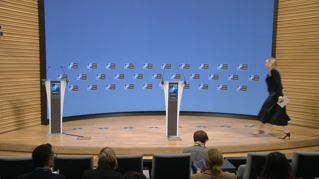
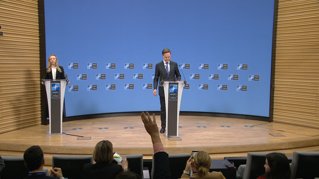
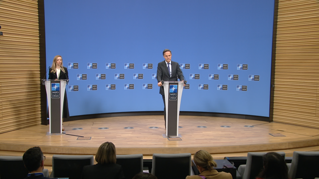
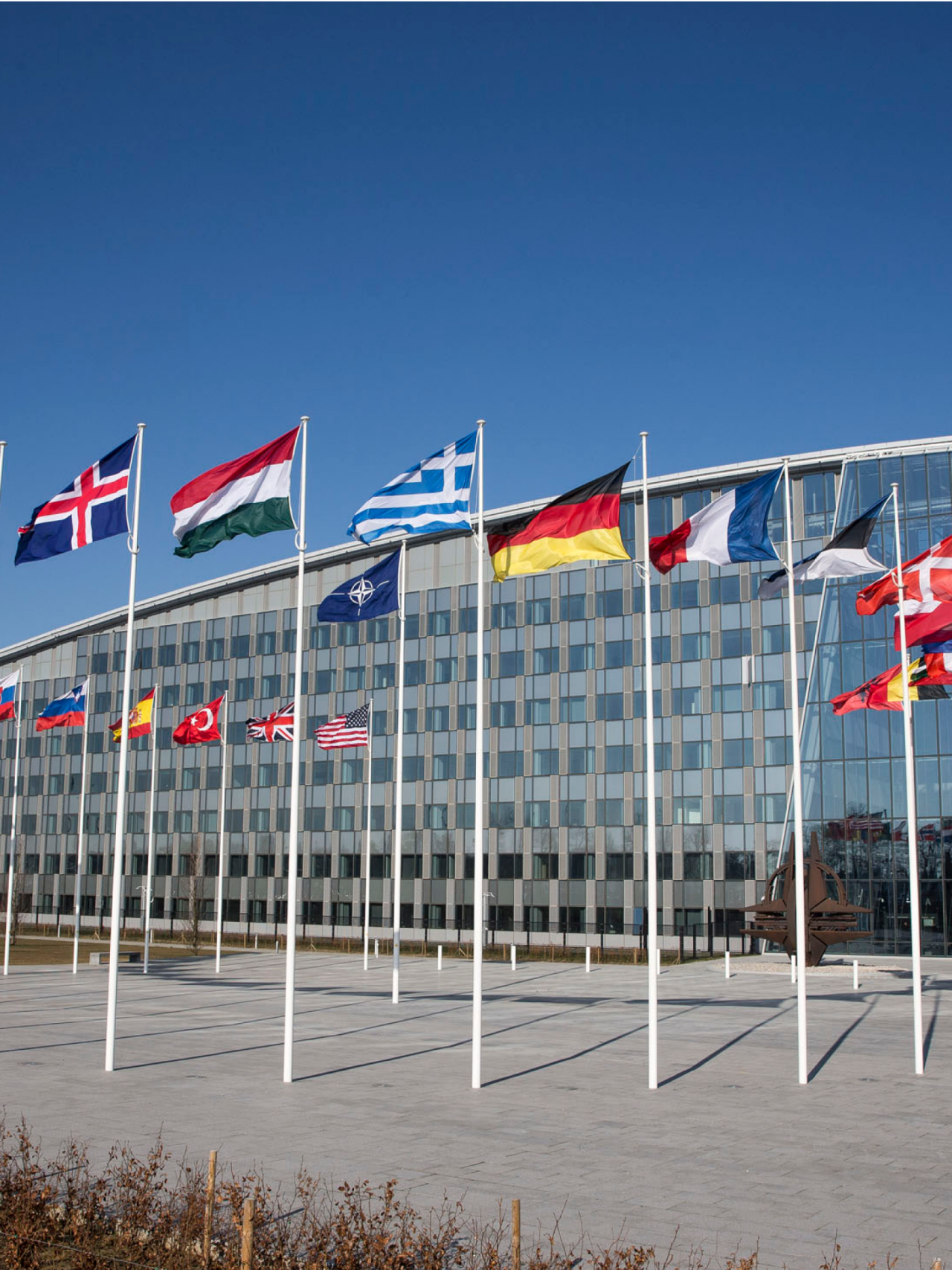
Press conference by NATO Secretary General Mark Rutte following the meeting of NATO Ministers of Defence on 12 February 2026 at NATO Headquarters in Brussels
Press conference by NATO Secretary General Mark Rutte following the meeting of NATO Ministers of Defence on 12 February 2026 at NATO Headquarters in Brussels
Press conference by NATO Secretary General Mark Rutte following the meeting of NATO Ministers of Defence on 12 February 2026 at NATO Headquarters in Brussels
Press conference by NATO Secretary General Mark Rutte following the meeting of NATO Ministers of Defence on 12 February 2026 at NATO Headquarters in Brussels
Press conference by NATO Secretary General Mark Rutte following the meeting of NATO Ministers of Defence on 12 February 2026 at NATO Headquarters in Brussels
Press conference by NATO Secretary General Mark Rutte following the meeting of NATO Ministers of Defence on 12 February 2026 at NATO Headquarters in Brussels
Press conference by NATO Secretary General Mark Rutte following the meeting of NATO Ministers of Defence on 12 February 2026 at NATO Headquarters in Brussels
Press conference by NATO Secretary General Mark Rutte following the meeting of NATO Ministers of Defence on 12 February 2026 at NATO Headquarters in Brussels
Secretary General’s Press Conference