Fermer
Retour
Accédez aux ressources médiatiques officielles de l'OTAN. Un contenu de qualité professionnelle, diffusé sur les dernières actualités. La référence pour les professionnels des médias.

Accédez aux ressources médiatiques officielles de l'OTAN. Un contenu de qualité professionnelle, diffusé sur les dernières actualités. La référence pour les professionnels des médias.
Désormais, vous pouvez télécharger des versions complètes ou partielles de nos vidéos depuis notre site Web.
Si vous souhaitez également vous abonner à la newsletter et recevoir nos dernières mises à jour, cliquez sur le bouton ci-dessous.
Entrez l'adresse e-mail avec laquelle vous vous êtes inscrit et nous vous enverrons un code pour réinitialiser votre mot de passe.
Le mot de passe doit comporter au moins 12 caractères, sans espaces, inclure des lettres majuscules/minuscules, des chiffres et des symboles.
Cliquez sur le bouton pour revenir à la page sur laquelle vous étiez et connectez-vous avec votre nouveau mot de passe.
Good afternoon, and we have just concluded our meeting of NATO Foreign Ministers – halfway between the Summit in The Hague and the next one in Ankara.
We face real and lasting dangers. Russia continues its brutal war against Ukraine, increasingly targeting its people and critical infrastructure as winter sets in.
Russia is also demonstrating increasingly reckless behaviour when it comes to NATO, such as violating our airspace, conducting cyberattacks, and deploying spy ships to map Allies’ undersea infrastructure.
These incidents underscore the need for unwavering vigilance.
We must continue to respond with strength, unity, and resolve.
A key focus today was defence investment. European Allies and Canada are stepping up significantly – a welcome development that demonstrates our shared commitment.
But we must do more, and all Allies need to pull their weight to ensure that we are prepared, and that the responsibility is fairly shared.
Ministers discussed the planning underway to chart a credible path toward the commitment made in The Hague: investing 5% of GDP annually in defence.
This will ensure we can develop and procure the core capabilities essential for our collective defence, including advanced systems for air defence.
We reaffirmed that support to Ukraine counts toward this 5% target, as it directly contributes to our own security.
Allies shared updates on their national plans, highlighting how increased spending is translating into tangible enhancements, such as bolstering forces on the eastern flank and modernising equipment.
This is not just about numbers; it is about building a stronger, more adaptable Alliance capable of deterring any aggression and defending every inch of Allied territory.
As we implement these measures, we are also addressing hybrid threats – whether sabotage, cyberattacks, or other efforts to destabilise our societies.
Turning to Ukraine, we all want the bloodshed to end, and I strongly welcome President Trump’s continued efforts to bring about a just and lasting peace.
This is vital for resolving this conflict, and we support the United States in leading this effort. And as negotiations proceed, we cannot waver in our commitment to Ukraine.
Every single day, Russian missiles and drones cause deaths and destruction, leaving civilians without heat, light, and water as winter approaches.
Ukraine’s security is closely linked to our own.
Our support must continue unabated to help Ukraine defend itself today and deter tomorrow. For their own sake, and for ours.
During today's NATO-Ukraine Council, Foreign Minister Sybiha briefed us on the latest developments, Ukraine's urgent requirements, and progress on the path to a durable peace.
EU High Representative Kallas joined us, underscoring the close cooperation between NATO and the EU in bolstering Ukrainian resilience.
Our support is making a real difference on the ground.
Through the Prioritised Ukraine Requirements List (PURL), funded by Allies, we are delivering essential, lethal and non-lethal U.S. capabilities, including desperately needed air defence, to help Ukraine hold the front line and protect its people.
And today we heard from Allies who are committing more resources to support Ukraine through PURL including, Canada, Germany, The Netherlands, Norway and Poland. Now over two-thirds of Allies have committed to the program. And though not here for our meeting today, we heard from Australia and New Zealand, who will also contribute to PURL – the first NATO partners to do so. And this means that Allies and partners have already committed now, really, over 4 billion dollars to PURL, getting us on the track to the 5 billion for the full year. And this flow of aid is crucial, and I urge again, all to accelerate their pledges – not just for this winter, but planning ahead also for 2026.
Ukraine continues to show incredible resilience. Putin believes he can outlast us, but we are not going anywhere. Today is yet another clear sign that he is wrong. We are strengthening our support for Ukraine and increasing pressure on Russia.
This includes countering Russia’s Shadow Fleet and other measures to pose strategic dilemmas for the Kremlin.
Today, Ministers reaffirmed our commitment to increasing defence investment, enhancing production, and stepping up support for Ukraine.
As we look to the Ankara Summit, our priorities are clear: investing in our security, strengthening our industry, and sustaining our support for Ukraine so it has the means to endure this tough winter and beyond.
Nobody wants peace more than Ukraine. And as we work hard for peace, we must continue to provide Ukraine with the tools to defend its sovereignty and achieve a lasting resolution.
Finally, NATO is a defensive Alliance. We will remain a defensive Alliance. But make no mistake – we are ready and willing to do what it takes to protect our one billion people and secure our territory.
Thank you. I am ready, of course, to take your questions.
NATO Spokesperson, Allison Hart – Okay we'll start in the second row with Reuters.
Lili Bayer, Reuters - Thank you very much, Lili from Reuters. In the NATO Strategic Concept, the Allies agreed a few years ago that the Russian Federation is the most significant and direct threat to Allied security and to peace and stability in the Euro-Atlantic area. Based on your discussions today, do you believe that all Allies, including the United States, still share this assessment that Russia is the most significant threat to the Alliance? And what role will NATO have in future discussions, if they take place, over the European security architecture? Thank you.
NATO Secretary General, Mark Rutte - On the first question, there's no reason to debate the outcome of the Strategic Concept. It's there, it stays there and what I hear from all Allies is that they're completely committed to that thinking and also making sure that we implement all the measures consistently with that notion and that strategy. To the second question, it has to do, of course, with the peace process. As I said yesterday, when it comes to NATO, if anything about NATO would be discussed as part of the peace process that will be dealt separately, so no news on that.
NATO Spokesperson, Allison Hart – All right, going here to the third row, ANSA.
Mattia Bagnoli, ANSA – Hi Secretary General, Mattia Bagnoli – ANSA - the national Italian news agency. The Kremlin essentially said no to the latest US proposal, or at least this is what we read in the press. But, I mean, we've been there before, it seems like Groundhog Day. Do you agree that with those that who think that this is basically some sort of a psy-op operation from the Kremlin to derail the US sanctions and the EU plan to, on, the frozen assets, so kicking the can down the road. And secondly, the Finnish President, Alexander Stubb said in an interview that the conditions for a just peace in Ukraine are unlikely to be met, and do you share that assessment?
NATO Secretary General, Mark Rutte - Again, as I said a number of times, there is only one person in the whole world who was able to break the deadlock when it comes to war in Ukraine, and that is the American president, Donald J Trump. And he did. He started in February to get engaged, and he is engaged up to and including today, and his team is engaged, including Steve Witkoff, Marco Rubio and all the key players on the American side. And that's crucial, because in the end, US is by far the biggest Ally in NATO and the strongest nation on earth, and it's really up to them first to break that deadlock and then make sure that others follow. But getting this piece done, as also the American president has said, is not something in a straight line, in one go. You need proposals on the table. You need to have discussions. And we have seen the meetings in Geneva, in Miami, now yesterday in Moscow, it will be a step-by-step approach. The last thing I want to do is to basically make it more difficult to get to a deal by commenting on every in-between step. I can assure you that NATO here, the headquarters, myself, my team is closely coordinating with the White House, with State Department. There's all the relevant players on the American side to be of maximum help in this process, because we find it crucial. And we all agree that in the end, what you need is a sovereign Ukraine, a sovereign Ukraine which knows that we have in place the necessary, so-called security guarantees by which Russia will - after a hopeful peace deal or a long-term ceasefire - will never again try to attack Ukraine, because then they know the reaction will be devastating. That's what we are aiming for.
NATO Spokesperson, Allison Hart – Okay, we'll come to the centre here, the Finnish public broadcaster.
Rikhard Husu, YLE - Thank you, Rikhard Husu, Finnish YLE. How significant are the new pledges to PURL in your opinion? And how do you respond to the criticism in some foremost northern member states regarding the burden-sharing in general in terms of supporting Ukraine. And what's your message to the countries who have not yet made pledges to PURL? Thank you.
NATO Secretary General, Mark Rutte - Yes, the number of countries not yet having made pledges to PURL is really limited, as I said, over two thirds of Allies have now made pledges. We know that one or two, its cooking at the moment in the government circles, and we have reason to believe there will be a positive outcome. So, it's only a handful of nations now, a little over a handful, not having yet committed to the PURL, so that's the good news. I also understand the northern Allies and others like the Netherlands or Canada or Germany, saying, hey, listen guys, we need to spread the burden fairly. We need burden-sharing here. But the fact that also today, I think it is in total, six countries, maybe even seven, depending on some final decisions in their capital, have committed to the PURL programme, is also testimony that we are getting there and that the burden-sharing is now in a much better place than it was only, let's say, four or six weeks ago. And the fact that now even New Zealand and Australia - and they are not in NATO - they are close NATO partners through the Indo-Pacific Four cooperation, but they are not in NATO, that they have also now committed to the programme, is really great news, and it gives us the sustained flow of weapons into Ukraine from essential US stockpiles. And it's also a signal to Vladimir Vladimirovich Putin, we are not going anywhere, we are here to stay, we are here to make sure that Ukraine has what it needs going forward. And in itself, that's also putting pressure on the Russians, because they know losing 20,000 of their soldiers a month now in Ukraine, that we will keep on supporting Ukraine going forward.
NATO Spokesperson Allison Hart - All right, let's see Euronews in the fourth row towards the centre.
Shona Murray, Euronews - Thank you. Shona Murray from Euronews. Can you tell us a little bit about the conversations in the room or the consensus, whether there was one, in relation to the use of immobilised Russian state assets? And obviously, we know there's the announcement from the Commission today. There's some countries there that have assets, like France, the UK, Canada, aside from Belgium and the US, had obviously had plans initially to use them. So, tell us a little bit about the conversations and whether you think there should be a reparations loan using them. Thanks.
NATO Secretary General Mark Rutte - Well, this is clearly something which is primarily, of course, playing out at the level of the European Union and the European Union in close conjunction with the UK, US and others. So this was, let's say, indirectly today on the table. Because when you look at Ukraine for next year, if the reparations loan/defreezing the assets, or making the assets mobilised, whatever the exact phrase is we are using, if that is not happening, and then it is absolutely clear that we need to get the money in another way. And I felt a commitment in the room first to see how far we can get. But again, that's on the EU side of town first of all, to get this done. And of course, NATO has no formal position. This is really an issue playing out in the EU, and I have the full confidence in the EU senior leadership, including António Costa and Ursula von der Leyen to steer that discussion. But there was also a clear understanding that if somehow this is not working out, Ukraine cannot be left alone. Then we have to make sure the money is still there, as we have done by the way, over the last couple of years, because we have been able to get the money necessary for Ukraine, also without the frozen assets. But let's see how far we get. Because, of course, it would make things easier.
NATO Spokesperson Allison Hart - Okay, coming over here to the third row, third seat in.
Alexis Cadier, TVP World- Thank you very much. Alexis Cadier from TVP World. You mentioned hybrid threats. We've seen increasingly brazen attacks attributed to Russia, including the attack on the Polish railways, which put Polish lives at risk. What concrete steps is NATO taking to address, pre-empt, prevent these escalating attacks from happening again?
NATO Secretary General Mark Rutte - Well, first of all, let me refer to what Radek Sikorski did, the Polish Foreign Minister. What he did is he directly linked the support of Poland, to the PURL program, to what happened with this railway line. And he said, ‘if this happens again, we will again do more. So Russia, you have to know we will create these asymmetric reactions. We will not blow-up railway lines in Russia. But we will make sure you feel if you do stuff like this, because it is extremely reckless and totally unacceptable’. And of course, the question, I think still in this particular case, is who is exactly behind it? I don't know, but that's up to Poland and our intelligence services to find out in more detail. But he made clear that whatever is behind it, know that we will, as Poland, do more and more and more on PURL if this happens, and we will also do other stuff. And this is exactly our hybrid strategy, that be it intentional or not, whatever Russia is doing or Belarus is doing. Look at the balloons with Lithuania, that we will react in a way of our own choosing and, but they will feel it.
NATO Spokesperson Allison Hart -We will go to the fourth row, NHK.
Sachiyo Sugita, NHK - Sachiyo from NHK, Public TV station of Japan. I'd like to ask about the annual report on China that has been endorsed today by the ministers, I believe. Could you share with us what new concerns were raised by the Allies?
NATO Secretary General Mark Rutte - What you see in the debate about China for some time now, in NATO and today was, I think, also testimony of that is that we see China closely working together with Russia, North Korea and Iran when it comes to enabling Russia's war effort in Ukraine. China can be seen as one of the key enablers, maybe even the key enabler of Russia when it comes to the war effort in Ukraine by sanction circumvention, by dual use goods deliveries, and also by other means. At the same time, we see China rapidly building up its own armed forces with a lack of transparency. There's a total lack of transparency. And what we do know is, even with the lack of transparency, is that they will get to 1000 nuclear warheads by the end of the decade. That they have now more navy ships sailing than the United States. They have, of course, a big shipbuilding industry. They have, anyway, a largely huge, developed defence industrial base. We have some of the biggest defence industrial companies in the world now are from China. Five to 10 years ago, you would find none. Now, you find a couple in the top 10. So, this is all evidence that we cannot be naïve. And we know their thinking about Taiwan, and we also have the absolute conviction that if China would ever move against Taiwan, that first Xi Jinping will call Vladimir Putin and ask him to keep us busy in this part of the world. So these theatres, the Indo-Pacific and the Euro-Atlantic, are more and more interconnected. So this is the type of debate on which we built on today.
NATO Spokesperson Allison Hart - All right, let's come here to the second row, we'll have first Moldova.
Iulia Sarivan, Jurnal TV - Good afternoon. Iulia Sarivan, Jurnal TV, Republic of Moldova. Mr Secretary General, the airspace of the Republic of Moldova was repeatedly violated by Russian drones. And the risk is very high right now for the citizens. Are there any concrete measures that Allies can take in order to protect our airspace? And the second question would be recently Kaja Kallas stated that the withdrawal of the Russian troops from the Transnistrian region should be part of the discussion in the negotiations of peace. I wonder whether you share this opinion. Do you think this could be a threat for Ukraine in the future? And what do you think about these things?
NATO Secretary General Mark Rutte - Yes. On the second question that has, again, to do everything with the peace process, which the US is currently leading. And as I said, we are closely coordinating with the United States, and of course, also with other NATO Allies to make sure we are aligned to the maximum extent when it comes to the peace process, all very much, basically commending the fact that the US is doing this. And that the American President has taken that initiative and feels the responsibility as being the biggest nation on earth to get this terrible war to a conclusion. But again, I'm really reluctant to discuss all kinds of specific elements, because me doing that in an official press conference would add complexity to the peace talks. So you have to accept that I'm speaking a little bit blurred on this and not as open as I would like to do. On the first issue, when it comes to airspace violations in Moldova, I can assure you that NATO and Moldova, and also countries like Romania, who is of course, very close to Moldova, are closely coordinating with Moldova on this situation, of course, trying to be maximum helpful and also clearly signalling to the Russians that it is reckless and unacceptable.
NATO Spokesperson Allison Hart - Okay, and just next to her in the second row, Anadolu.
Melike Pala, Anadolu - Hello, Turkish news agency, Anadolu, Melike Pala. While peace talks and war in Ukraine going on, we are also seeing that countries strengthen their military policies such as extending service duration, considering mandatory construction for all men, and also increasingly, including women in mobilisation plans. Some European countries have already revised actually their laws to include women in conscription or pre-op mobilisation training, and others are signalling similar intention. So I wonder, how do you see this trend? Does it reflect preparation to secure long-term peace in Europe, or a response to potential future conflicts? Thank you.
NATO Secretary General Mark Rutte - When it comes to making sure that our militaries are to the max prepared for the situation at hand. And we know at the moment that Russia is spending about 40% of its state budget on defence, about $200 billion a year, and their purchasing power is at 200 billion is higher than we in Europe because of a different construction of our economies. They spent about 10% of their GDP now on defence. So given that fact and a rapid buildup of the Russian Armed Forces, means that we have to react, and that is the 5% defence pledge, including 3.5% spent on core defence. And that has to do, of course, with men and women in uniform. But also with making sure that the defence industrial base can deliver the output necessary, like your defence industrial base in Türkiye, the over 3000 companies part of that defence industrial base, delivers the output to make sure that we can deter and defend.
But then it is up to each nation to decide, how do we get enough men and women in uniform? So, you will have some nations with conscription. You will have some nations with models which are discussing conscription or make it more voluntary, like for example the recent decisions in Germany. Germany understands there is a constraint by the Constitution to also make that offer to the women, young women, in Germany. We see in Norway in the meantime, now one in three men and women in uniform in Norway are women. So this is rapidly building up. But in the end, it's up to each nation. What we will look at consistently is our nations delivering what they promise to do when it comes to interoperability, command and control, and when it comes to your specific question, the capability targets, including the size of the armed forces and industrial output, and of course, the money spent on that. But then those specific decisions are up to each country.
NATO Spokesperson Allison Hart - Okay, we have time for a few more. We'll go to the fourth row on the aisle.
Dmytro Kliuchko, Unian Information Agency - Unian Ukraine, Dmytro Kliuchko. Let's imagine the negotiations break down. Both sides continue fighting, and USA stops supplying weapons to Ukraine, even for money. Do you have a Plan B for this? Thank you.
NATO Secretary General Mark Rutte - Well, I do not. No, I don't think that Plan B we have to think about, because US is very consistent in support for Ukraine. Like all NATO Allies are very consistent. Of course, what US told us is we want to supply Ukraine with the necessary weapons, both lethal and non-lethal. But we expect Europeans and Canadians to step up when it comes to the paying for it. And that's this PURL programme where the US is delivering the necessary weapons, including the air defence systems and the PAC-3 missiles for the Patriot systems, but also for the other air defence systems and all the other stuff and all the military gear you need to stay as strong as possible in the fight, paid for by European and Canadian Allies. And that is the big programme. It started in July, and at the moment, already 4 billion. And I think by the end of the year, 5 billion of that supply will have been delivered to Ukraine, critical material. But I have no reason to think that we have to prepare for those eventualities.
NATO Spokesperson Allison Hart -Third row in the centre here.
Mikhail Kalinin, The Insider - Mikhail Kalinin, The Insider, Russian media in exile. So my question is, what real pressure can NATO put on Russia to end the war, and why should it work? Because by now we don't see that Russia is ready to end the war, and nothing seems to work.
NATO Secretary General Mark Rutte -There is a peace process ongoing, and let's do the max to make that into a success. But if it is not successful, and what we have done consistently over the last three, four years is a couple of things.
First of all, making sure Ukraine has the weapons it needs to fight the war, and the PURL initiative, starting in July and now having delivered at the end of this year at least over 4 billion. But I'm again confident we will get to the 5 billion for the full year, and then, of course, continuing the program next year of key US supplies to Ukraine, is also putting pressure on Russia, because it shows that we are serious. As I said, we are not going anywhere. We are serious. We will make sure that Ukraine has what it needs to stay in the fight.
Secondly, we have the economic sanctions, which are having an impact on the Russian economy, and there is only so much Putin can do to paper that over to a certain extent, with some sovereign assets and whatever he has. He can try to give the impression to the Russian people that all is fine, but we know that increasingly it is hollowing out and he is getting to the end of the line when it comes to these ways of covering up for the huge economic impact of the sanctions.
Thirdly, what we are doing is indeed, when it comes to the Shadow Fleet, for example, increasingly taking action to make sure that we make it more difficult for the Shadow Fleet to sail. And if they pose a threat to the environment or to whatever vital infrastructure we have in our part of the world that we will make sure that we intervene, and that's what we are doing. And all of this is putting pressure, of course, on the Russians, and we will continue doing so. And whenever there's a creative idea to do more, we will do more. But I feel all Allies really being extremely motivated to get this done.
NATO Spokesperson Allison Hart - And just next to him in the third row here.
Alexey Minshionok, Zerkalo Belarus - Hi, Alexey Minshionok, Belarusian independent media outlet Zerkalo. Relations between the United States and Belarus are going to improve now Washington has a special envoy for Belarus. In your opinion, shouldn't NATO also improve relations with Belarus? Could this help to separate country from Russia?
NATO Secretary General Mark Rutte - Well, I commend the American initiatives to see how that relationship can be improved, and I'm in contact with the Special Envoy who is a specialist on this, who is doing great work, who is also working on getting some of the people freed who are still in Belarusian custody. So, all of this is positive. And of course, if other nations could help, we will. But at the moment, I think it is really important that the US is taking this initiative.
NATO Spokesperson Allison Hart - Okay and final question, we'll go over here to Deutsche Welle.
Xenia Polska, Deutsche Welle - Xenia Polska, Deutsche Welle for Ukrainian and Russian service. Thank you very much for the floor. So you talked about what is already being done to put pressure on Russia, but I would like to know - you are familiar with the matter of the talks. I know you don't want to talk about the details very much, but do you know whether the Russian position, thanks to your American counterparts, has moved a tiny bit closer to the Ukrainian position within these days thanks to all these measures that are being taken? And also, what should the next steps by NATO and the European Union, the Allies and partners be to actually make sure that at some point, and we hope sometime soon, both Russia and Ukraine sit at the table?
NATO Secretary General Mark Rutte - To your first question. I survived 40 years of Dutch media, and they are really tough, so I recognise the sort of question you ask, and I really respect it. But I will not get into it, because it still would get me into commenting on a process which I think benefits from me not commenting on it. So I will not do that.
When it comes to the second question, we have to continue the pressure on Russia because we do not know whether the peace process will eventually lead to a successful outcome. If so, we all pray for it. That will be fantastic, in a way where Ukraine is going forth as a sovereign nation, where Ukraine will be able to defend itself by its own armed forces, by credible security guarantees, so that - other than what happened after the Minsk agreement - Russia will not try again post such a potential peace agreement. And that means continuing the flow of weapons, continuing the economic pressure, and therefore changing the calculus of President Putin for him to understand that there is no way out. That eventually he will have to compromise, be it now hopefully, and if not, in the near future.


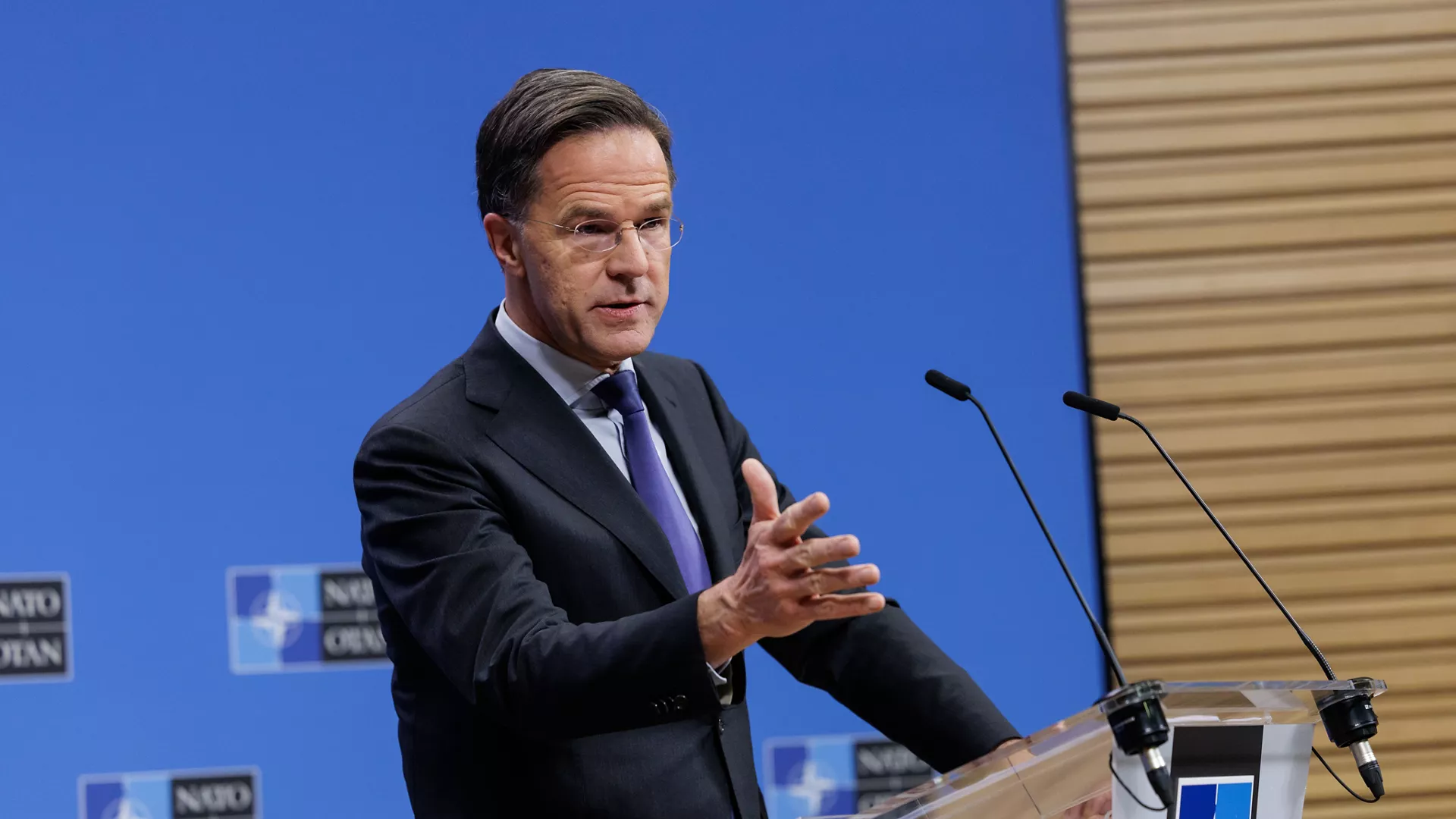


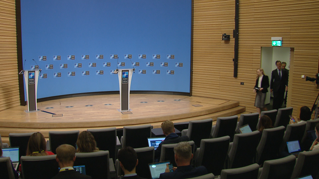
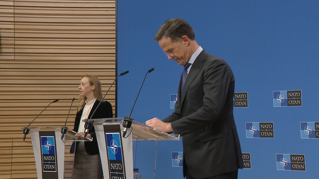
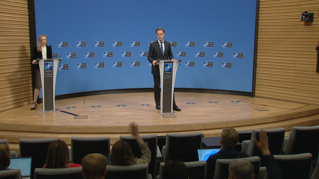
Press conference by NATO Secretary General Mark Rutte following the meetings of NATO Foreign Ministers
Press conference by NATO Secretary General Mark Rutte following the meetings of NATO Foreign Ministers
Press conference by NATO Secretary General Mark Rutte following the meetings of NATO Foreign Ministers
Press conference by NATO Secretary General Mark Rutte following the meetings of NATO Foreign Ministers
Press conference by NATO Secretary General Mark Rutte following the meetings of NATO Foreign Ministers
Press conference by the NATO Secretary General