Fermer
Retour
Accédez aux ressources médiatiques officielles de l'OTAN. Un contenu de qualité professionnelle, diffusé sur les dernières actualités. La référence pour les professionnels des médias.

Accédez aux ressources médiatiques officielles de l'OTAN. Un contenu de qualité professionnelle, diffusé sur les dernières actualités. La référence pour les professionnels des médias.
Désormais, vous pouvez télécharger des versions complètes ou partielles de nos vidéos depuis notre site Web.
Si vous souhaitez également vous abonner à la newsletter et recevoir nos dernières mises à jour, cliquez sur le bouton ci-dessous.
Entrez l'adresse e-mail avec laquelle vous vous êtes inscrit et nous vous enverrons un code pour réinitialiser votre mot de passe.
Le mot de passe doit comporter au moins 12 caractères, sans espaces, inclure des lettres majuscules/minuscules, des chiffres et des symboles.
Cliquez sur le bouton pour revenir à la page sur laquelle vous étiez et connectez-vous avec votre nouveau mot de passe.
26 avril 2018
3 MIN DE LECTURE

(As delivered)
Good morning.
NATO’s Foreign Ministers will meet tomorrow to prepare for the upcoming Summit in July.
We will begin with a meeting to discuss Russia.
For several years, Moscow has shown a pattern of dangerous behaviour.
This includes:
Russia also backs the brutal regime in Syria, which has repeatedly used chemical weapons.
It is also highly likely that Russia was behind the nerve agent attack in Salisbury.
NATO has responded with resolve and unity.
We have undertaken the biggest reinforcement of our collective defence since the end of the Cold War.
But we continue to see attempts to intimidate and interfere in Allied countries.
So we must continue to adapt to hybrid challenges.
And Ministers will examine what more we can do.
When tensions are high, it is even more important to talk with Russia.
So NATO remains open to meaningful dialogue.
We continue to work towards the next meeting of the NATO-Russia Council.
And our Supreme Commander for Europe, General Scaparrotti, met with the Russian Chief of Defence General Gerasimov last week.
They discussed military posture and exercises.
And how to increase predictability and transparency.
During the second session, we will discuss the situation in the Middle East and North Africa.
I expect that Ministers will address the situation in Syria, the Iran nuclear deal, as well as NATO’s plans to scale up training in Iraq.
We will be joined by the EU High Representative / Vice President Federica Mogherini.
Together we will discuss how NATO and the European Union could cooperate more closely to build stability.
We have seen too often how turmoil in this region can inspire terrorist attacks on our own soil.
And drive desperate refugees and migrants to our shores.
That is why NATO is stepping up efforts to train local forces to fight terrorism and keep their countries stable.
Last month, I saw for myself the valuable training work that our Alliance does in both Jordan and Iraq.
Building on these efforts, we will launch a new training mission for Iraq at our Summit in July.
Ministers will agree further details on the mission tomorrow.
We are currently planning for a training mission of several hundred.
They will train Iraqi instructors, and help build Iraqi military schools.
So that our expertise can reach thousands of others and help prevent the re-emergence of ISIS.
We will also discuss possible further support for Jordan and Tunisia.
Because stability in the region is vital for our own security.
We will also address Afghanistan.
We will focus on the prospects for peace and reconciliation.
We welcome President Ghani’s unprecedented offer of peace talks to the Taliban.
NATO has helped to create the environment for this to happen, with our practical and political support.
And we have renewed our commitment, including with significant troop increases and financial support.
We will close the Ministerial with a meeting on the Western Balkans and NATO’s Open Door policy.
NATO remains committed to the vision of a Europe whole, free and at peace.
We will discuss the progress made by
Bosnia and Herzegovina, the former Yugoslav Republic of Macedonia1, and Georgia.
Ukraine has also expressed its aspirations for membership.
And I expect ministers will want to address that too.
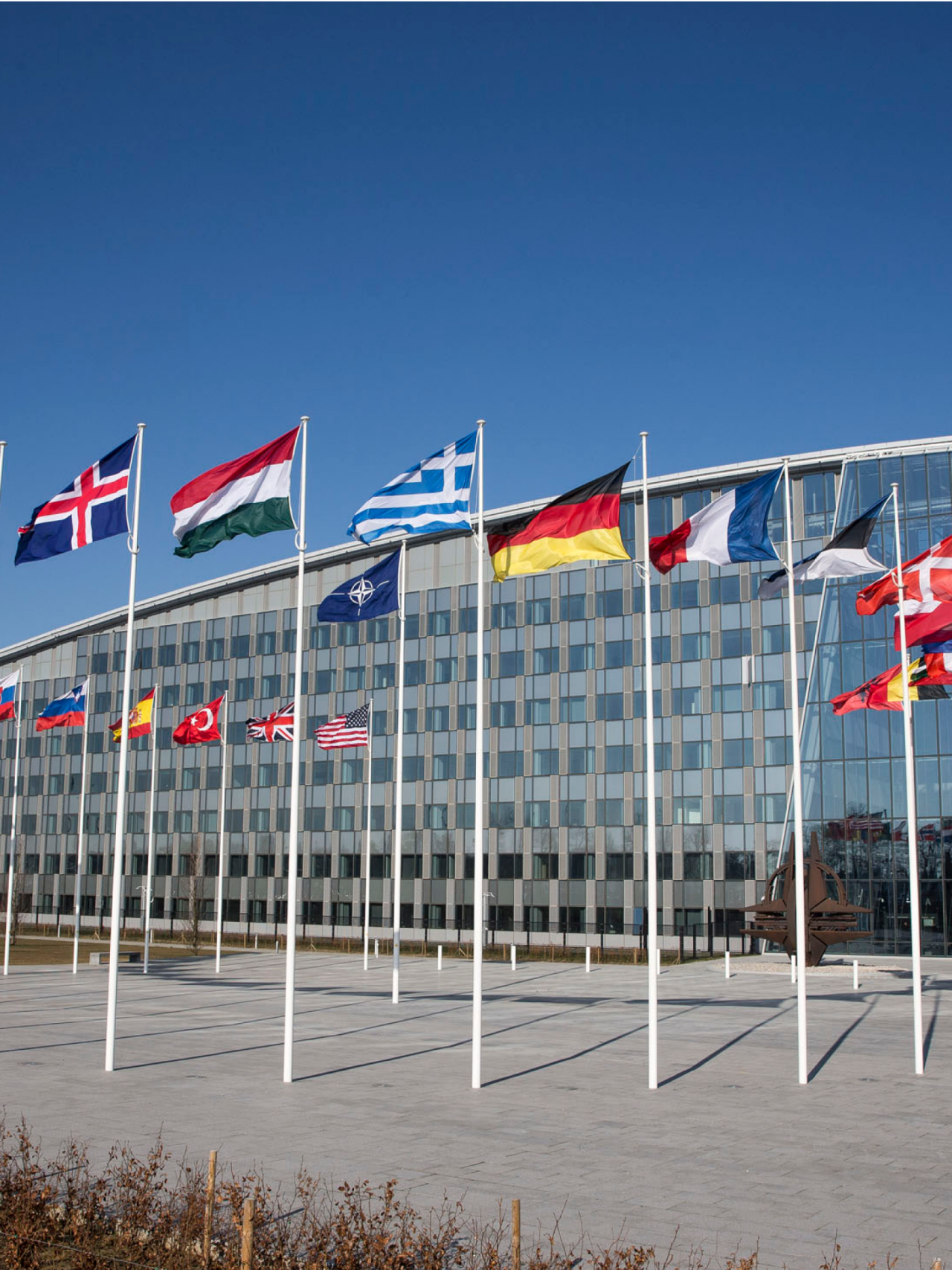
This will be our last meeting in this building − NATO’s headquarters for the past 50 years.
Since we have been here we have grown from an Alliance of 15 to 29.
When Allied Defence Ministers meet in June, we will gather in our new headquarters.
I want to thank Belgium for being our hosts and for all their support in creating our new headquarters across the road.
It is a new home for a modern and forward-looking Alliance.
And with that, I’m ready to take your questions.