Fermer
Retour
Accédez aux ressources médiatiques officielles de l'OTAN. Un contenu de qualité professionnelle, diffusé sur les dernières actualités. La référence pour les professionnels des médias.

Accédez aux ressources médiatiques officielles de l'OTAN. Un contenu de qualité professionnelle, diffusé sur les dernières actualités. La référence pour les professionnels des médias.
Désormais, vous pouvez télécharger des versions complètes ou partielles de nos vidéos depuis notre site Web.
Si vous souhaitez également vous abonner à la newsletter et recevoir nos dernières mises à jour, cliquez sur le bouton ci-dessous.
Entrez l'adresse e-mail avec laquelle vous vous êtes inscrit et nous vous enverrons un code pour réinitialiser votre mot de passe.
Le mot de passe doit comporter au moins 12 caractères, sans espaces, inclure des lettres majuscules/minuscules, des chiffres et des symboles.
Cliquez sur le bouton pour revenir à la page sur laquelle vous étiez et connectez-vous avec votre nouveau mot de passe.
Great to be here and to see so many people I know so well. And of course, Teri, who will lead us later in the debate. And of course, you, Madam President, dear Valérie, thank you for your very warm welcome.
And let me start by saying that it is always a pleasure to be on this side of town, to be at the European Parliament.
This is my first public speaking engagement this year, and it is very meaningful to have this conversation with you – with the members of parliament.
At the NATO Summit in The Hague last summer, we decided to make our deterrence and defence a priority.
We agreed a plan, as you know, to invest 5% of GDP annually in defence by 2035 – with 3.5% on core defence, and 1.5% on defence- and security-related issues.
Yes, that is a lot of money, but it is what is required to build our armed forces and buy the capabilities those forces need to protect us.
And here we are talking about battle tanks, fighter jets, ships, long range missiles, and ammunition, but also artificial intelligence, cyber-defence, space capabilities, and of course, much more.
In The Hague, we also agreed to speed up defence production and innovation.
And this is of course about re-energising our industries across Europe and North America so that they step up supply.
There are certainly business opportunities for our industries. But it’s more than that: there are real benefits for all of us. Because when supply goes up, the result is more security, more economic growth, and also many more jobs – the defence dividend.
The defence dividend is real.
I know – and you all know – that getting to this famous 5% and accelerating production requires hard work and tough decisions from all of us – all our nations and all your constituents.
But we need to do it. And we need to do it basically for two reasons.
One, because the security situation demands it. We need to be honest: the dangers we face are real, and the dangers we face are lasting.
Russia remains our most significant threat. Putin’s war machine is churning out military equipment around the clock. And Moscow is testing us through cyber-attacks, sabotage and more.
And there is no reason to believe Russia’s pattern of aggressive and reckless actions will change any time soon. On the contrary, Russia is seeking long-term confrontation.
And it is not alone. Russia is working with China, with Iran, and North Korea. And these countries fuel Moscow’s war against Ukraine. And together, they are attempting to undermine our stability and security.
At the same time, the threat from terrorism persists, and instability remains rampant in NATO’s southern neighbourhood.
The second reason why we need to deliver on the 5% is that the time when we conveniently let the United States carry the burden for our security is over.
The US is absolutely committed to NATO. But this commitment comes with a clear and long-standing expectation: that Europe and Canada take more responsibility for their own security. And I believe that is only fair.
So 5% must be the direction of travel.
There’s basically no time to waste.
Ensuring Allies step up and speed up efforts on defence will remain my – and NATO’s – absolute priority as we prepare for the next Summit, which will take place in Ankara, in Türkiye, in July.
Then Ukraine, which clearly is still a huge priority.
Because, as we all know, our security is inextricably linked to Ukraine’s security.
Just last week, I was at the Coalition of the Willing meeting in Paris, where leaders discussed how we can support and secure the future for Ukraine.
It was a constructive meeting, where we had concrete discussions on robust security guarantees for Ukraine, and where Europe and the US affirmed their readiness to provide such guarantees to secure Ukraine after a peace deal with Russia.
Meanwhile, NATO continues to support Ukraine every day, and we do that in various ways, including through the PURL initiative, which supplies vital US equipment, including air defence – which is particularly vital these days – for Ukraine to protect its people and hold the front line, paid for by Allies.
Regardless of when this war ends, our support to Ukraine will continue to be important to ensure a lasting peace. After all, the Ukrainian Armed Forces will remain the first line of defence.
Supporting Ukraine and keeping our own people safe is not a job that NATO does alone.
It is a team effort. And the European Union is an essential player.
The partnership between NATO and the EU is growing stronger every day.
And that is exactly what we need.
Because, when we combine our strength, of NATO and the EU, we can more effectively tackle the many challenges we face.
And as you know, 23 nations, members of the EU, are also Allies in NATO.
And working together, we keep Ukraine strong today and able to defend itself against any aggression in the future.
And working together, we can produce more defence capabilities, and we can produce them faster. We can innovate better and outsmart our competitors.
Now is not the time to go it alone. And it’s not the time to create barriers between us that would increase costs, complicate production, and hamper innovation.
Instead, we need to leverage our respective strengths even more.
NATO is strong at standard setting and capability targets that are informed by our defence plans. NATO has a strong command and control force structure. And the European Union has all the tools of the internal market at its disposal, and of course the convening power to bring together the Member States in the EU, so to make sure that the money is there to invest in defence.
So we complement each other.
And yes, it is undeniable that Russia, China, North Korea, and Iran are aligning more and more. And they’re challenging us.
But they are only starting to understand what partnership really means.
We are miles ahead.
We can build on decades of friendship between our organisations and between our nations on both sides of the Atlantic.
And we can build on the growing partnerships with countries around the world.
And that is an incredible advantage. Let’s ensure we retain it.
I’ll certainly play my part. And I count on you – and I know I can – to play yours.
So thank you very much, and I look forward to our discussions.
Teri Schultz, moderator – Okay. So Mr Secretary General, I know things - some things - are going well for you, and I would just point out I've covered NATO almost 20 years, so we're kind of the same in that we kind of just hang around and keep our jobs and hope for the best. But - you know I have to ask this - you mentioned, ‘don't go it alone, don't create fractures where none are needed’, we cannot avoid the question, the problem that has been created with President Trump's claims on Greenland. The Greenlandic government yesterday stated again, they want their security to be determined by NATO, to be inside NATO, so this is going to be on your plate - even if you wish it weren't.
And you said yesterday that it is not a crisis, so I would like to know what word you would use to describe what's happening now, and how you can possibly explain that security inside the Alliance is enhanced in any way by the US claims that they need to own Greenland, not just maybe boost their presence, but actually own the island. Can you just unpack that for us? It's really what's on everybody'sminds here
Mark Rutte, NATO Secretary General - Well, let me start by saying that it was Donald Trump, the American president who already, when he was Trump 45 - so his previous presidency between 2016 and 2020 - was making us aware collectively of the need to protect the High North and the Arctic. As you know, we have eight High North countries in the Arctic. One is Russia - outside NATO, and seven are inside NATO - that's Canada and the US, and then in Europe, it is Denmark through Greenland, and Iceland, Finland, Norway and Sweden.
These seven countries are basically bordering on the Arctic, and it was President Trump, in his first term, as I said, who basically alerted us to the fact that sea lanes are opening up, that Russia and China are more active, and that you have to do more there together. We had a very good discussion in NATO. It was around summer. We are now taking next steps to build on that, because we all agree - in NATO - we all agree that when it comes to the protection of the Arctic, we have to work together, and that's exactly what we are doing.
Then, of course, I'm never commenting when there are discussions between Allies. That's not up for me to comment on, but I can assure you that there is complete agreement that when it comes to the assessment of the urgency of the security situation, not only in the Baltic Sea, not only on the eastern flank, but also in the Arctic and in the southern neighbourhood obviously also, but now concentrating on the Arctic, we all work together.
Teri Schultz, moderator – Okay, but I really asked about Greenland specifically. Is there any single Ally who would support the US forcibly taking Greenland?
Mark Rutte, NATO Secretary General - Again, what we are discussing here is to make sure that the Arctic is safe, that we have seven countries working together, including the United States, so we came together in NATO, in the North Atlantic Council. As you know, we work together as the ambassadors, and sometimes it is in the formation of foreign ministers or defence ministers or the leaders when it is a Summit - we call that the North Atlantic Council, a bit like you have the European Council in Europe. The North Atlantic Council came together at the level of the ambassadors and decided that we have to step up collectively, we all agree on this, and when it comes now to the next steps. You all also all agree that we have to take those next steps, and we are working on that diligently at the moment.
Teri Schultz, moderator – And Denmark did this. I mean, over the last year, it spent 14 billion additional dollars, including on defence for Greenland specifically. It has enhanced its missile defence, it's got new Arctic vessels, it's really spent a lot of money and put a lot of time, perhaps acknowledging that it should have been done earlier. You know, this is something that Allies can agree on, but I still have to come back to the point, how would Arctic security be enhanced if the US invaded Greenland?
Mark Rutte, NATO Secretary General - But again, and therefore, my role is to make sure that the Alliance as a whole is doing what is necessary to keep the whole of the Alliance safe. And you're totally right on Denmark. Denmark is investing in Boeing P-8s, Denmark is investing in long-range drones -
Teri Schultz, moderator – They’re the surveillance planes for those non-NATO people.
Mark Rutte, NATO Secretary General - Yeah, they are also investing in more F-35 and they're investing in air-to-air refuelling and all these capabilities you need, not only to keep Denmark safe, to keep NATO as a whole, safe, but also to make sure that when it comes to the Arctic region and - for them, of course, a special priority when it comes to Greenland - to stay as safe as possible. But again, I never comment when there are discussions between Allies.
Teri Schultz, moderator – I know, I’m doing my best.
Mark Rutte, NATO Secretary General - So we agree, but I can tell you that when we talk about the security of the Arctic region, there is no disagreement within the Alliance when it comes to that issue, and that is not only pertaining to the seven who border on the Arctic, that's also true for other Allies who are very much involved here. You have seen comments from the Brits and from the Germans, who all want to help here to make sure that the Arctic region that is US, Canada and Europe stays safe.
Teri Schultz, moderator – Well, I was just going to follow up if you wanted to make any announcement that there's going to be something like an ‘Arctic Sentry’ mission, it would be a good place to do it. You know, you had Baltic Sentry, Eastern Sentry, when the need was acute. I mean, do you expect, or do you expect ‘Arctic Sentry’ or ‘Greenland Sentry’ to be stood up?
Mark Rutte, NATO Secretary General - What I expect over the coming weeks is discussions how we will take the next step, and the next step has to be about, given the fact that we come to the same analysis, all NATO Allies, and had a very good discussion on this around summer, we had a first debate again. It was now, I think, last week in the North Atlantic Council on what the next steps should be, and we are now working on that with all Allies involved, particularly of course, the seven who are bordering on the Arctic.
Teri Schultz, moderator – I'm not allowed to take all the questions for myself, because I would, but I do have to open to discussion and hopefully some of them will follow up on some of this. And when I call on you, please stand up because I don't know where everyone is sitting that is going to get a question. First MEP, is Dan Barna - there you go, Dan. And we have the Secretary General until four o'clock, he's given us some extra time, so let's do our best.
Dan Barna, MEP - Thank you, thank you, Mark. Thank you, nice to see you here. Following the January 6 summit you have mentioned in your speech, how does NATO assess the genuine credibility of security guarantees that rely primarily on European force projections without direct troop commitment of the United States? Specifically, does shifting the burden of enforcement to a coalition within the Alliance risk creating a two-tier NATO that emboldens Russia to test these new boundaries? This is the first question.
The second one is something on everyone's lips. We hear about NATO's future and the role in academia, in media, and, of course, in politics. I grew up in Romania when NATO was just a dream and then became a reality, and now I see doubts and fears cast shadow on this reality. So allow me to be very blunt - are you the last Secretary General of NATO?
Teri Schultz, moderator – So you thought I would be provocative.
Mark Rutte, NATO Secretary General - I was not planning to quit already, but I'm sure there will be a successor someday. I have no idea, by the way, how long I will be in this job because nobody told me, but -
Teri Schultz, moderator – And you never know, as we saw with Stoltenberg.
Mark Rutte, NATO Secretary General - You never know. And there needs to be unanimity on a successor, but I never got a contract or whatever, so I have no idea for how long I have been appointed. But I was thoroughly enjoying the role and the job, and I feel it's really important, and there is a lot of support, not for me personally, that's not important, but for the collective endeavour as NATO. And I'm so happy - you're from Romania and what you just mentioned - and I think it is totally true that NATO is crucial. Can we only, I mean, I was born in 1967 and I was raised with the idea that Nicolae Ceausescu would forever rule Romania. Now Romania is in the EU, Romania is in NATO. These are some of the big events of history, let’s never forget what we collectively went through and how important that is.
, NATO is strong, and I think because of the decisions in The Hague during the NATO Summit, it is even stronger, because finally now we have decided to spend what is needed to protect ourselves based on an assessment of all the defence needs we collectively have. And by doing that, we are also equalising our spending with the United States, which was, since Eisenhower, a debate, the fact that US was spending so much more than the Europeans and the Canadians, and now we are equalising - I think that's great news.
On your first question, it is a little bit different. When you look at the meeting in Paris last week, what came out of that meeting is a three-level approach when it comes to security guarantees for Ukraine. Level one is the Ukrainian armed forces. They will be, of course, the first line of defence, as in every country defending themselves.
The second element of security guarantees will be what is called the Coalition of the Willing, being brought together by Keir Starmer and President Macron of France, Emmanuel Macron. Many countries working together, providing security guarantees for Ukraine, including training the Ukrainian Armed Forces and whatever is necessary to make sure that Ukraine can defend themselves.
But there is a third element, and the third element is the United States. The United States is now completely involved, and that involvement of the United States in securing the security guarantees is really extremely important. So that means that you now have a package in place which is almost done - we have to nail the final details - but that will provide a situation where, if Russia would ever think of attacking again, post a long-term cease fire or a peace deal, they will only think of this a couple of minutes and then let go, because they know the situation has changed dramatically since Minsk, and the reaction will be devastating. They will not do it.
Teri Schultz, moderator – Okay, all right, take a drink of water because I'm calling on a Danish MEP, Stina Bosse.
Stina Bosse, MEP - Thank you very much, and thank you for being here with us today. And allow me to address you as the guy who's looking after all of us. And I just want you to notice, and I'm sure you have noticed it, because it's been all over the place that the people of Greenland - it's 56,000 people - are scared stiff. They're stressed, and they're more than just worried. You have put now also out there all the truths about ‘Denmark has invested, we are all part of NATO, we are all talking together,’ and yet we have already an agreement. It's from 1951 - you know that as well - between Denmark, the Kingdom of Denmark, and the US, allowing the US to deploy all the military forces they want. They had more than 1000, now they have 200.
There are not one single Chinese or Russian ship around Greenland - let that be stated as a fact. And there are, of course, also now conversations going on to try and make this go in a direction where we as Allies - and I and my country and all the people in Greenland - strongly believe that we are Allies and that you are there to protect us, but please give us an indication of what can this Alliance do if two parts, two countries within the Alliance, cannot agree? Thank you.
Mark Rutte, NATO Secretary General - Thank you so much for that very well put question. But you have to respect the fact that when there are discussions between Allies, my role has to be to make sure we solve issues. And when it comes to the protection of the High North, that is my role. I can never comment on that, that's impossible in public. And what I am doing, and with the US and Canada and all our Allies in Europe, is to make sure that we not only concentrate about Greenland, this is an issue about the High North, this is an issue about the Arctic territory.
Let’s not be naïve, even if there are not that many ships sailing at the moment, we know that with the sea lanes opening up in the High North and the Arctic - and this is not only true for Greenland, this is true for the whole Arctic area - it's not only Russia active there, it is increasingly also China being active there. So, when it comes to the Arctic region, we have to work together as an Alliance. And that is exactly what we are doing. And we are now putting more details to the next step to make sure that we indeed can do that as a collective Alliance. You can be sure of that.
Teri Schultz, moderator – But is it, sir, is it unthinkable, unimaginable - the words we used to use - that one Ally could take up arms against another inside NATO?
Mark Rutte, NATO Secretary General - Again, my role as Secretary General, I'm very clear - I never, ever comment when there are discussions within the Alliance. We have discussions between Greece and Türkiye. We have had discussions between other Allies, what you then will see all my predecessors do – and myself – is never comment on that in public. You work behind the scenes. And when it comes to the issue at stake here – and I believe there is a bigger issue at stake here – and that is the defence of the High North, the defence of the Arctic area. There, you can be sure that we do everything to protect the whole of the Alliance. That's my role: to keep 1 billion people safe. And that is not only the eastern flank and the US and the southern flank, that is also the Arctic area.
Teri Schultz, moderator – You might want to take another drink, because I'm calling on Andrew. Andrew Gray from Reuters, please stand up. He's way in the back, he's back there - you know him. There he is.
Andrew Gray, Reuters - Thank you. Andrew Gray from Reuters. Secretary General, I will keep this one short. I'm not asking you to comment on specific discussions, as you've already made clear that you won't do that. But in general, is it acceptable for one NATO Ally to threaten the use of force to take the territory of another?
Mark Rutte, NATO Secretary General - I think it's the same question in another - so I refer to the previous answer.
Teri Schultz, moderator – Oh, that was it? Okay. All right. This is going well. Okay, next on my list is Malik Azmani.
Malik Azmani, MEP - Yes. Well, dear Mark, it’s quite strange, of course, to put also questions because we have, of course some…
Mark Rutte, NATO Secretary General - We are party colleagues, so I planted this question.
Teri Schultz, moderator – Fair enough, then, I planted Andrew. We’re even.
Malik Azmani, MEP - When you hear the question Mark, it could be that people are thinking it because I want to touch on other subjects, and that is the situation in Iran. I would like to ask you about the shocking situation. Of course, what we see with peaceful protesters are facing violent crackdowns. People are dying. And the only thing what they want is freedom. And I was wondering, how do you assess the current situation in Iran? What is your take also on the ongoing protest? Thank you.
Mark Rutte, NATO Secretary General - Thank you for that question. And of course, as NATO we concentrate on the North Atlantic area. But let me try to answer the questions, despite the fact that it’s outside NATO territory. Because I think - and I hope we all agree - that what is happening in Iran is repellent. What the leadership is doing against its own population. People protesting peacefully to make their views clear. Let's not forget, democracy is not only parliaments. Yes, parliaments are very important, I can tell you. But it is not only parliaments.
Democracy is parliaments plus free media, plus the right to protest, and to make your views known. And this oppressive regime in Tehran is now applying massive force and massive violence against its own population. There are many reports of many people dying; I find it repellent. I can assure you that NATO Allies are day-in, day-out navigating this crisis, in constant touch on this. But I think we can all agree that we wish the best for Iran and particularly not for the leadership, but for the Iranian people.
Teri Schultz, moderator – Okay, I'm going to go back to the journalist row. Mina from LIGA in Ukraine. I can’t - it’s very hard to see out there - sorry. Stand up please, Mina.
Milana Holovan, LIGA.net - Thank you so much for this opportunity. Milana Holovan from Ukrainian media outlet LIGA.net. Secretary General, after the Oreshnik ballistic missile hit on Lviv, the fire was visible near the Russian border. If Russia attacks, with the same missile, NATO territory tomorrow, will NATO respond?
Mark Rutte, NATO Secretary General - Yes, but we also respond now. Because this is already terrible. These Oreshnik missiles are weapons of death and destruction. And we have seen this now when they were used on Lviv the other day, and I find this terrible. We have seen last night again, hundreds of drones and tens of missiles hitting Ukraine, and particularly now hitting the civilian infrastructure, innocent civilians. This has nothing to do with the combat on the front line. This is just creating panic and death among the general Ukrainian population. And it is evidence of the atrocities the Russians are willing to go to.
So that is why I'm so inspired to try to do everything to make sure you guys have the interceptors necessary to take out the missiles wherever you can. And please also here to the parliamentarians - work with your governments to dig deep in your stockpiles and to find the necessary interceptors for Patriot systems, for NASAMS systems, for SAMP/T systems because they are urgently needed by the Ukrainians.
This is why I agreed with President Trump on this PURL initiative in July. Because, yes Europe has a lot. But after three, four years of war, a lot of the stockpiles in Europe have been depleted, so we have to rely more on what is still in the stockpiles in the United States. And there's still, luckily, a lot left there and that's crucial for Ukraine, paid for by European and Canadian Allies. That's this PURL initiative. This is why we are doing that, because your fight is our fight. You have to survive this war. And we have to make sure that we can end this war as soon as possible and get to a full peace deal – or if necessary, a long-term cease fire – and to stop the fighting and the killing.
By the way, let's not forget that the Russians at the moment are losing massive amounts of their soldiers thanks to the staunch Ukrainian defence. In a month, this is 20,000 to 25,000 Russians dead. I'm not talking seriously wounded. Killed. Dead. 20,000-25,000 a month. When you compare that to the Afghan war in the 1980’s, they lost 20,000 in 10 years. Now they lose these amounts and more in one month. So that's also unsustainable on their side. But you can be sure that is why I'm so much motivated to work with President Zelenskyy and European, Canadian, and US Allies to make sure you've got what you need to keep yourself strong in the fight, but also strong at the negotiating table.
Teri Schultz, moderator – Mr Secretary General, does Ukraine need to win the war, not just survive it?
Mark Rutte, NATO Secretary General - When you look at the moment, I think we have to bring Ukraine to a place where the President knows that security guarantees are in place, that the Russians will never attack again. But that then will lead to a very sensitive discussion about territory. And a sensitive discussion about territory is something only the Ukrainian people can decide. That's not for me to decide, but for the Ukrainian President and Ukrainian leadership to be able to strike a deal one day with the Russians hopefully – if the Russians come to the table and are willing to play ball, which they are not at the moment.
Their reaction to the meeting in Paris was this Oreshnik missile, you could argue. So, they are clearly, at this moment, not serious about negotiating. But we have to make sure the moment that these talks start, that the Ukrainian leadership has the guarantee that the security guarantees are in place so that the Russians will never try to attack again.
Teri Schultz, moderator – Okay, I have three more MEPs and eight minutes, Hilde Vautmans. I don't usually like your short answers but this time it's working out.
Hilde Vautmans, MEP - Thank you very much, and good to see you here Mark. Secretary General. [Translated from Dutch] It's great to see you here. I must say that as a Dutch leader, you did dare to say more. I will continue to try to convince you to answers the questions here, because that's the role also of the Parliament. We in this Parliament are very worried by some declarations of the US President, I cannot repeat them here, but we are very worried. The European citizens ask us really ‘take care of our security’. Stine [Bosse] told you, ‘You’re the man we rely on for our security.’ But I think we should rely more on European security, on European countries who work together. Because you say, ‘invest 5%.’
But if countries will do that at the same way they're doing, I don't think it will help a lot. So, my question is very open and clear, how do you work towards a European pillar in NATO? How can we do that? Because European citizens ask us that, ‘be strategic autonomous.’ And personally - and my colleagues know that, I even go a step further - I really want a European army, and that's also what the citizens want in the future. But help us to create that European pillar, and what can we do in this Parliament to help you to create that in NATO? Thank you very much, Mark.
Mark Rutte, NATO Secretary General - Good to answer that question, but I am afraid I do not completely agree with the assessment or the solution. But you want to be straightforward, so let me be straightforward, as we always do. So, first of all, let's not forget that in Europe, we reaped a peace dividend after the fall of the Berlin Wall, which was too big in hindsight, and therefore we have underinvested in our European armed forces. This is true for basically every European country, except maybe for Poland and the Baltics. That's fact number one.
Fact number two is that I strongly believe that the transatlantic relationship with the United States, with Canada, is crucial, not only today, but also long-term. And by the way – and here I'm going to defend President Trump – I am absolutely convinced who is here from Spain, who is here from Italy, from Belgium, from other countries not nearly at 2% at the beginning of last year, all these countries have now reached 2%. Do you really believe you would have done that if Trump would not have been elected as President of the United States? No way you would have done that. And you had to do that, not because of Trump, but because of your own security.
Then, at The Hague Summit, do you really believe without President Trump, we would ever have agreed to spend, in 2035 with a credible path together, 3.5% on core defence, 5% on overall defence, if he would not have been elected? No way we would have done it. And we have to do it, not because of President Trump, but because, based on the analysis of our security and our defence plans, this is the minimum amount we need to spend to make sure we stay ahead of the Russians, we stay ahead of the Chinese and stay ahead of the Chinese, the Russians, Iran and North Korea working together.
So I'm fine with everybody criticising leaders within NATO, that's democracy. But I would just ask us to concentrate on the facts, and the fact says that without President Trump, we would have not taken those decisions. These eight, nine countries, not on 2%, on 2% late last year, and the whole of the Alliance committing to 5% defence spending, I would say that is thanks to President Trump. And I know you will all hate me now saying this, but this is what I believe, and I'm going to repeat it. And that's why we need a transatlantic relationship.
And then on Europe, Europe is crucial. When I came in, I visited Ursula von der Leyen, and we had a meeting, and it was fantastic, because she was a defence minister before. She knows everything, and she knows exactly the division of labour. That NATO is good at command and control and standards and capability targets, and that the EU has the convening power, the power to get the (€)800 billion and the (€)150 billion for SAFE, but also when it comes to the internal market, all the soft power the EU can muster, why we have the European Union. And that working together is a very strong formula.
So, if we are going to repeat structures, command and control structures, and you have a whole hierarchy of European generals, we find it difficult today to fill all the senior officer positions within NATO, if you then have to replicate that on the European side, forget that you can ever do that. And the Russians will love it, because it is more complexity on our side, more time to debate, more discussions, whilst they try to attack us. And let's not forget, our security services are telling us that by ‘27, ‘29 or ’31, the Russians are ready to try something against us. At least they have the capability to do it.
And my worry is, if China would move on Taiwan, they will never do this alone. They will always force their junior partner, being one Vladimir Putin in Moscow, to move against us. And we have to be ready. And I would say, let's be thankful for what Trump did, really encouraging us, maybe even stronger than encouraging us, to get to this 2%. For Belgium, (€)4 billion more than what you guys spent at the beginning of the year thanks to Theo Francken and Bart De Wever and the coalition ruling Belgium at the moment. This is great news.
Teri Schultz, moderator – Okay, I've got two more. Marie-Agnes Strack-Zimmermann, and Nathalie Loiseau is going to ask as well. Sorry, can I take you two together because we've got a couple minutes?
Mark Rutte, NATO Secretary General - We’re running a bit late, but I’m fine with 10 minutes more.
Marie-Agnes Strack-Zimmermann, MEP - Okay, welcome on this side of the town. Tell your people in NATO, we are not far away from NATO, so they are all welcome.
Mark Rutte, NATO Secretary General - It is a 20 minutes drive.
Marie-Agnes Strack-Zimmermann, MEP - Okay, yes, just, just a question, coming back to Greenland. In September, there was a NATO exercise, Arctic Light, and we were observers. With some colleagues we travelled to Greenland, but without the US. Why? Because we are, I hope so, still partners.
Mark Rutte, NATO Secretary General - But here, of course, the Danish question was interesting, referring back to the 1951 treaty between Denmark and the United States. I think you said over a thousand. I believe the US had, at one point, thousands of Americans present in Greenland. At the moment, it's 150 on a rotational basis. And Denmark is completely relaxed about the fact that the US might, in the future, have much more presence in Greenland than they have at the moment.
Teri Schultz, moderator – Which begs the question of why Trump is making these threats.
Mark Rutte, NATO Secretary General - And that is why I tell you that it is so good that as an Alliance, we not only concentrate on Greenland, we concentrate on the whole of the High North. Because this is not only Greenland, this is also Iceland, this is Finland, this is Norway, this is Sweden, this is Canada, this is the United States. This is making sure that the whole of the Arctic area is safe. And we always look at the map, of course, the Mercator map, as we have it since 1600s, as we see it. But when you look at from above, you can see the threats which might emerge if the sea lanes open up in the coming years.
Teri Schultz, moderator – Okay, she's not happy with that, but we're running out of time.
Mark Rutte, NATO Secretary General - I cannot leave this room if you're not happy, that's the deal.
Marie-Agnes Strack-Zimmermann, MEP – Sorry, just - I asked why - where were the United States in September during this exercise?
Mark Rutte, NATO Secretary General - Yeah, but not in all exercises all nations always participate. But US is really very active in many exercises in Europe and, of course, in NATO territory.
Teri Schultz, moderator – All right, Nathalie, it's up to you.
Nathalie Loiseau, MEP - So I'm not going to torture you, Mr. Secretary General, about Greenland or about Donald Trump. I want to tease you about something that's happening within NATO under your leadership. Before, there was a strong commitment of NATO to fight against FIMI - disinformation, information manipulation. I haven't heard, or I haven't noticed, that FIMI are decreasing worldwide, coming from Russia, but also from other nations like Iran or China.
Teri Schultz, moderator – So Nathalie, foreign interference and manipulation?
Nathalie Loiseau, MEP – Yes. So why on earth is NATO decreasing its efforts to fight against information manipulation right now?
Mark Rutte, NATO Secretary General - Well, let me tell you. What we are doing is mainstream all this work, basically when it comes to hybrid, cyber, misinformation, everything, we have mainstreamed this because, as an Alliance – and this is true for each of the individual Allies, it's also true for the Alliance as a whole – we have to step up and to make sure that when it comes to cyber, hybrid, etc, we have to be the best in class, and that's exactly what we are doing. Of course, the Russians love us to talk about that, so I don't do this the whole day, but I can assure you that all Allies are working at this extremely hard to make sure we not only can defend ourselves in the conventional way, but also when it comes to this broader hybrid and cyber domain.
Teri Schultz, moderator – And can you assure everyone that despite the reorganisation at NATO Headquarters, that this is has not been kicked down the priority list?
Mark Rutte, NATO Secretary General - What we have done in the reorganisation at NATO Headquarters is we have mainstreamed everything, because what I always hated when I was in national government, that you would have one minister responsible, for example, for women affairs or for some other specific issue, and then the rest of the cabinet would say, ‘Yeah, but he or she is responsible for this, so we don't have to care’. And what we have done in the reorganisation is to mainstream all these activities and work strands.
Teri Schultz, moderator – Because the cognitive domain is definitely a warfare domain these days.
Mark Rutte, NATO Secretary General - It is all interlinked, so you cannot separate the one from the other.
Teri Schultz, moderator – All right well this is - I'm getting the signal that I have to wrap up. Thank you so much for the extra time, Mr. Secretary General. That was really a treat. And I think this was really a conversation that we needed to have to start off 2026, everybody's wondering about this, and Valerie is going to come back, yes, and I'm going to let you go.


![[from left to right] Valérie Hayer, President of the Renew Europe Group, NATO Secretary General Mark Rutte, Roberta Metsola, President of the European Parliament, and Malik Azmani, Member of the Bureau of the Renew Europe Group](https://s7g10.scene7.com/is/image/ncia/20260113_event-sg-renew-europe_0020:16x9?fmt=webp-alpha&qlt=80 "NATO Secretary General addresses the Renew Europe Group")
![[from left to right] Valérie Hayer, President of the Renew Europe Group, NATO Secretary General Mark Rutte, and Roberta Metsola, President of the European Parliament](https://s7g10.scene7.com/is/image/ncia/20260113_event-sg-renew-europe_0022:16x9?fmt=webp-alpha&qlt=80 "NATO Secretary General addresses the Renew Europe Group")
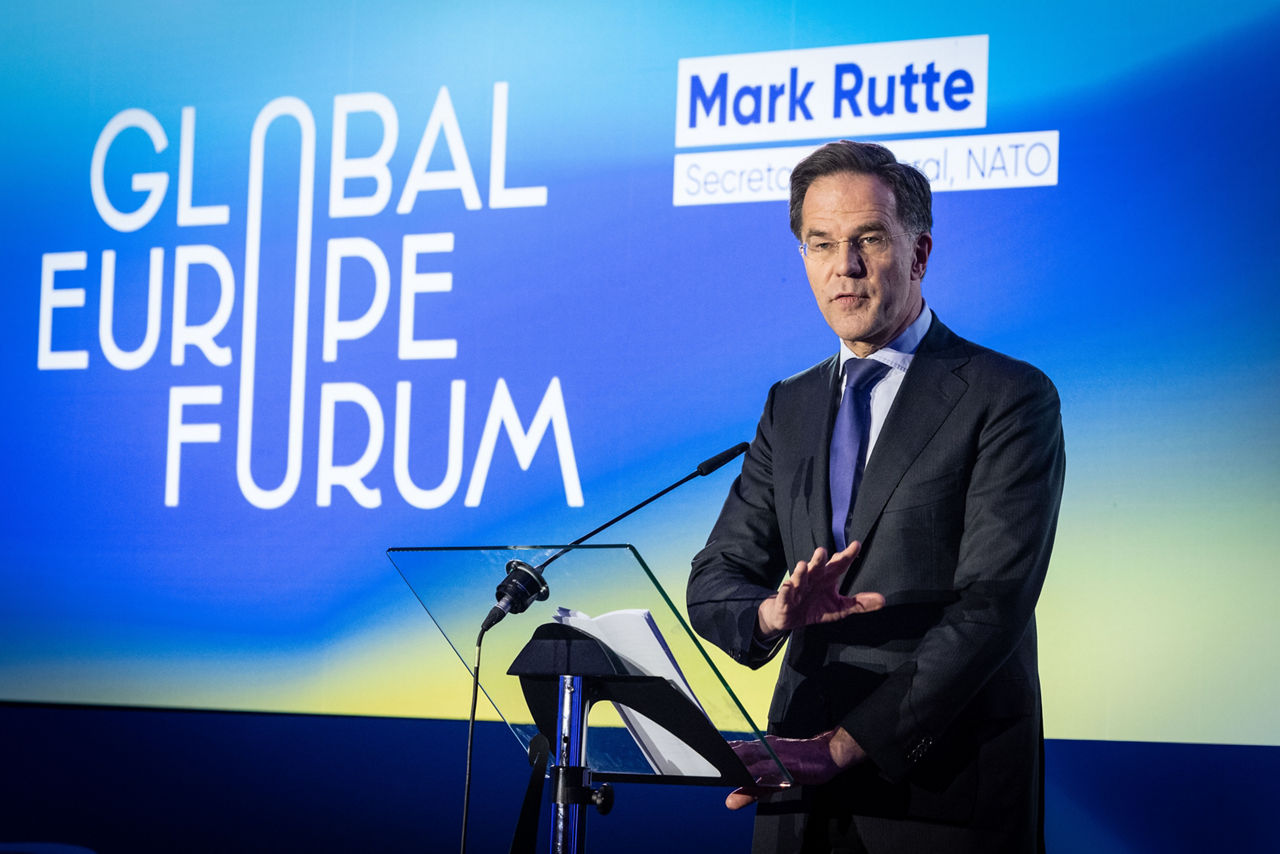
NATO Secretary General Mark Rutte addresses the Renew Europe Global Europe Forum 2026 at the European Parliament
NATO Secretary General Mark Rutte addresses the Renew Europe Global Europe Forum 2026 at the European Parliament
NATO Secretary General Mark Rutte addresses the Renew Europe Global Europe Forum 2026 at the European Parliament
[from left to right] Valérie Hayer, President of the Renew Europe Group, NATO Secretary General Mark Rutte, Roberta Metsola, President of the European Parliament, and Malik Azmani, Member of the Bureau of the Renew Europe Group
[from left to right] Valérie Hayer, President of the Renew Europe Group, NATO Secretary General Mark Rutte, and Roberta Metsola, President of the European Parliament