Fermer
Retour
Accédez aux ressources médiatiques officielles de l'OTAN. Un contenu de qualité professionnelle, diffusé sur les dernières actualités. La référence pour les professionnels des médias.

Accédez aux ressources médiatiques officielles de l'OTAN. Un contenu de qualité professionnelle, diffusé sur les dernières actualités. La référence pour les professionnels des médias.
Désormais, vous pouvez télécharger des versions complètes ou partielles de nos vidéos depuis notre site Web.
Si vous souhaitez également vous abonner à la newsletter et recevoir nos dernières mises à jour, cliquez sur le bouton ci-dessous.
Entrez l'adresse e-mail avec laquelle vous vous êtes inscrit et nous vous enverrons un code pour réinitialiser votre mot de passe.
Le mot de passe doit comporter au moins 12 caractères, sans espaces, inclure des lettres majuscules/minuscules, des chiffres et des symboles.
Cliquez sur le bouton pour revenir à la page sur laquelle vous étiez et connectez-vous avec votre nouveau mot de passe.
31 mai 2016
9 MIN DE LECTURE
(As delivered)
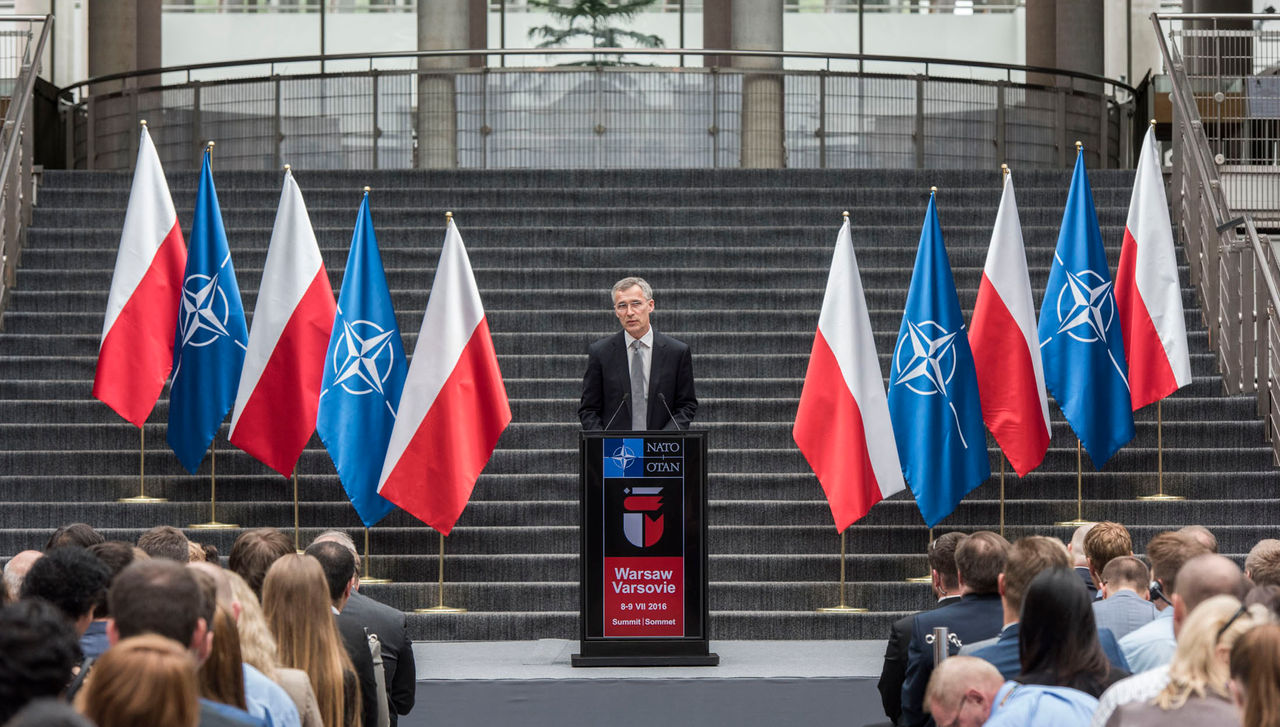
Good morning, it’s good to see you all here this morning, and I’m looking forward to speak to you and I’m also looking forward to answer your questions afterwards.
But let me start by thanking for the kind introductions. And also to thank you Professor Palys for the invitation to speak to this audience today. And I would also like thank Dr. Debski and his colleagues at the Polish Institute of International Affairs for the work they do in cooperation and in partnership with NATO.
And I’m also very much looking forward to speak to your experts at the prestigious Experts Forum which you are co-hosting with NATO in connection with and on the margins of the NATO Summit in July. So thank you once again for inviting me here. And then I will address all of you, guests, professors, students. And I’m looking forward to speak to you because we are facing a new and more challenging security environment and therefore it is important that we keep the debate going on on how we can develop, how we can strengthen NATO in response to a more challenging security environment.
And for me it’s very natural to do that at this university because this year Warsaw University celebrates its 200th anniversary.
And this great institution’s long history reflects Poland’s turbulent past.
Occupiers have turned it, at different times, into a medical school, an Imperial University, and even a military barracks.
And when martial law was declared in the early 1980s, brave members of the academic staff organised an underground university.
At great risks for themselves.
The University library opened in 1999.
The very same year that Poland joined NATO.
Since then, Poland has made extraordinary progress.
Over the past seventeen years, Poland has evolved from a new Ally into a leading Ally.
This evolution is testament to the transformative powers of the Open Door of NATO, and of EU enlargement.
But it owes most, of course, to the commitment, determination and hard work of the Polish people. And of successive Polish governments.
At NATO, that commitment takes many forms. Including the most precious.
Over the years, 40 Polish soldiers have given their lives serving under a NATO flag in Afghanistan. Their sacrifice will never be forgotten.
As Secretary General of NATO, I have a close political relationship with Poland.
But I also have a personal relationship with your country.
When I was a child, I remember my grandfather telling me about his time in a German prisoner of war camp in Poland.
My father visited Poland frequently during the 1970s and the 1980s as a Norwegian politician.
He met secretly with representatives of Solidarnosc on several occasions – providing political and financial help.
He went on to become a strong advocate of NATO membership for Poland and other countries of the former communist bloc.
And I, as a young activist, was one of many in Western Europe who supported Solidarnosc and political prisoners in Poland during the 1980s. And I as a young politician in Norway had also then strong relationships with Poland.
So it was natural that I, when I became Secretary General of NATO, to make my first visit to Poland, in my very first week in the job, and I have also visited Poland later. I came again last summer.
To see the first military exercise by our new high-readiness Force.
And, today, I am here to meet with the President and members of the government.
To discuss the preparations for NATO’s Summit, here in Warsaw, just in a few weeks.
At the Summit, NATO’s leaders will come together to agree on the Alliance’s future direction.
I often think about the sacrifices my grandfather’s generation made in service to a greater good. What they went through is a powerful reminder of the importance of collective security and the need to prevent war.
It is also a reminder of NATO’s essential role in continuing to keep the peace. And our nations safe. That is why the upcoming Summit is so important.
It will take place at a critical moment for our Alliance. A moment where our security and our values face significant challenges.
Challenges both from the east and from the south.
To the east, we see Russia’s illegal annexation of Crimea.
Its continuing actions against Ukraine.
And a significant build-up of its military forces – stretching from the Barents Sea, to the Baltic and the Black Sea, and the eastern Mediterranean.
To the south, turmoil across the Middle East and North Africa has unleashed the biggest migrant and refugee crisis in Europe since World War Two.
We see other threats that have no respect for territorial borders. Terrorism. Cyber-attacks. Nuclear, and ballistic missile proliferation.
To carry out NATO’s mission in this more dangerous world, we need to strengthen our collective defence, and to project stability beyond our own borders.
This will be the focus of our decisions at our Warsaw Summit in July.
And this is what I want to talk about now.
Let me start with defence and deterrence.
In response to the changes in our security environment, NATO has significantly increased its collective defence.
The NATO Response Force – our quick reaction force – is now three times bigger compared to what it was previously.
With 40,000 troops ready to move at short notice.
Including a very-high readiness force capable of moving within 48 hours.
We have added eight new small headquarters in the east of our Alliance – including here in Poland – to help link up national forces with other NATO forces.
We have increased the number of our exercises.
We have developed detailed plans for the defence of our eastern Allies. And we have sped up our decision-making.
Together, these measures represent the largest reinforcement of our collective defence since the end of the Cold War.
We need to continue to adapt, and to be prepared for the long haul. And we are.
Last night, I met with President Duda.
I told him there will be more NATO troops in Poland.
We have already agreed to enhance our forward presence in the Eastern part of our Alliance. With more troops, more infrastructure and more pre-positioned equipment. And a greater capacity to plan and command, so that forces already on the ground can provide a bridgehead for NATO reinforcements, if needed.
This presence will be multinational and rotational.
Our military planners have put forward proposals for several battalions in different countries in the region. We are now discussing the exact numbers and the exact locations. And we will take those decisions at the Summit in Warsaw.
This enhanced forward presence, combined with the ability to deploy NATO forces quickly, will send a clear message.
An attack on Poland – or any other Ally – will trigger a response from the entire Alliance.
That multinational forward presence shows our resolve. It enhances our deterrence.
And – because it will significantly increase the costs to any potential aggressor – it will have a stabilising effect on NATO’s borders.
NATO is adapting to other existing and emerging challenges too. We are improving our resilience. Our ability to resist – and to recover from – hybrid and cyber-attacks.
Recently, you broke ground here in Poland on a new missile defence site. This will become an important part of our defence against ballistic missile attacks from outside the Euro-Atlantic area.
Later this year, we will deploy our advanced reconnaissance drones to Sicily and it will enhance our ability to keep a continuous watch on developments in and around the Alliance.
And we will maintain a safe, secure and effective nuclear deterrent as part of our overall collective defence and deterrence.
Everything we do is defensive, it is proportionate and it’s fully in line with our international obligations.
My message is clear:
NATO does not seek confrontation with Russia. We don’t want a new Cold War. We don’t want a new arms race.
Russia is our biggest neighbour, a member of the UN Security Council, and can still play a constructive role in world affairs.
We saw this with the Iran nuclear negotiations and in the destruction of chemical weapons in Syria.
Our aim is a more positive and a more cooperative relationship with Russia.
At the very least, we must work towards a relationship that is more predictable.
NATO Allies remain committed to dialogue with Russia and to transparency in military affairs.
Poland itself has put forward constructive proposals to strengthen confidence-building measures.
Channels of communication and political dialogue are in our best interest.
That is why the NATO-Russia Council, where we have met for almost 20 years, is important.
And why there is broad agreement among Allies that we should seek to meet again before the Summit here in Warsaw.
***
Defending our homelands is not just about defending our borders.
It is also about projecting stability beyond our borders.
Because if our neighbours are more stable, we are more secure.
That will be the other major theme for the Warsaw Summit.
In North Africa and the Middle East, terrorist groups like ISIL exploit weak states and ungoverned spaces to spread chaos and violence.
Terrorism poses a real threat to our security and to our way of life.
NATO Allies are taking direct military action as part of the Global Coalition Against ISIL.
Helping to degrade and destroy a brutal terrorist group, which has inspired and directed attacks on our own streets.
But, as we have learned through many years of operations, building local capacity and training local forces is as important as our ability to deploy our own combat troops.
In fact, training local forces is often our best weapon against terrorism.
That is exactly what we are doing in Afghanistan. While our combat mission there has come to an end, we remain to train, advise and assist the Afghans. So they can continue to take full responsibility for the security of their own country.
For the same reason, we are helping our partners in the Middle East and North Africa – to build stronger defence institutions, to field more capable forces, and to regain lost territory.
We are training Iraqi officers.
And we are working with the Iraqi government to identify ways of scaling up this training.
We are also helping Jordan and Tunisia to develop stronger defence institutions, and improve their Special Forces and intelligence capabilities. And all of this is part of how NATO contributes to the global efforts to fight ISIL and to fight terrorism.
And we stand ready also to assist Libya, if requested, and as part of broader UN-led efforts.
Given the magnitude of the threats we face, we must do more. And that is also among the issues we will discuss at the Summit here in Warsaw in July.
In the East, we are also boosting the defence capabilities, and increasing the resilience, of our partners.
At the Summit, we will meet with the Ukrainian President and agree on a new comprehensive package of assistance from NATO to Ukraine.
And we are strengthening our already very close cooperation with Georgia, and with Moldova.
To do all this, to ensure strong deterrence and defence, and to project stability in our neighbourhood, we need sufficient resources.
That is why Allies have to invest more in defence. Poland has shown leadership on defence spending over several years. Last year, in 2015, Poland met NATO’s target of spending 2% of GDP on defence. And that is something I welcome very much. In every Allied capital I visit, I use Poland as an example of what is possible.
Other Allies are also starting to increase their defence spending. After a long decline, defence cuts among European Allies virtually came to a halt last year.
This is an important first step. We must spend more. And we must spend better.
That means strengthening our cooperation with other partners.
The European Union is a unique partner for the Alliance.
Together, we have transformed Europe.
We have helped to spread peace and prosperity across the continent after centuries of war.
And we helped to extinguish the fire of ethnic conflicts in the Western Balkans.
Cooperation between NATO and the European Union – as demonstrated by our deployment in the Aegean Sea – gives a big boost to the security in and around Europe.
At the Warsaw Summit, we will seek a new level of cooperation with the EU. On issues such as countering hybrid threats, cyber defence and maritime security. Cooperation in the face of common threats. Cooperation to ensure our common security.
NATO is an Alliance of democracies.
In democracies there are many different opinions and views. And democracies sometimes disagree with each other. But throughout NATO’s history we have demonstrated our ability to stand together. To make decisions. And to act.
Our common values – individual liberty, democracy and the rule of law – are the source of our unity.
And unity is our greatest strength.
At our Summit here in Warsaw, we will demonstrate that unity. With a strong deterrence and defence. And a determination to project stability beyond our borders. To honour the generations who fought to defend our values. And to safeguard peace and security for the generations to come
Thank you so much.