Fermer
Retour
Accédez aux ressources médiatiques officielles de l'OTAN. Un contenu de qualité professionnelle, diffusé sur les dernières actualités. La référence pour les professionnels des médias.

Accédez aux ressources médiatiques officielles de l'OTAN. Un contenu de qualité professionnelle, diffusé sur les dernières actualités. La référence pour les professionnels des médias.
Désormais, vous pouvez télécharger des versions complètes ou partielles de nos vidéos depuis notre site Web.
Si vous souhaitez également vous abonner à la newsletter et recevoir nos dernières mises à jour, cliquez sur le bouton ci-dessous.
Entrez l'adresse e-mail avec laquelle vous vous êtes inscrit et nous vous enverrons un code pour réinitialiser votre mot de passe.
Le mot de passe doit comporter au moins 12 caractères, sans espaces, inclure des lettres majuscules/minuscules, des chiffres et des symboles.
Cliquez sur le bouton pour revenir à la page sur laquelle vous étiez et connectez-vous avec votre nouveau mot de passe.
21 January 2026
13 MIN READ
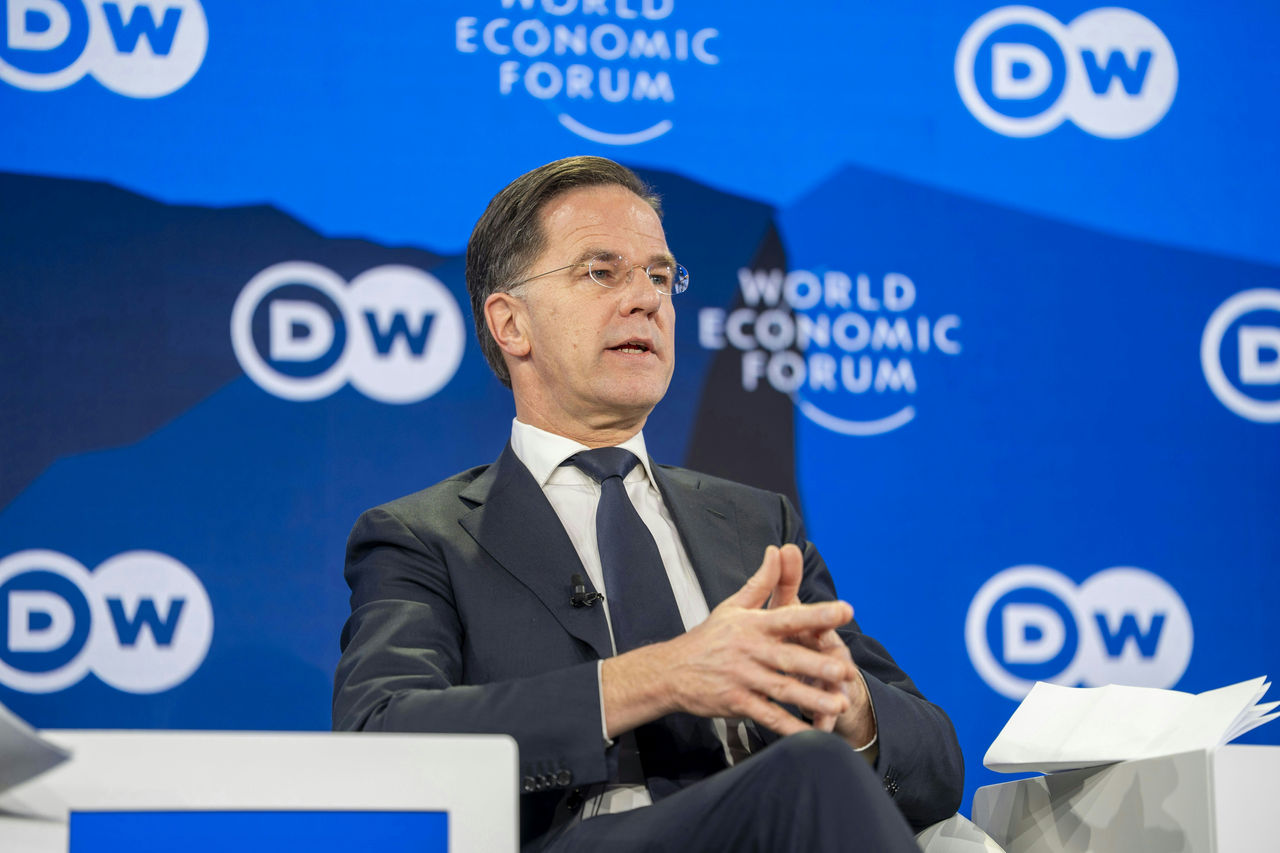
© 2026 World Economic Forum. Copyright: World Economic Forum/Valeriano Di Domenico
Sarah Kelly, Moderator
Hello and a very warm welcome to this special edition of Deutsche Welle’s Conflict Zone from the World Economic Forum in Davos, Switzerland. I'm Sarah Kelly. We're here with the NATO Secretary General Mark Rutte, the President of Poland Karol Nawrocki, President of Finland Alexander Stubb, the President of the European Investment Bank Nadia Calviño, and the CEO of Sanofi, Paul Hudson.
Welcome to all of you, and thank you so much for joining us. Now, this question, can Europe defend itself has really been thrust into the forefront as Donald Trump threatens Allies over Greenland. As we wait for Trump to deliver a statement in just a few hours, there has been so much discussion in the past few days, not only about the potential for a trade war with Europe, but also even the collapse of the NATO Alliance itself. And with that, Mr. Secretary General, I'd like to begin with you, because, with the US still a guarantor of European security, are European NATO Allies hostage to Trump's demands?
NATO Secretary General Mark Rutte
Listen, NATO since 1949 is the Transatlantic Alliance, and I think we have to be very careful in considering the fact that the US and Canada are not only in NATO to prevent the historic mistake the US made, in their own view, after the First World War, which was retreating from the world stage and then the long arm of history reaching out to the US again in the Second World War, not wanting to repeat that mistake.
They are in NATO because NATO is crucial, not only for the defence of Europe, but also for the defence of the United States. For the United States to stay safe, you need a safe Arctic, a safe Atlantic, and a safe Europe. And all the military, all the politicians, and you guys know this, and we really have to be mindful of this. So when the question is, is Europe safe? Yes, Europe is safe because of what Europe is doing itself within NATO, but also because we have that strong transatlantic relationship.
Sarah Kelly, Moderator
But we know the history, we know the stakes. Let's talk about the current dynamics. And I'd like to ask you, you know, for perhaps a bit of reflection here, did you ever think that you would ever see one NATO member threaten the territorial integrity of another? I mean, you have now the prime minister of Greenland telling his public, an attack cannot be ruled out.
NATO Secretary General Mark Rutte
Listen, my role as NATO Secretary General, when there is tension within the Alliance, it has been there in the past between Greece and Türkiye, there have been other moments when there was tension, then my predecessors always took the view that they should not comment on that in public. That's impossible. Why is that impossible? Because as soon as I do, I cannot any longer help to somehow, with others, of course, not me, only myself, but of course, with other leaders, to basically defuse the tension, to deescalate, etc. That's why you will not hear me comment. You can be assured that I'm working on this issue behind the scenes, but I cannot do it in public. So, sorry, no comments from me on Greenland.
Sarah Kelly, Moderator
Well, sometimes behind the scenes, comments do become public in various ways.
NATO Secretary General Mark Rutte
That's true.
Sarah Kelly, Moderator
You talked about security in the Arctic, no matter how you come out of this Greenland row. I mean, it really seems as if the dynamics have fundamentally changed within NATO. You have Macron saying yesterday, we are shifting to a world without rules. Hasn't all of this fundamentally damaged the foundations of NATO, this shared trust, the shared values.
NATO Secretary General Mark Rutte
Of course, I see that there are these tensions at the moment. There's no doubt. Again, I'm not going to comment on that, but I can assure you, the only way to deal with that is, in the end, thoughtful diplomacy. So statements from me will not add anything here.
And when it comes to the Arctic, I think President Trump is right, other leaders in NATO are right: we need to defend the Arctic. We know that the sea lanes are opening up. We know that China and Russia are increasingly active in the Arctic. There are eight countries bordering on the Arctic. Seven are a member of NATO, that's Finland and Sweden and Norway and Denmark, Iceland, Canada and the US. And there's only one country bordering on the Arctic outside NATO, that's Russia.
And I would argue there is a ninth country, which is China, which is increasingly active in the Arctic region. So, President Trump and other leaders are right. We have to do more there. We have to protect the Arctic against Russian and Chinese influence. And that is exactly what NATO ambassadors decided to do in September. We are working on that, making sure that, collectively, will we defend the Arctic region.
Sarah Kelly, Moderator
Do European NATO Allies need to think more about having capabilities that overlap with the United States? To hedge their bets.
NATO Secretary General Mark Rutte
NATO is constructed like this: that the US, Canada and the European NATO Allies work completely integrated. It doesn't mean that there is the US coming to the rescue of Europe, or Europe coming to the rescue of the United States – we are working completely integrated. And for the protection of both the US and Europe, it's crucial that NATO is there.
There was one big irritant on the on the American side with NATO, and the big irritant, since Eisenhower, was that they were spending, the US was spending, so much more than Europe was spending. Even today, the US is spending 3.5% of GDP on core defence; we are spending in Europe average 2% on defence. And here's my question to the audience. I mean, many of you, I know, criticize Donald Trump, but do you really think that without Donald Trump, eight big economies in Europe, including Spain and Italy and Belgium, Canada, by the way, also outside Europe, would have come to 2% in 2025 when they were only on 1.5% at the beginning of the year?
No way. Without Donald Trump, this would never have happened. They are all on 2% now. Do you really think that in the Summit in The Hague, as already Alex was saying, sorry, the President of Finland was saying, that we would come to a overall defence spending of 5%, including 3.5 in core defence, if President Trump would not have been re-elected as president of the United States?
No way. It would never have happened. So again, I'm not popular with you now because I'm defending Donald Trump, but I really believe you can be happy that he is there because he has forced us in Europe to step up, to face the consequences that we have to take care more of our own defence. And this is the thing – the Americans still have over 80,000 soldiers in Europe. They are still, including in Poland, in Germany, etc, they are still heavily invested in European defence. And yes, they have to pivot more towards Asia. So, it is only logical for them to expect us in Europe to step up, over time.
And there is this plan already — since Jens Stoltenberg, my predecessor, designed it — the NATO Defence Planning Process, to over time, make sure that Europe can take over more of these capabilities, of these core enablers from the US to do more of the protection of the European continent.
We are still having a strong, conventional US presence in Europe also going forward, and, of course, the nuclear umbrella as our ultimate guarantor. But again, I'm absolutely convinced, without Donald Trump we would not have taken those decisions. And they are crucial, particularly for the European and the Canadian side of NATO to really grow up in the post-Cold War world.
Sarah Kelly, Moderator
Secretary General, I'd like to ask for your remarks also on that point. We've been talking about can Europe defend itself? The question is, how and how that evolves also over the next years? Do you ever see a day where European defence doesn't have NATO as the cornerstone?
NATO Secretary General Mark Rutte
No, I don't. And let's not forget, the EU is great. It is 23 countries in NATO of the 32 are also in the EU. But it is only 25% of NATO’s overall GDP. 75% of NATO GDP is outside the European Union. Let's not forget, that's a fact. The US is by far the most powerful nation on Earth. And the President of the United States is therefore the leader of the free world. And you cannot envision NATO without the leader of the free world being an integral part of that organisation. And nobody wants it, not on the US side, not on the European side. He said last night in his presser that he was doubtful whether the Europeans would come to the rescue if Article 5 would be triggered. I tell him: yes, they will. And they did on the 11th of September — 9/11 — in 2001 when, for the first and only time, Article 5 was triggered. I have no doubt the US will come to the rescue here [in Europe]. We will come to the rescue of the US. And we need each other for our collective protection.
You [President Stubb] made a very good point. The risk here is that we focus, of course, on Greenland because we have to make sure that that issue gets solved in an amicable way. But the main issue is not Greenland now, the main issue is Ukraine. And I agree with everything Alex Stubb was saying, but I'm also a little bit worried that we might drop the ball focusing so much on these other issues. And, as we speak, Russian missiles and Russian drones are attacking the energy infrastructure in Ukraine. We know that it is now minus 20 degrees in Kyiv. We know that Ukraine can only take care of 60 percent of its own electricity. And yes, it is true, the Russians have lost in December 1000 people dead – not seriously wounded, dead – a day. That's over 30,000 in the month of December. In the 1980s in Afghanistan, the Soviets lost 20,000 in 10 years. Now they lose 30,000 in one month.
But they still continue the attack. They still increase the attacks. And that means that if we Europeans here in NATO are thinking that because of the 90 billion the Commission has been able to bring together with the nations, or because the peace process is moving in the right direction, we can forget about the defence of Ukraine, don't. They need our support now, tomorrow and the day after. And yes, great if there is a peace deal. Everybody's working on that. The Americans, of course, are leading that process. Great that the 90 billion is there, but that will only be there in March, April, May, whenever. So that still takes time. So I need European Allies to keep focus on this issue. And what I'm really worrying about is that because of the peace process and because of the 90 billion we lose sight. And that in the meantime, Ukrainians do not have enough interceptors, [do not] have enough American gear — [which] particularly they need because it is not any longer available in Europe - for them to defend themselves. So, this focus in Ukraine should be our number one priority, and then we can discuss on all the issues, including Greenland. But it should be Ukraine first because it is crucial for our European and US security.
Sarah Kelly, Moderator
I'd like to open up the conversation now to the audience. This is a very high-level audience, we have to say. I'm seeing President of Latvia sitting in the front row. I believe I also spotted the Defence Minister of the Netherlands here as well, right there. We'll be passing around a mic, and I would like to ask that you please stand up and that questions are kept brief, because I see many hands going up.
Question from the audience
Thank you very much. I have a very short question to SecGen Rutte. There are negotiations about Ukraine, and I fully agree with you that Ukraine is a main challenge, and Russia, basically is the main threat. The question is, once we agree that there are some chances for the long-lasting peace, are we as Europe prepared for what would be next with Russia, with this aggressive approach with the society — which is still through disinformation — educated with aggressive approach towards the West. What will happen with those hundreds of thousands of troops, capabilities, etc, if they won't be engaged in Ukraine? They won't just wait for the better prosperous future. Are we ready as NATO to take this problem. Thank you very much.
NATO Secretary General Mark Rutte
Yes, we are ready today. There's no doubt. But we have to be ready in ‘27 and ‘29 and ’31. And this is why what we decided in The Hague — to ramp up defence spending to this 5% — was crucial. But you also have to ramp up the defence industrial production. And we're not doing it. Not in the US, not in Europe. We're not nearly producing enough. The fact that Poland, which is the closest Ally to the US you can find, is buying in South Korea, is because they cannot buy enough in the US or in the European-
President of Finland Alexander Stubb
And buying in Finland.
NATO Secretary General Mark Rutte
Yes, Alex, I love you, but you’re not producing enough. Your defence industrial base has to ramp up. And you know it, so please spend time on that. And this is true for the whole of NATO territory. So, it is not only money, it's also the defence industrial base, including preparing our other industries, including our car industries, etc, for a moment when there might be a situation where we need them. Russia is on a war economy footing. They spend 40% of the state budget on defence, 200 billion a year with a spending power with the 200 billion - because of the structure of their economy, which is much higher than we can do in Europe. So we really have to be watchful here. Yes, we can defend ourselves today, but we have to deliver on The Hague commitments. Not because of Donald Trump — yes, it equalizes with the US that keeps them in — but particularly because we have to defend ourselves.
Question
My name is Andrea Malaguti. What do you think about the Board of Peace with Lukashenko and Putin for Gaza?
NATO Secretary General Mark Rutte
NATO is 32 countries in the Northern Atlantic, and I'm not commenting on things outside the North Atlantic area. Sorry, I have too much on my plate already. Thank you.
Question
Mark Rutte, can you please comment on Mark Carney’s speech yesterday here in Davos. It was very honest. What is your reaction to it?
NATO Secretary General Mark Rutte
I respect him a lot, and I’ll see him later today. And I think he had a speech which was strong on Canadian values and what Canada can contribute to the world. At the same time, I would say this is very good, and Canada is back when you look at NATO. They were spending 1.3, 1.4%. They got to the 2%. They have now a plan to reach the 5%. They're massively helping out with Ukraine now so I could say, since he [Mark Carney] became Prime Minister, [Canada] is really back in NATO, back in defending the transatlantic Alliance. And I think that's great news.
Question
Thank you very much. Would you think that if the transfer of the sovereignty of agreement can be achieved, would you think this might lead to the demise of the idea of so called ‘Western collective?’ And secondly, that if this needs to be transferred, would you think that the NATO 3.0 just like President Stubb said, might be veer into something more like the Warsaw Pact rather than original NATO. Of course, we have the Polish president; you can also coordinate. Thank you very much.
Question
I'm [inaudible] from Saudi Arabia with a Greek mother and an Italian wife. Europe can defend itself. That's very clear today. But my question is, do we feel safer? I'm planning to retire in Europe. Do I feel safer today with all this stock up of military? As you asked the question, when the war is over, what you do with all this military?
NATO Secretary General Mark Rutte
If you want to prevent war, prepare for war. The only way we can prevent the Russians or anyone who wants to do us harm is to make sure that they know that the reaction we will have is devastating. Today, yes, it is. But if we would have continued with this 1.8, 1.9% defence spending and the defence industrial base - which is not producing enough- we would not be ready in ‘29, ’31. And our adversaries know this. So, I know that people are worried that we are spending more on defence. Yes, we do this to prevent war from breaking out. You have to be strong. We have to be strong against those who wish us ill.