
Close
Back


From now on you can download videos from our website
If you would also like to subscribe to the newsletter and receive our latest updates, click on the button below.
Enter the email address you registered with and we will send you a code to reset your password.
The password must be at least 12 characters long, no spaces, include upper/lowercase letters, numbers and symbols.
Click the button to return to the page you were on and log in with your new password.
05 May 2020
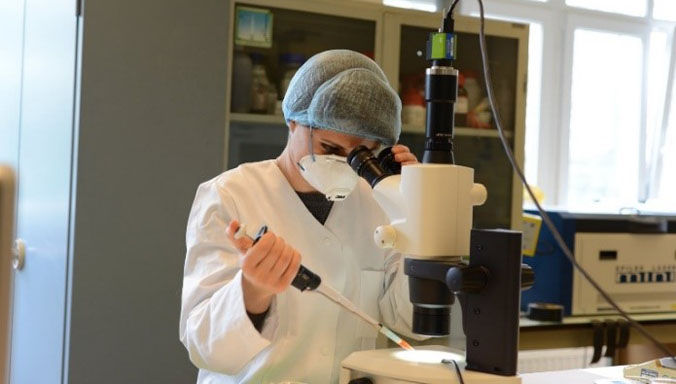
NATO is launching a practical scientific project to develop new tools for a rapid and accurate diagnosis of SARS-CoV-2 infection.
This multi-year project is launched within the framework of NATO’s Science for Peace and Security (SPS) Programme, and is led by scientists on the frontline of COVID-19 research from Italy’s Istituto Superiore di Sanità (National Health Institute) and Tor Vergata University Hospital together with the University Hospital of Basel University in Switzerland. This 24-month initiative aims to enhance the speed and efficiency of COVID-19 diagnosis through a multidisciplinary approach, by bringing together experts in the field of immunology, virology and molecular biology.
This project supports NATO’s efforts to enhance resilience and civil preparedness of Allied and partner nations, and highlights the Alliance’s commitment to further enhance research and development efforts to combat COVID-19. “This SPS project is an excellent example of the research community’s global effort to fight against COVID-19.” said Dr. Antonio Missiroli, NATO’s Assistant Secretary General for Emerging Security Challenges. “This project also stresses the dedication of Allies to support each other, as well as partners, in times of crisis; and while the expected results of this project are extremely relevant to the situation the world currently finds itself in, we look forward to the long-term impact it will have on the international response to naturally occurring and man-made viruses and pathogens,” he added.
“Italy has been actively engaged in the SPS Programme since the beginning; not only by laying its very foundations with the contribution of Gaetano Martino, one of the three wise men, but also by steadily contributing to streamlining its decision-making, and by promoting more sophisticated projects through the active involvement of Italy’s scientific and academic community,” said Ambassador Francesco M. Talò, Italian Permanent Representative to NATO. “The launch of this project is yet another brilliant example of the political nature of this Alliance,” he highlighted.
“The speed and the scale of the COVID-19 virus is unprecedented and all types of disruptions it has caused are unparalleled. As daunting as it may seem, we will get back to some sort of normality only when effective means to prevent the spread of COVID-19 will be identified,” said Ambassador Philippe Brandt, Ambassador of Switzerland to the Kingdom of Belgium and Head of the Swiss Mission to NATO. “For Switzerland, being associated to NATO Partnership for Peace means sharing capacities to improve security in a multilateral framework. With several top-ranked universities and programmes, scientific academies and moreover a strong relationship between private sector and scientific research, Switzerland is well positioned to join the international community efforts to combat COVID-19. Academics and researchers working within Swiss institutions have been associated to various projects conducted by NATO through the Science for Peace and Security programme (SPS),” he pointed out.
Professor Silvio Brusaferro, President of the National Health Institute and Professor of General and Applied Hygiene at the University of Udine (Italy) remarked on the role played by the National Health Institute. "The National Health Institute is fully committed to dealing with the COVID-19 pandemic,” he said. “This project is very important, especially in the context of new indispensable tools that we will have to deal with the second phase of the health emergency,” he added.
The results foreseen from this project are extremely relevant to the current pandemic, and they are expected to have a long-term impact on the international response to the spread of viruses on a large scale. The contributions to the improvement of risk management and public health measures will be significant. This project will also represent a model for quick measures to counteract epidemics.
The NATO SPS Programme supports security-relevant civil science and technology addressing a set of Allied-approved priorities. In addition to this innovative project, several other SPS activities are also supporting the development of new technologies and capabilities relevant to the fight against COVID-19. These are mainly in the fields of telemedicine, emergency response coordination, and the detection of biological threats.