Організація Північноатлантичного договору

NATO-Russia Council

NATO member states and Russia working together as equal partners in areas of common interest

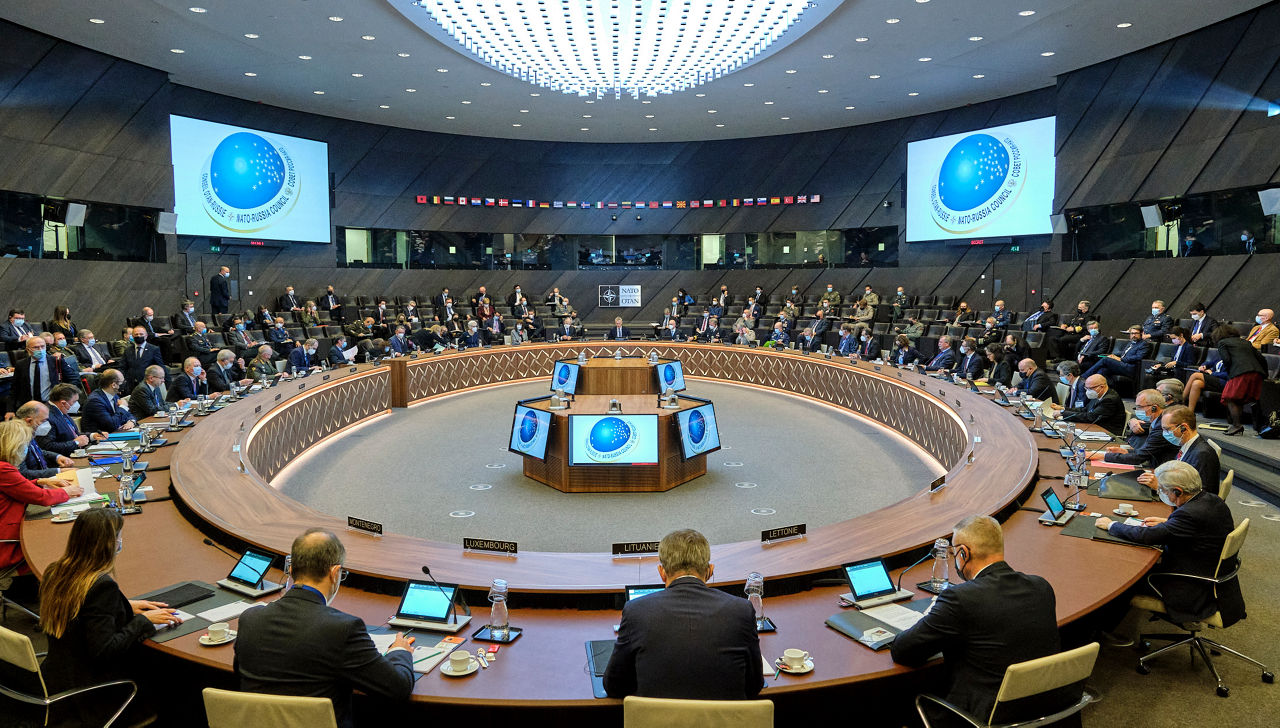
The NATO-Russia Council (NRC) is a mechanism for consultation, consensus-building, cooperation, joint decision and joint action, in which the individual NATO member states and Russia work as equal partners on a wide spectrum of security issues of common interest.

The NRC, established at the NATO-Russia Summit in Rome on 28 May 2002, replaced the Permanent Joint Council (PJC), a forum for consultation and cooperation created by the 1997 NATO-Russia Founding Act on Mutual Relations, Cooperation and Security, which remains the formal basis for NATO-Russia relations.

The spirit of meetings has dramatically changed under the NRC, in which Russia and NATO member states meet as equals “at 27” – instead of in the bilateral “NATO+1” format under the PJC.

What are its authority, tasks and responsibilities?

The NRC was established by the 2002 Rome Declaration on “NATO-Russia Relations: a New Quality”, which builds on the goals and principles of the 1997 Founding Act. Its purpose is to serve as the principal structure and venue for advancing the relationship between NATO and Russia. Operating on the principle of consensus, it works on the basis of continuous political dialogue on security issues with a view to the early identification of emerging problems, the determination of common approaches and the conduct of joint operations, as appropriate.

Operating on the principle of consensus, it works on the basis of continuous political dialogue on security issues with a view to the early identification of emerging problems, the determination of common approaches and the conduct of joint operations, as appropriate.

In accordance with the Rome declaration, NATO member states and Russia work as equal partners in areas of common interest in the framework of the NRC, which provides a mechanism for consultation consensus-building, cooperation, joint decision and joint action on a wide spectrum of security issues in the Euro-Atlantic region. The members of the NRC, acting in their national capacities and in a manner consistent with their respective collective commitments and obligations, take joint decisions and bear equal responsibility, individually and jointly for their implementation.

Work under the NATO-Russia Council focuses on all areas of mutual interest identified in the Founding Act. Cooperation is being intensified in a number of key areas, which include the fight against terrorism, crisis management, non-proliferation, arms control and confidence-building measures, theatre missile defence, logistics, military-to-military cooperation, defence reform and civil emergencies. New areas may be added to the NRC’s agenda by the mutual consent of its members.

Who participates?

The 26 NATO member states and Russia participate in the NRC. Meetings of the NRC are chaired by NATO's Secretary General and are held at least monthly at the level of ambassadors and military representatives; twice yearly at the level of foreign and defence ministers and chiefs of staff; and occasionally at summit level.

How does it work in practice?

Since its establishment, the NRC has evolved into a productive mechanism for consultation, consensus-building, cooperation, joint decision and joint action. It has created several working groups and committees to develop cooperation on terrorism, proliferation, peacekeeping, theatre missile defence, airspace management, civil emergencies, defence reform, logistics, and scientific cooperation focused on new threats and challenges. Experts have been tasked to take work forward on individual projects in other key areas.

An important innovation under the NRC is the Preparatory Committee, which meets at least twice a month to prepare ambassadorial discussions and to oversee all experts’ activities under the auspices of the NRC.

A stocktaking of the NRC’s activities was undertaken in spring 2006. NRC member countries looked at the progress achieved and challenges identified in the course of implementing the NRC’s agenda. On this basis, Allied and Russian foreign ministers meeting in Sofia in April 2006 agreed a set of priorities and recommendations to guide the NRC’s work in the medium term.

Overarching priorities include reinforcing political dialogue; strengthening cooperation in the areas of interoperability, defence reform, the struggle against terrorism and crisis management; further developing mutual trust, confidence and transparency with regard to NATO and Russian armed forces; identifying areas for result-oriented cooperation on non-proliferation; heightening public awareness of the NRC’s goals, principles and achievements; and seeking adequate resources to support NATO-Russia initiatives.

Key areas of NRC cooperation

Cooperation between Russia and NATO member states is directed by the NRC and developed through various subordinate working groups and committees. Every year, NRC member countries agree on an annual work programme. Key areas of cooperation include the fight against terrorism, defence reform, military-to-military cooperation, counter-narcotics training of Afghan and Central Asian personnel, theatre missile defence, crisis management and non-proliferation.

Russia also cooperates with NATO in airspace management, civil emergency planning, scientific cooperation and environmental security.  In addition, the Allies and Russia regularly exchange views on current security issues in the Euro-Atlantic area, creating thereby a standing mechanism for consultation on larger political issues. 

Current security issues

The NRC has provided a forum for the development of a continuous political dialogue on current security issues, which has expanded steadily to include frank and constructive exchanges on topical and sometimes controversial issues. Discussions have been held on subjects such as the situation in the Balkans, Afghanistan, Georgia, Ukraine, Belarus, Central Asia, the Middle East and Iraq, as well as exchanges on issues such as NATO’s transformation, energy security, missile defence and the Conventional Forces in Europe (CFE) Treaty.

In some instances, political dialogue has resulted in joint positions – on border control in the Balkans (February 2003), on defence reform in Bosnia and Herzegovina (July 2003) and on the presidential elections in Ukraine (December 2004).

Dialogue has also generated some ideas for practical cooperation, such as the decision to launch in December 2005 of an NRC pilot project for counter-narcotics training of Afghan and Central Asian personnel (see below).

Combating terrorism

Cooperation in the struggle against terrorism has taken the form of regular exchanges of information, in-depth consultation, joint threat assessments, civil emergency planning for terrorist attacks, high-level dialogue on the role of the military in combating terrorism and on the lessons learned from recent terrorist attacks, and scientific and technical cooperation. NATO Allies and Russia also cooperate in areas related to terrorism such as border control, non proliferation, airspace management, and nuclear safety.

In December 2004, NRC foreign ministers approved a comprehensive NRC Action Plan on Terrorism, aimed at improving overall coordination and strategic direction of NRC cooperation in this area.

Moreover, since December 2004, joint pre-deployment training has been underway to prepare Russian ships to support Operation Active Endeavour (OAE), NATO’s maritime counter-terrorist operation in the Mediterranean. The first ship to deploy was the frigate RFS Pitliviy in September 2006 and a second vessel, the RFS Ladniy, deployed a year later in September 2007. Additional Russian ships are expected to be rotated into the operation in future.. 

Counter-narcotics training of Afghan and Central Asian personnel

The NRC pilot project for counter-narcotics training of Afghan and Central Asian personnel was lai-unched by NRC foreign ministers in December 2005 to help address the threats posed by the trafficking in Afghan narcotics. It seeks to build local capacity and to promote regional networking and cooperation by sharing the combined expertise of NRC member states with mid-level officers from Afghanistan, Kazakhstan, the Kyrgyz Republic, Tajikistan, Turkmenistan and Uzbekistan. The project is being implemented in cooperation with the United Nations Office for Drugs and Crime (UNODC).

Russia and Turkey have hosted training courses for Afghan and Central Asian personnel at specialized centres of excellence, and mobile courses are being conducted in each of the six participating countries. In summer 2007, the NRC welcomed Finland’s willingness to contribute to the initiative. By spring 2008, almost 450 officers had been trained under the NRC project.

Land-transit agreement in support of ISAF

In April 2008, the Russian Foreign Minister and NATO’s Secretary General signed  a document which will facilitate the land transit across Russian territory of non-military equipment destined for the NATO-led, UN-mandated International Security Assistance Force (ISAF) in Afghanistan.

Non-proliferation, arms control and

Dialogue on a growing range of issues related to the non-proliferation of weapons of mass destruction has developed under the NRC. Concrete recommendations have been made to strengthen existing non-proliferation arrangements. A number of in-depth discussions and expert seminars have been held to explore opportunities for practical cooperation in the protection against nuclear, biological and chemical weapons. Informal talks at a seminar in Florence, Italy, in September 2007, focused on ballistic missile proliferation and nuclear terrorism, generating ideas which are being followed up by more formal discussion in the NRC framework.

Arms control

The NRC has also provided a forum for frank discussions on issues related to conventional arms control, such as the CFE Treaty, the Open Skies Treaty and confidence-and-security-building measures. A key priority for all NRC countries is to work towards the ratification of the Adapted Treaty on Conventional Forces in Europe. The Allies have expressed concern over Russia’s unilateral “suspension” of its particpation in the treaty in December 2007. While differences remain on this issue, it is important to note that the Allies remain committed to ratifying the Adapted Treaty. Discussions are ongoing with Russia, both in the framework of the NRC and the Organization for Security and Co-operation in Europe on how to make this possible.

Nuclear weapons issues

In the nuclear field, experts have developed a glossary of terms and definitions and organised exchanges on nuclear doctrines and strategy. They have also observed four nuclear-weapon-accident-response field exercises in Russia in 2004, the United Kingdom in 2005, the United States in 2006, and France in 2007. Inviting experts to attend such exercises increases transparency, develops common understanding of nuclear-weapon-accident-response procedures, and builds full confidence that the nuclear weapon states of NATO (France, the United Kingdom and United States) and Russia are fully capable to respond effectively to any emergency involving nuclear weapons.

Theatre missile defence

Cooperation in the area of theatre missile defence is addressing the unprecedented danger posed to deployed forces by the increasing availability of ever more accurate ballistic missiles. A study was launched in 2003 to assess the possible levels of interoperability among the theatre missile defence systems of NATO Allies and Russia.

Three command post exercises have been held – the first in the United States in March 2004, the second in the Netherlands in March 2005, and the third in Russia in October 2006. A computer assisted exercise took place in Germany in January 2008. Together with the interoperability study, these exercises are intended to provide the basis for future improvements to interoperability and to develop mechanisms and procedures for joint operations in the area of theatre missile defence.

Cooperative Airspace Initiative

Significant progress has been made on the Cooperative Airspace Initiative (CAI), which aims to foster cooperation between NRC countries on airspace surveillance and air traffic management. The underlying goal is to enhance transparency, predictability and collective capabilities to fight terrorism.

Based on a feasibility study completed in 2005, detailed system requirements and a project plan were agreed for a system that will enable the reciprocal exchange of air traffic data between centres in NATO countries and in Russia. Implementation began in March 2006, the technical operational capability was in place by end 2007 and full operational capability is planned for the end of 2008. In parallel, work is progressing on developing a concept of operations,an exercise and training concept, coordination procedures and legal arrangements.

A total of around 5 million euros have been invested in the CAI project. Nations that have contributed financially include Canada, France, Greece, Hungary, Italy, Luxembourg, Norway, Poland, Russia, Turkey, the United Kindom and the United States.

The CAI system consists of four units in Russia, and four units in NATO member countries. The sites stretch from the far north of Europe in Bodø, Norway, and Murmansk, Russia, down to Ankara, Turkey, and Rostov-on-Don, Russia, in the south. The NATO Coordination Centre is located in Warsaw, Poland, and the Russian Coordination Centre is located in Moscow. 

Military-to-military cooperation

Since the NRC was established, military liaison arrangements have been enhanced, at the Allied Commands for Operations and for Transformation, as well as in Moscow. A key objective of military-to-military cooperation is to improve the ability of NATO and Russian forces to work together in preparation for possible future joint military operations. A programme has been set up to develop interoperability, in which training and exercises are an important component.  The “Political-Military Guidance Towards Enhanced Interoperability Between Forces of Russia and NATO Nations”, which was approved by NRC defence ministers in June 2005, has added further impetus to these efforts.

Another key document is the Partnership for Peace Status of Forces Agreement, which Russia signed in 2004 and the Russian parliament ratified in May 2007. It will facilitate further military-to-military and other practical cooperation, in particular the deployment of forces participating in joint operations and exercises. It will also facilitate Russian logistical support to the NATO-led International Security Assistance Force in Afghanistan.

Submarine-crew search and rescue

Work in the area of submarine-crew search and rescue at sea has intensified, since the signing of a framework agreement on cooperation in this area in February 2003, and has contributed to a real-life rescue.  In June 2005, Russia took part in NATO’s largest-ever search-and-rescue exercise, Sorbet Royal. The experience and networks developed during the exercise contributed to the success of an actual rescue operation in August 2005 off the coast of Russian Kamchatka peninsula. In 2008, Russia is planning to participate in an even more ambitious exercise, Bold Monarch.

Crisis management

NATO and Russia have a long history of cooperation in crisis management. In fact, between 1996 and 2003, Russia was the largest non-NATO troop contributor to NATO-led peacekeeping operations. Close cooperation in the Balkans has been critical in improving relations and building trust between the Russian and Allied militaries.

Since 2002, the NRC has taken steps to prepare for possible future cooperation in this area, notably through the approval in September 2002 of “Political Aspects for a Generic Concept for Joint NATO-Russia Peacekeeping Operations”. This paper explores common approaches, establishes a framework for consultation, planning and decision-making during an emerging crisis, and defines issues related to joint training and exercises. These were tested in a procedural exercise, conducted in three phases between May 2003 and September 2004.

Defence reform and cooperation

Initiatives launched in the area of defence reform focus on the evolution of the military, management of human and financial resources, reform of defence industries, managing the consequences of defence reform, and defence-related aspects of combating terrorism.

One key project which demonstrates the practical benefits of NRC cooperation in this area is the NATO-Russia Resettlement Centre, which is facilitating the integration of former Russian military personnel into civilian life. Set up in Moscow in July 2002, its operations have since been expanded into the regions. Its activities now include not only the provision of information regarding job-search and resettlement, but also professional courses for trainees, job-placement services, and English-language and management courses for small and medium-sized enterprises. By spring 2008, over 2000 former military personnel from the Russian armed forces had been retrained. About 85 per cent of them succeded in finding civilian employment as a result of the training or the help of the Centre’s job placement unit.

Another key initiative is the development of the “Political-Military Guidance Towards Enhanced Interoperability Between Forces of Russia and NATO Nations”. It was approved by NRC defence ministers in June 2005 and is aimed at facilitating the preparation of NATO and Russian forces for possible joint operations.

A broad-based “Study on NATO-Russia Defence Industrial and Research and Technological Cooperation”, launched in January 2005, is expected to have a positive impact on future cooperation in this area

Two fellowships for Russian scholars have been set up at the NATO Defense College in Rome to promote research on defence reform. Moreover, the NRC is subsidising defence reform courses for Russian officers at the USA and Canada Institute of the Russian Academy of Sciences.

Logistics

Logistics form the backbone of any military operation and in today's security environment, the need for more mobile forces and multinational operations calls for improved coordination and the pooling of resources, wherever possible. Various initiatives are pursuing logistic cooperation on both the civilian and the military side.

Meetings and seminars have focused on establishing a sound foundation of mutual understanding in the field of logistics by promoting information sharing in areas such as logistic policies, doctrine, structures and lessons learned.

Opportunities for practical cooperation are being explored in areas such as air transport and air-to-air refuelling. The PfP Status of Forces Agreement, which was ratified by the Russian parliament in May 2007, will significantly facilitate practical cooperation between NATO and Russia in these areas, and also helped secure the land-transit agreement in support of ISAF (see above).

Civil emergencies

NATO and Russia have been cooperating since 1996 to develop a capacity for joint action in response to civil emergencies, such as earthquakes and floods, and to coordinate detection and prevention of disasters before they occur. Moreover, it was a Russian proposal that led to the establishment in 1998 of the Euro-Atlantic Disaster Response Coordination Centre, which coordinates responses to disasters among all countries of the Euro-Atlantic Partnership Council (the 26 NATO members and 23 Partner countries).

Under the NRC, a key focus of cooperation in this area has been to develop capabilities to manage the consequences of terrorist attacks. Two disaster-response exercises held in Russia (in Bogorodsk in 2002, and Kaliningrad in 2004) and another in Montelibretti, Italy, in 2006, have resulted in concrete recommendations for consequence management. Another table-top consequence-management exercise will be hosted by Norway in 2009.

A Russian-Hungarian initiative for the establishment of a rapid deployment capability was launched in 2003 to enhance NRC countries’ capability to protect civilian populations from natural and man-made disasters, as well as from terrorist acts involving the use of chemical, biological, radiological and nuclear agents.

New threats and challenges

Scientific and technological cooperation between NATO and Russia dates back to 1998. Over the years, NATO’s science programmes, which foster collaboration and research between scientists in NATO and Partner countries, have awarded more grants to scientists from Russia than any other country.

Under the NRC Science for Peace and Security Committee, promising work is taking place on confronting new threats and challenges through scientific and environmental cooperation. Key areas include explosives detection, protection from chemical, biological, radiological and nuclear agents, cyber security, psychosocial consequences of terrorism, transport security, environmental security and eco-terrorism, and the forecast and prevention of catastrophes.

Raising public awareness of the NRC

An NRC web site (http://www.nato-russia-council.info/) was launched in June 2007 to increase public awareness of NRC activites. Discussion are also ongoing on exploring ways to facilitate other forms of dialogue among political scientists, research institutions, the academic community, and other relevant organizations.

Last updated: 21-Dec-2009 09:49