NATO - North Atlantic Treaty Organisation

NATO cooperation with New Zealand

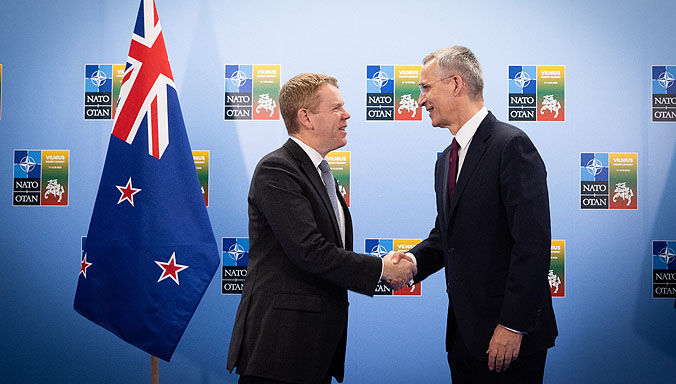
NATO Secretary General Anders Fogh Rasmussen welcomes the Prime Minister of New Zealand, John Key to NATO Headquarters.

The Prime Minister of New Zealand, Ms Helen Clark and NATO Secretary General Jaap de Hoop Scheffer (Oct 2007)

In addition to its formal partnerships¹, NATO cooperates with a range of countries that are not part of these structures. Often referred to as “other partners across the globe” or “Contact Countries”, they share similar strategic concerns and key Alliance values. Australia, Japan, the Republic of Korea and New Zealand are all examples in case.

NATO and New Zealand have had regular contacts since 2001. During her term in office, former Prime Minister Helen Clark came regularly to NATO Headquarters. The New Zealand Foreign Minister Phil Goff met the then Secretary General Lord Robertson twice, first in September 2001 and again in November 2003. As part of the new coalition government, Mr Goff has now taken over the defence portfolio and has met the current Secretary General  several times.

Relations with NATO have developed largely as a result of New Zealand’s contribution to the International Security Assistance Force (ISAF) in Afghanistan, where the country leads a Provincial Reconstruction Team (PRT) in Bamyan. This is not the first troop contribution as several New Zealand officers served in the NATO-led Stabilization Force (SFOR) in Bosnai and Herzegovina under the British flag. (New Zealand continues to support the EU-led force that took over from NATO.)

New Zealand is regularly involved in various meetings and discussions related to ISAF operations. On that basis, the then Prime Minister Helen Clark attended the meeting of ISAF troop-contributin nations that took place at the Bucharest Summit in April 2008.

Other practical cooperation is being taken forward on the basis of an annual Individual Tailored Cooperation Package (TCP) of activities. New Zealand also participates in a number of technical activities, primarily focused on areas related to peace-support operations.

New Zealand and NATO have signed an agreement regarding the protection of classified information. On that basis, both sides exchange information of operational nature, related to the fight against terrorism

1. The Euro-Atlantic Partnership Council, the Partnership for Peace, the Mediterranean Dialogue and the Istanbul Cooperation Initiative..