Close
Back


From now on you can download videos from our website
If you would also like to subscribe to the newsletter and receive our latest updates, click on the button below.
Enter the email address you registered with and we will send you a code to reset your password.
The password must be at least 12 characters long, no spaces, include upper/lowercase letters, numbers and symbols.
Click the button to return to the page you were on and log in with your new password.
Updated: 28 August 2024
NATO worked to build a partnership with Belarus for many years, developing dialogue and practical cooperation in areas of common interest since 1992, when the country joined the North Atlantic Cooperation Council. In 2021, Allies suspended practical cooperation between NATO and Belarus, while maintaining dialogue, as necessary. NATO Allies have condemned Belarus for enabling Russia’s full-scale invasion of Ukraine in February 2022 and for its ongoing complicity in Russia’s war of aggression.

NATO Allies condemn all those who are facilitating and thereby prolonging Russia’s war of aggression against Ukraine. Belarus continues to enable this war by making available its territory and infrastructure, allowing Russian forces to continue attacking Ukraine. Belarus must end its complicity with Russia and return to compliance with international law.
Russia’s deepening political and military integration of Belarus, including the deployment of advanced Russian military capabilities and personnel in Belarus, has negative implications for regional stability and the defence of the Alliance. NATO condemns Russia’s irresponsible nuclear rhetoric and coercive nuclear signalling, including its announced stationing of nuclear weapons in Belarus, which demonstrate a posture of strategic intimidation.
Belarus’ relations with NATO started in 1992, when it joined the North Atlantic Cooperation Council. This forum for dialogue was succeeded in 1997 by the Euro-Atlantic Partnership Council, which brings together all Allies and partner countries in the Euro-Atlantic area.
Bilateral cooperation began when Belarus joined the Partnership for Peace (PfP) programme in 1995. Under the PfP, NATO and Belarus developed practical cooperation in a number of areas through the Individual Partnership and Cooperation Programme (IPCP) agreed between NATO and Belarus (see next section for specific examples).
Belarus’ diplomatic mission to NATO opened in April 1998.
In August and September 2020, following mass protests over the results of the Belarusian presidential election, NATO expressed serious concern over the arbitrary detentions and abductions of opposition figures and called on the Belarusian authorities to demonstrate full respect for fundamental rights, including freedom of speech and the right to peaceful protest.
In May 2021, NATO strongly condemned the diversion and forced landing of a Ryanair flight between Athens and Vilnius in Minsk, Belarus, as well as the removal and arrest of Raman Pratasevich, a Belarusian journalist travelling on board, and his partner Sofia Sapega.
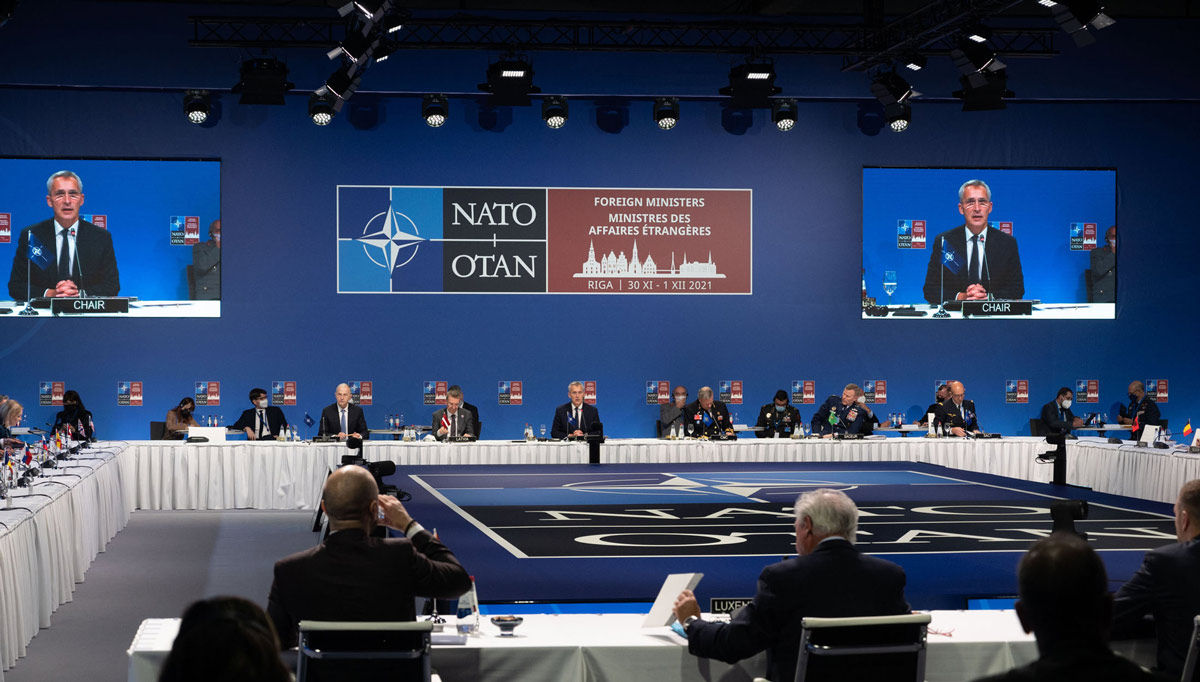
In November 2021, NATO condemned Belarus for sending large numbers of irregular migrants to the country’s borders with Poland, Lithuania and Latvia as part of its hybrid activities. NATO Allies called on Belarus to cease these actions, to respect human rights and fundamental freedoms, and to abide by international law.
Following these developments, Allies suspended all practical cooperation, both civilian and military, between NATO and Belarus in November 2021, while maintaining dialogue, as necessary.
Belarus’ cooperation with NATO prior to 2021 was mutually beneficial. Some highlights included:
10 July 2024
11 July 2023
24 March 2022
25 February 2022
3 March 2023
29 June 2022
14 June 2021