Close
Back


From now on you can download videos from our website
If you would also like to subscribe to the newsletter and receive our latest updates, click on the button below.
Enter the email address you registered with and we will send you a code to reset your password.
The password must be at least 12 characters long, no spaces, include upper/lowercase letters, numbers and symbols.
Click the button to return to the page you were on and log in with your new password.
Updated: 29 September 2026
In order to deter aggression and defend against threats, NATO forces need to be capable of all the activities that enable military power – not only repelling armed attacks, but also gathering intelligence, maintaining supply lines, transporting troops and much more. NATO Allies ensure that the Alliance has these capabilities by developing and maintaining a wide range of platforms and tools. NATO plays an important supporting role in capability development – assessing which capabilities the Alliance as a whole needs; setting targets for capability development; and assisting with the national, multinational and collective development of platforms that provide the Alliance with critically needed capabilities.
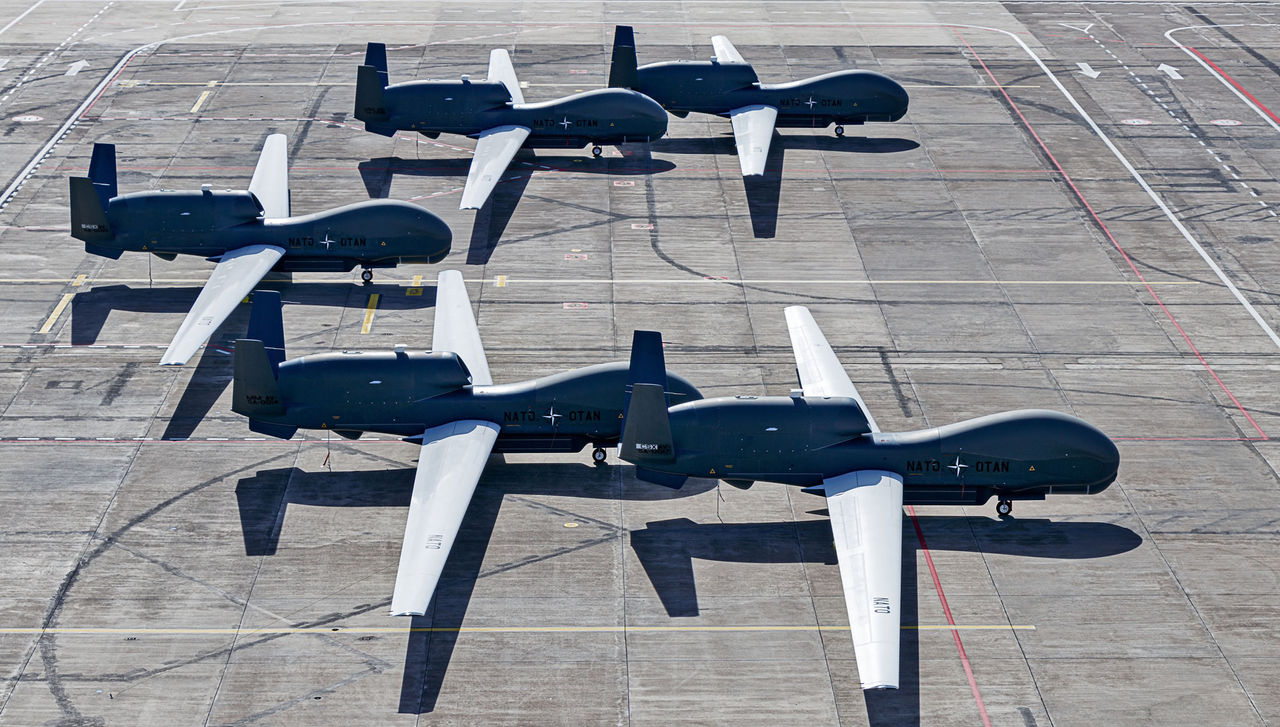
NATO’s five RQ-4D “Phoenix” surveillance aircraft, part of the NATO Intelligence, Surveillance and Reconnaissance Force (NISRF) based in Sigonella, Italy. The NISRF provides Allies with a collectively owned and operated ISR capability.
NATO officially defines a capability as “the ability to create an effect through employment of an integrated set of aspects categorised as doctrine, organisation, training, materiel, leadership development, personnel, facilities and interoperability.”
Put more simply, a NATO capability is the ability to do something that achieves a certain objective. NATO sets Capability Targets defining what effect Allies should be able to provide, but it does not tell Allies how they should do it. For example, an Ally can agree to develop the capability to provide the Alliance with a clear picture of what’s happening on the ground in an operational area. It’s up to that Ally to determine which specific platforms (i.e., which systems, tools, technology, etc.) it will develop to deliver this capability.
Although NATO leaves it up to Allies to determine how they will meet a Capability Target, it’s important that the systems and methods that they use are interoperable, so that the Alliance’s multinational forces are able to work together efficiently and effectively. As such, one of NATO’s most important contributions to capability development is through its role as a standard-setting body. Standardization ensures that NATO forces share common doctrines and procedures, compatible systems and equipment, and interchangeable supplies.
While national capability development is a sovereign responsibility, NATO plays an important supporting role in facilitating national capability development and delivery. Through a wide range of structures, NATO brings together national experts in defence planning, ensuring that Allies are developing the tools needed to fill capability gaps and align with NATO standards. Using the structures and processes described below, NATO has set Capability Targets throughout its history. The Alliance continuously evaluates which capabilities are needed to maintain deterrence and defence, ensuring that NATO adapts to the evolving security environment and to new technological developments.
Most recently, NATO Defence Ministers agreed a new set of Capability Targets in June 2025, based on the defence plans adopted at the 2023 Vilnius Summit. The new Capability Targets demand more forces, equipped with the right tools, underpinned by greater defence investment. They also require expanded defence industrial capacity, more robust supply chains and new technologies. The top priorities include air and missile defence, long-range weapons, logistics and large land manoeuvre formations. Allies will continue to revise NATO’s force posture; modernise the Alliance’s command structure, including its cyber defence elements; and strengthen NATO’s integrated air and missile defence.
The NATO Defence Planning Process (NDPP) provides a framework within which national and Alliance defence planning activities can be harmonised to meet agreed targets in the most effective way. It is the primary means to facilitate the identification, development and delivery of NATO’s present and future capability requirements. By setting targets for implementation by Allies, either individually or, where appropriate, collectively, the NDPP guides national, multinational and collective capability development and delivery.
Allies participate in the NDPP as independent states, coordinating their national defence plans with those of NATO without compromising their national sovereignty. To that point, not all national capability development projects are related to NDPP targets – many Allies have national requirements beyond their NATO capability targets, and the NDPP provides for only part of their national capability development strategy. Nevertheless, the NDPP helps each Ally determine and contribute a fair share of the overall forces and capabilities needed for the Alliance to be able to undertake its full range of operations, missions and other activities.
In order to deliver capabilities collectively, Allies have developed a range of platforms that are owned and operated by NATO itself. These systems and structures are directly funded by NATO Allies. They are run by multinational staff made up of civilian and military personnel from NATO’s member countries (and in some cases, they also include NATO partners). These collectively owned platforms represent a small fraction of the total capabilities that Allies bring to the Alliance, but they nonetheless play an important role in deterrence and defence, helping fill critical capability gaps and ensuring 360-degree protection across the Alliance.
NATO’s most fundamental capability is its ability to make decisions and take action collectively. The Alliance’s integrated command and control structure on the one hand enables NATO forces to receive and carry out orders from the highest levels, and on the other hand ensures that the Alliance’s political and military leaders have the information they need in order to make informed decisions. Consensus decision-making is at the heart of NATO, and it occurs in every NATO body, from the North Atlantic Council (NATO’s top political decision-making body) and the Military Committee (NATO’s senior military authority) all the way down through their subordinate committees and structures.
The NATO Command Structure is the overarching military command system for NATO. It consists of two strategic commands and a complex structure of operational and tactical commands, multinational headquarters, training centres, and other bodies. Through the NATO Command Structure, the Alliance maintains a wide range of programmes and systems that provide NATO with critical capabilities. Some specific examples are highlighted below.
The Alliance has long recognised the fundamental importance of Joint Intelligence, Surveillance and Reconnaissance (JISR) to its strategic preparedness and to the success of its operations and missions. The aim of NATO’s JISR system is to support the coordinated collection, processing and sharing within NATO of ISR material. NATO’s JISR system includes the NATO Intelligence, Surveillance and Reconnaissance Force (NISRF) and its fleet of five Alliance Ground Surveillance (AGS) drones, the NATO Airborne Early Warning and Control Force (NAEW&CF) and its fleet of AWACS planes (see next section), and Allies’ own ISR assets.
As one of the most visible and tangible examples of what cooperation between Allies can achieve, the NATO Airborne Warning and Control System (AWACS) provides NATO-owned and operated airborne command and control, air and maritime surveillance, and battlespace management capability. AWACS has continuously proven itself to be a critical asset to NATO and Allies, for example by monitoring the Alliance’s eastern perimeter and providing support to the United States following the 9/11 terrorist attacks. NATO’s current E-3A AWACS fleet will continue to be modernised and extended in service until 2035, when it will be replaced by a new generation of aircraft.
NATO maintains a number of jointly owned and operated platforms that ensure a consistent and reliable fuel supply and energy security for Allied armed forces. The NATO Pipeline System and the Central European Pipeline System extend through multiple Allied countries, ensuring that NATO maintains its capability to provide military commanders with fuel for aircraft and ground vehicles, whenever and wherever required.
Cyber threats to the security of the Alliance are complex, destructive, coercive and becoming ever more frequent. This has been illustrated by ransomware incidents and other malicious cyber activity targeting critical infrastructure and democratic institutions in Allied countries, which might have systemic effects and cause significant harm. NATO and its Allies rely on strong and resilient cyber defences to fulfil the Alliance’s core tasks of deterrence and defence, crisis prevention and management, and cooperative security. The NATO Cyber Security Centre (NCSC), based at Supreme Headquarters Allied Powers Europe in Mons, Belgium, protects NATO's own networks by providing centralised and round-the-clock cyber defence support. NATO has also established a Cyberspace Operations Centre (CyOC) in Mons, Belgium, which supports military commanders with situational awareness and coordinates NATO's operational activity in cyberspace, ensuring freedom to act in this domain and making operations more resilient to cyber threats.
NATO Allies also develop their capabilities by participating in the Alliance’s multinational structures and activities.
For example:
Taking part in these (and many more) activities give Allies the opportunity to strengthen their national capabilities – identifying areas where they can fill capability gaps and add the most value, learning best practices and how to use new systems and tools, and enhancing their skills through regular practice with friendly peers.
NATO also helps Allies develop and deliver capabilities through multinational cooperation. Procuring and sustaining capabilities with all Allies participating collectively, or in groups of interested countries, provides economies of scale and enhances the interoperability of Allied armed forces. It also allows groups of countries with smaller defence industrial bases to pool their resources and acquire shared capabilities that would otherwise be unavailable.
Over the years, NATO has pursued various approaches to encourage Allies to more systematically engage in multinational cooperation and increase their chances of reaping the benefits. The Conference of National Armaments Directors (CNAD), the senior NATO committee responsible for promoting cooperation between countries in the armaments field, launched a process to address existing obstacles toward multinational capability cooperation. The solution included the proactive identification, formulation and advocacy for specific cooperation opportunities, combined with a deliberate top-down political approach for capturing Allies’ buy-in and pursuit of these opportunities.
Since its adoption in 2014, this approach led to an ever-expanding portfolio of multinational High Visibility Projects (HVPs) addressing a wide range of critical capability areas, for example air-to-air-refuelling, provision of precision munitions, Special Operations Forces, surface-based air and missile defence, and anti-submarine warfare.
Beyond the HVPs, a number of Allies participate in other multinational initiatives that provide shared capabilities, for example the Rapid Air Mobility initiative and strategic airlift capabilities that enable forces to be quickly deployed to wherever they are needed. Allies also increasingly invest in space capabilities through multinational programmes such as the Alliance Persistent Surveillance from Space (APSS) initiative, STARLIFT and NORTHLINK.
The majority of the platforms that deliver capabilities are produced, maintained, repaired, modernised, adapted, retired and replaced by industry. Allies therefore recognise the relevance of engaging closer and earlier in the capability development process with a wide range of industry stakeholders. A sustainable, innovative and globally competitive defence industry is critical to the Alliance’s success.
NATO plays a key role in increasing Allied defence industrial production, bringing together civilian and military experts from Allied governments and armed forces with private sector actors from large firms, start-ups, and small and medium-sized enterprises, as well as participants from academia and research establishments. This helps Allies harmonise their defence procurement demands and helps industry understand Allied requirements so that they can deliver a sustainable supply.
Furthermore, through NATO, Allies have agreed a number of policies to boost capability development and delivery. Under the Defence Production Action Plan, Allies are accelerating joint procurement, boosting production capacity and enhancing Allies’ interoperability. The NATO Industrial Capacity Expansion Pledge is strengthening transatlantic defence industrial cooperation and helping Allies restock their arsenals.
Allies recognise the need to maintain a strong defence industrial base in both Europe and North America. Developing greater European military capabilities strengthens the transatlantic bond, enhances the security of all Allies and fosters an equitable sharing of the burdens, benefits and responsibilities of NATO membership.
NATO has two large agencies, of which all Allies are members, that help them meet individual, multinational and collective defence capability requirements. The NATO Communications and Information Agency (NCIA) is the Alliance’s principal consultation, command and control (C3) capability as well as communication and information systems (CIS) service provider. The NATO Support and Procurement Agency (NSPA) offers cost-efficient acquisition, logistics, operational and systems support and services.
Allies have also established agencies to manage the procurement and sustainment of specific multinational capability programmes. These include management agencies for NATO’s Alliance Ground Surveillance capability (NAGSMA), the NH90 Helicopter programme (NAHEMA), NATO’s Airborne Early Warning and Control capability (NAPMA) and the Eurofighter and Tornado fighter jet programme (NETMA).
The NATO Science and Technology Organization (STO) delivers innovation, advice and scientific solutions to meet the Alliance’s ever-changing needs. It ensures NATO maintains its military and technological edge to face current and future security challenges. Similarly, the Defence Innovation Accelerator for the North Atlantic (DIANA) works with leading researchers and entrepreneurs across the Alliance, helping them develop technologies to keep NATO populations safe and secure.


8 December 2023
16 November 2022