NATO - North Atlantic Treaty Organisation

NATO’s relations with Tajikistan

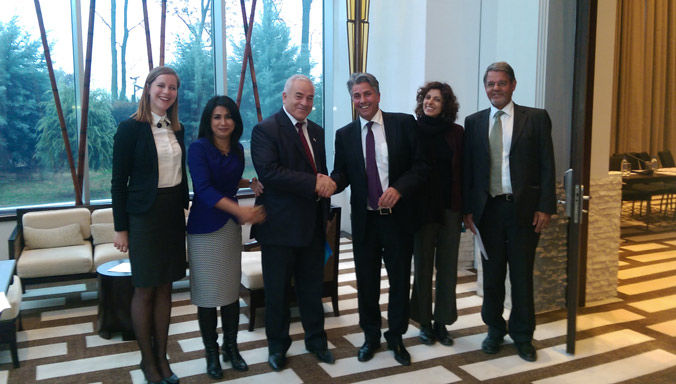
From left to right: the President of the Republic of Tajikistan, Emomali Rahmon shaking hands with NATO Secretary General Anders Fogh Rasmussen.

Ambassador Rahimov signing the PfP Framework Document.

NATO’s relations with Tajikistan should be viewed through the Partnership for Peace framework which the country joined in 2002. NATO and Tajikistan actively cooperate in the fight and against terrorism and have developed practical cooperation in many other areas. The Individual Partnership Programme (IPP) lays out the programme of cooperation between NATO and Tajikistan.

Tajikistan participates in a range of activities under the Partnership for Peace (PfP) programme.

How does cooperation work in practice?

Dialogue takes place within the framework of the Euro-Atlantic Partnership Council (EAPC). The NATO Secretary General’s Special Representative for the Caucasus and Central Asia, Ambassador Robert F. Simmons, conducts high-level political dialogue with Tajik authorities through regular visits to the country. The NATO Liaison Officer in Central Asia also visits Dushanbe regularly and reviews cooperation with the government.

NATO and Tajikistan are developing practical cooperation in a number of areas through the country’s Individual Partnership Programme (IPP), which is jointly agreed for a two-year period. Key areas include security and peacekeeping cooperation, especially counter-terrorism cooperation and border security, crisis management and civil emergency planning.

Security cooperation

Tajikistan plays an important role in supporting Allied operations in Afghanistan through the hosting of French military aircraft at Dushanbe Airport. The Allies and Tajikistan also cooperate in the fight against international terrorism. NATO is supporting the country in its efforts to create an educational course on counter-terrorism for the Military Institute of the Ministry of Defence. Tajikistan is also exchanging relevant expertise and information with the Allies.

Tajikistan has listed a number of units as available for NATO/PfP operations and training exercises. Participation requires a government decision in each individual case.
The units include an infantry platoon to support PfP activities within Tajikistan, a group of staff officers and a group of military medics. Tajikistan is also seeking to enhance cooperation with NATO Allies in mine-clearing activities. The country has participated in a number of PfP exercises with NATO Allies and other Partner countries.

Defence and security sector reform

Tajikistan aims to develop sustained and effective democratic control of its armed forces. In consultation with the Allies, the country is developing coordination procedures between the government, parliament and the military. It is also in the process of reforming its armed forces.  Cooperative processes with the PfP framework assist in achieving these goals and enhance the country’s ability to take part in peacekeeping or other operations alongside NATO forces.

The Allies are available for consultations on Tajikistan’s efforts to consolidate its defence policies, strategies and relevant legislation. NATO is also ready to support the country’s efforts to modernise and mobilise relevant state resources. NATO and Tajikistan are working to further cooperate in strengthening the country’s border security and countering cross-border crime, especially drug trafficking.

Military education is a key area of cooperation, and joint efforts are ongoing on developing courses in such areas as border security and control, and language training. NATO and Tajikistan continue to work on preparing selected individuals from the country for NATO-related activities and the possible introduction of Alliance standards in the country’s military education programmes. Tajikistan has sent officers to take part in NATO familiarisation courses and in various other courses at the NATO School at Oberammergau.

Civil emergency planning

Tajikistan is working to further familiarise itself with Allied disaster-relief organisation and procedures in order to further develop its own capabilities. The country is considering the creation of its own disaster-relief operation centre and the creation of a small, NATO-compatible disaster-relief unit.

The Allies are working with Tajikistan in developing early warning systems for natural disasters. Individuals from Tajikistan have participated in NATO-run tactical and operational civil-military-cooperation courses.

Science and environment

Scientists from Tajikistan have received grant awards in a number of areas under NATO’s Science for Peace and Security (SPS) programme. In 2006, a networking infrastructure grant was issued to upgrade the cooperative area network in the Tajik technical university.

Collaboration with NATO and other Partner countries is also ongoing on Uranium extraction and environmental security, and new SPS projects are under preparation.

Tajikistan also participates in the Virtual Silk Highway project, which aims to increase internet access for academic and research communities in countries of the Caucasus and Central Asia through a satellite-based network.

Public information

Tajikistan and NATO are working together to increase public understanding of NATO and the benefits of cooperation. The country is also aiming to increase public awareness in support of defence and security reforms.

Work is ongoing on building and enhancing networks with universities, non-governmental organisations, and the press and media in order to increase awareness of the Alliance and Euro-Atlantic security issues.

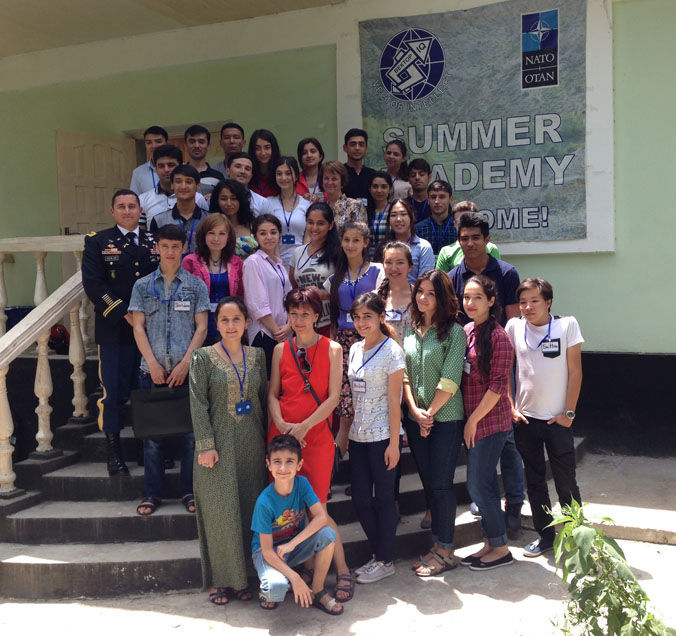
NATO supports educational activities relevant to security and defence issues in the country. In July 2006 and 2007, NATO’s Public Diplomacy Division sponsored a summer academy in Tajikistan which brought together advanced students from around the country and beyond, to learn about and discuss international security issues.

A group of parliamentarians and journalists from the country visited NATO Headquarters in July 2006. A group of government officials from Tajikistan visited NATO Headquarters in September 2007.

How did relations with Tajikistan evolve?

NATO-Tajikistan relations date back to 1992, when the country joined the North Atlantic Cooperation Council (later renamed the Euro-Atlantic Partnership Council in 1997). Tajikistan joined the Partnership for Peace in 2002 to work alongside the Allies in areas where bilateral aims converge. Since joining PfP, Tajikistan has played an active role in hosting and participating in PfP exercises, with a special focus on command and control, civil-emergency planning and civil-military co-operation. There remains further scope for deepening cooperation.

Key milestones

1992 Tajikistan joins the North Atlantic Cooperation Council, renamed the Euro-Atlantic Partnership Council in 1997
2002 Tajikistan joins the Partnership for Peace.
2003 Tajikistan is connected to the Virtual Silk Highway.
2004 NATO Secretary General Jaap de Hoop Scheffer visits Dushanbe
  The Allies sign a transit agreement with Tajikistan in support of the NATO-ISAF operations in Afghanistan
2006 The annual NATO-sponsored Summer Academy in Tajikistan runs its first course.
2007 On 2 July 2007, Tajikistan’s Foreign Minister, Hamrokhon Zarifi, visits NATO Headquarters for discussions with the NATO Secretary General.