NATO - North Atlantic Treaty Organisation

NATO’s relations with Armenia

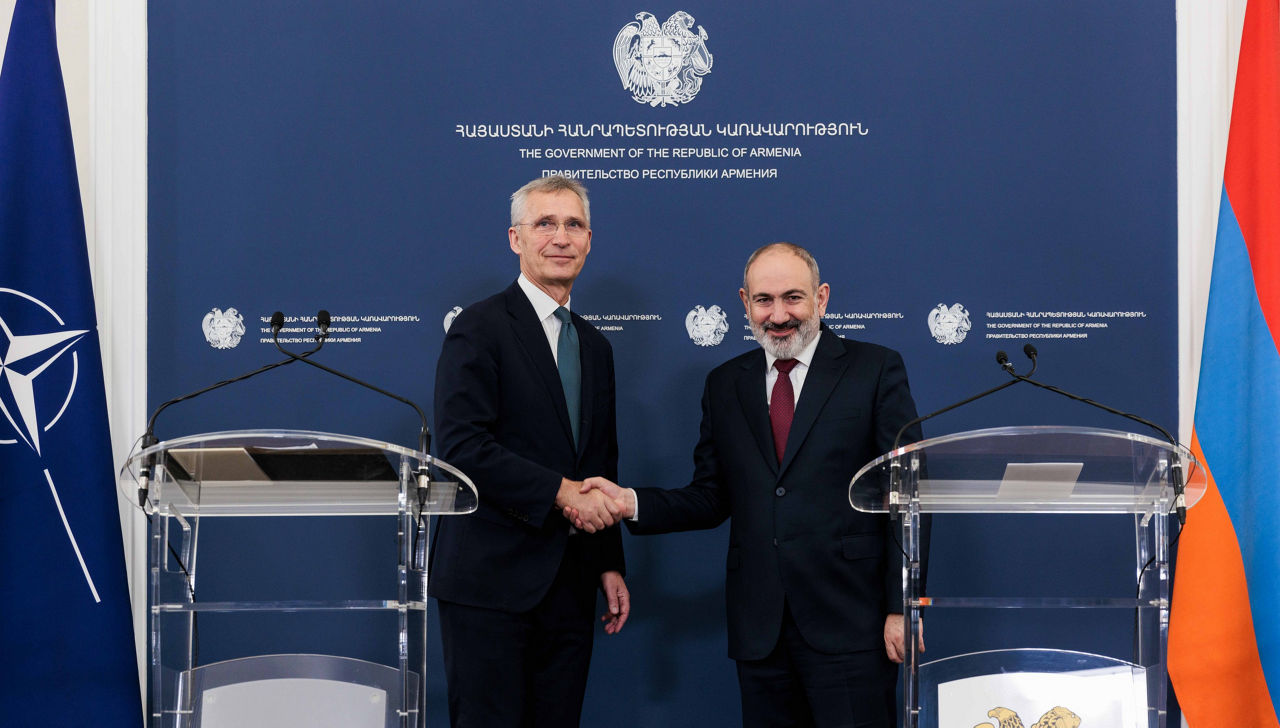
NATO Secretary General Anders Fogh Rasmussen shakes hands with the President of Armenia, Mr. Serzh Sargsyan

NATO and Armenia cooperate on democratic, institutional, and defence reforms, and have developed practical cooperation in many other areas, including peacekeeping operations. The Individual Partnership Action Plan (IPAP) lays out the programme of cooperation between Armenia and NATO and sets out a wide-ranging roadmap for reforms.

While Armenia intends to intensify practical and political cooperation with NATO in order to draw closer to the Alliance, it does not seek membership in NATO.

Beyond the focus on reform, another important area of cooperation is the country’s support for NATO-led operations. Armenian peacekeepers are currently deployed as part of the Kosovo Force (KFOR) and Armenia is considering contributing units to the International Security Assistance Force (ISAF) in Afghanistan.

Framework for cooperation

Armenia sets out its reform plans and timelines in its Individual Partnership Action Plan (IPAP), which is jointly agreed for a two-year period. Armenia’s IPAP is geared towards strengthening political dialogue between NATO and Armenia and to supporting Armenia’s democratic and defence reforms. 

The wide-ranging nature of the IPAP means that Armenia is not only cooperating with NATO in the defence sphere, but is in regular consultation with the Allies on rule of law, transparency of reforms, counter-terrorism and the fight against corruption. As part of the IPAP, NATO agrees to support Armenia in achieving its reform goals through providing focused advice and assistance.

Armenia also makes important contributions to NATO-led operations. In 2004, Armenian forces joined the NATO-led peacekeeping operations in Kosovo; the Armenian contingent in KFOR was doubled in 2008 to include about 85 personnel. Discussions on an Armenian contribution to the International Security Assistance Force (ISAF) in Afghanistan are ongoing.

Armenia also cooperates with NATO and other Partner countries in a wide range of other areas through the Partnership for Peace (PfP) programme and the Euro-Atlantic Partnership Council (EAPC). Armenia tailors its participation in the PfP programme through an annual Individual Partnership Programme, selecting those activities that will help achieve the goals it has set in the IPAP.

Key areas of cooperation

Security cooperation

Since joining the PfP in 1994, Armenia has contributed to Euro-Atlantic security alongside NATO Allies. Armenian troops have worked alongside those of NATO countries in peacekeeping operations in Kosovo since 2004. Armenia is considering contributing units to ISAF in Afghanistan.

Armenia is cooperating with NATO and individual Allies on facilitating the interoperability of the Armenian armed forces with those of NATO countries. This includes the establishment of a peacekeeping brigade, with combat support and combat service support units, using NATO standards. Armenia and NATO are also in consultations over the reform of Armenian military education practices.

Armenia’s participation in the PfP Planning and Review Process (PARP) since 2002 is helping develop the ability of its forces to work with NATO. PARP is a core element of Armenia’s cooperation with NATO.

Armenia contributes to the fight against terrorism through its participation in the Partnership Action Plan on Terrorism (PAP-T). This includes sharing intelligence and analysis with NATO, enhancing national counter-terrorist training capabilities and improving border security.

In consultation with NATO, Armenia has begun a process of reviewing its national crisis-management procedures and arrangements.

Defence and security sector reform

NATO is supportive of the wide-ranging democratic and institutional reform process underway in Armenia.  In the area of defence and security sector reform, NATO and individual Allies have considerable expertise that Armenia can draw upon.

A key priority for Armenia is to ensure democratic control of the armed forces. Armenia’s participation in Partnership Action Plan on Defence Institution Building initiative is reinforcing these efforts.

Armenia has consulted with NATO Allies on the development of a National Security Strategy and a new Military Doctrine and is currently conducting a Strategic Defence Review.. Armenia and NATO are in consultations over Armenian defence planning and defence budgeting procedures which will be key tools for the conduct and implementation of the Strategic Defence Review.

NATO and Armenia are cooperating on the establishment of a situation centre in Yerevan. This centre will assist in crisis-management and counter-terrorism coordination.

Civil emergency planning

Armenia is determined to improve its emergency preparedness and response capabilities to deal with disasters and asymmetric threats. In the context of the IPAP, the Armenian Rescue Service is taking a number of measures to improve contingency planning and is actively contributing to the establishment of the planned government crisis-management centre. Armenia is also working to enhance links with the NATO-based Euro-Atlantic Disaster Response Coordination Centre (EADRCC) in order to contribute to international disaster relief operations.

Science and environment

Under the Science for Peace and Security (SPS) Programme, Armenia has received grant awards for about 38 projects for scientific and environmental collaboration. Projects undertaken include the prevention, detection and response to nuclear and radiological threats, risk assessment on natural disasters and water security.

Other projects include collaboration on improving trans-boundary water quality with Azerbaijan and Georgia, and network technology studies. Armenia also participates in the Virtual Silk Highway project, which aims to improve internet access for academics and research communities in the countries of the Caucasus and Central Asia through a satellite-based network.

Public Information

Armenia intends to raise public awareness of NATO and Armenia’s cooperation with the Alliance, as well as to improve public information in support of its defence and security reforms. In line with this, NATO continues to provide advice and support where requested, including relevant training and consultations. An information centre on NATO was established in Yerevan in 2006 with the support of the Armenian government and NATO.

Evolution of relations

NATO-Armenia relations date back to 1992, when Armenia joined the North Atlantic Cooperation Council (renamed the Euro-Atlantic Partnership Council, EAPC, in 1997).

Cooperation deepened and broadened after Armenia joined the Partnership for Peace programme in 1994. Armenia’s participation in the PfP Planning and Review Process since 2002 and its first contribution to KFOR in 2004 further deepened relations. NATO and Armenia agreed on the country’s first Individual Partnership Action Plan (IPAP) in late 2005. 

Key milestones
1992 Armenia joins the newly created North Atlantic Cooperation Council, renamed the Euro-Atlantic Partnership Council in 1997
1994 Armenia joins the Partnership for Peace (PfP)
2002 Armenia  is connected to the Virtual Silk Highway.
  Armenia joins the PfP Planning and Review Process (PARP)
2003 Armenia hosts the PfP exercise “Cooperative Best Effort 2003” in June.
2004 Armenian forces join KFOR.
At the Istanbul Summit, Allied leaders place special focus on the Caucasus – a special NATO representative and a liaison officer are assigned to the region.
2005 On June 16, Foreign Minister Vartan Oskanian presents Armenia’s first IPAP to the North Atlantic Council.
  President Kocharian visits NATO Headquarters
  NATO and Armenia agree on Armenia’s first IPAP.
2006 Allies hold their first IPAP Assessment with Armenia in Brussels. Foreign Minister Oskanian and Defence Minister Sargsyan participate.
  A NATO information Centre is officially opened in Yerevan
2008 Armenia hosts the PfP Exercise Cooperative Longbow/Lancer
  The Armenian contingent in KFOR is doubled from one platoon to two platoons, plus Company staff (total about 85 personnel)
  Armenian President Serzh Sargsyan visits NATO headquarters.

Last updated: 27-Oct-2010 15:00