Close
Back


From now on you can download videos from our website
If you would also like to subscribe to the newsletter and receive our latest updates, click on the button below.
Enter the email address you registered with and we will send you a code to reset your password.
The password must be at least 12 characters long, no spaces, include upper/lowercase letters, numbers and symbols.
Click the button to return to the page you were on and log in with your new password.
Updated: 19 May 2022
High levels of piracy activity in the Gulf of Aden, off the Horn of Africa and in the Indian Ocean undermined international humanitarian efforts in Africa and the safety of one of the busiest and most important maritime routes in the world – the gateway in and out of the Suez Canal – for a long time. Between 2008 and 2016, NATO helped to deter and disrupt pirate attacks, while protecting vessels and helping to increase the general level of security in the region through different military operations.

For a long time, piracy and armed robbery disrupted the delivery of humanitarian aid to Somalia, and threatened vital sea lines of communication (SLOC) and economic interests off the Horn of Africa, in the Gulf of Aden and the Indian Ocean.
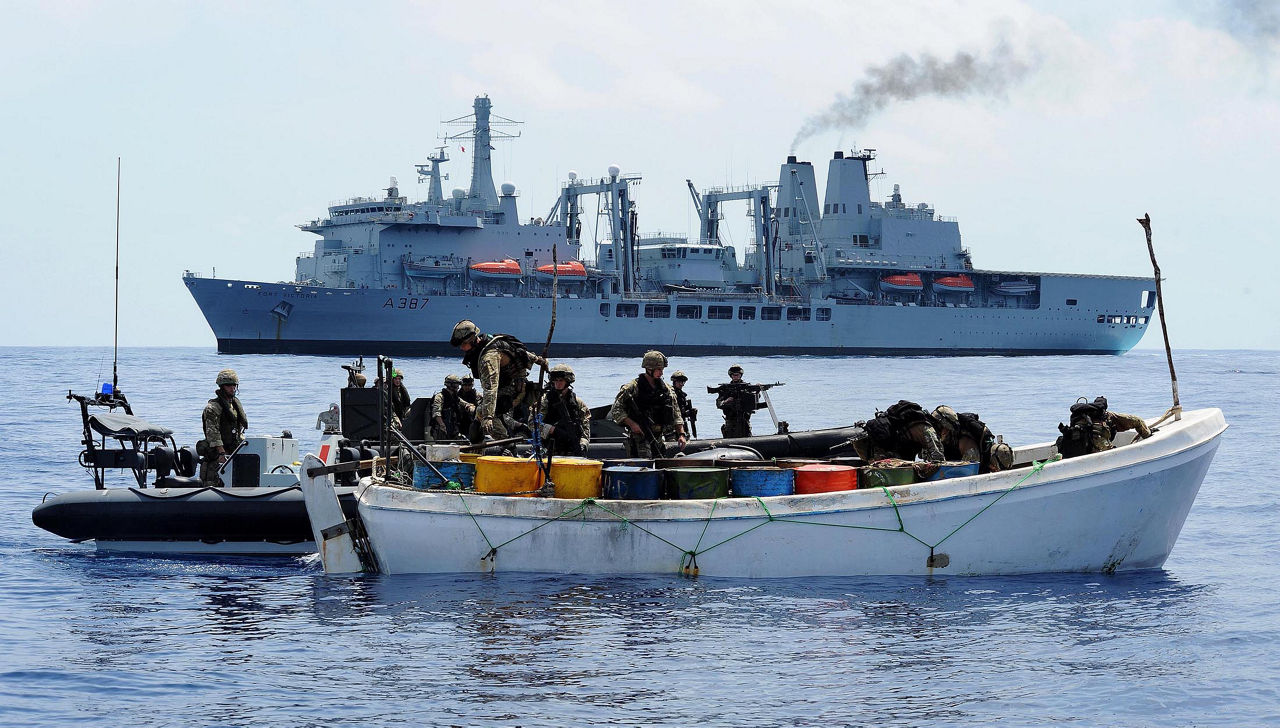
Building on the two previous counter-piracy missions conducted by NATO, Operation Ocean Shield initially focused on at-sea counter-piracy activities. NATO vessels conducted, for instance, helicopter surveillance missions to trace and identify ships in the area; they also helped to prevent and disrupt hijackings and to suppress armed robbery. NATO also agreed, at the request of the UN, to escort the United Nations Support Office for AMISOM (UNSOA) supply vessels to the harbour entrance of Mogadishu, Somalia.
Over time, the operation evolved to respond to new piracy tactics: the March 2012 Strategic Assessment, for instance, highlighted the need to erode the pirates’ logistics and support-base by, among other things, disabling pirate vessels or skiffs, attaching tracking beacons to mother ships and allowing the use of force to disable or destroy suspected pirate or armed robber vessels. With Operation Ocean Shield, the Alliance also broadened its approach to combating piracy by offering, within means and capabilities to regional states that request it, assistance in developing their own capacity to combat piracy. In sum, NATO's role was to prevent and stop piracy through direct actions against pirates, by providing naval escorts and deterrence, while increasing cooperation with other counter-piracy operations in the area in order to optimise efforts and tackle the evolving pirate trends and tactics.
Operation Ocean Shield was approved by the North Atlantic Council on 17 August 2009 and it was terminated on 15 December 2016.
NATO worked hand in hand with the European Union’s Atalanta, the US-led Combined Task Force 151 and with independent deployers such as China, Japan and South Korea.
From January 2015 onwards, NATO ships contributed to counter-piracy efforts through a “focused presence”, in line with the decision taken at the 2014 Wales Summit. This meant that assets were primarily deployed during the inter-monsoon periods (spring or autumn) and at other times if needed. During the periods without surface ships, maritime patrol aircraft continued to fly sorties, and links to situational awareness systems and counter-piracy partners remained in place. In this effort, the NATO Shipping Centre played a key role.
Partner countries also contributed to Operation Ocean Shield, including Australia, Colombia, New Zealand and Ukraine.
Allied Maritime Command Headquarters Northwood (MARCOM), in the United Kingdom, provides command and control for the full spectrum of NATO’s joint maritime operations and tasks, including Operation Ocean Shield at the time. From its location in Northwood, it plans, conducts and supports joint maritime operations. It is also the Alliance's principal maritime advisor and contributes to development and transformation, engagement and outreach within its area of expertise.
From 2009 to end 2014, Standing NATO Maritime Group 1 (SNMG1) and Standing NATO Maritime Group 2 (SNMG2) alternated between each other for the six-month rotations of Operation Ocean Shield. They otherwise functioned according to the operational needs of the Alliance, therefore helping to maintain optimal flexibility. SNMGs are part of NATO’s rapid-response capacity.
|
June - December 2014 - SNMG1 |
|
|---|---|
|
Commodore Aage Buur Jensen (Denmark) |
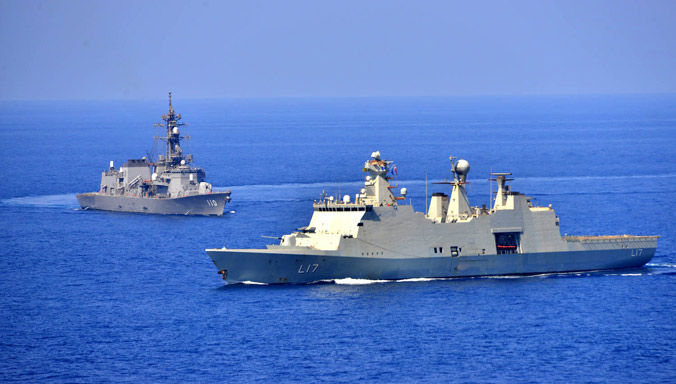
HDMS Absalon (flagship Denmark) |
|
January - June 2014 - SNMG2 |
|
|
Rear Admiral Eugenio Diaz del Rio (Spain) |
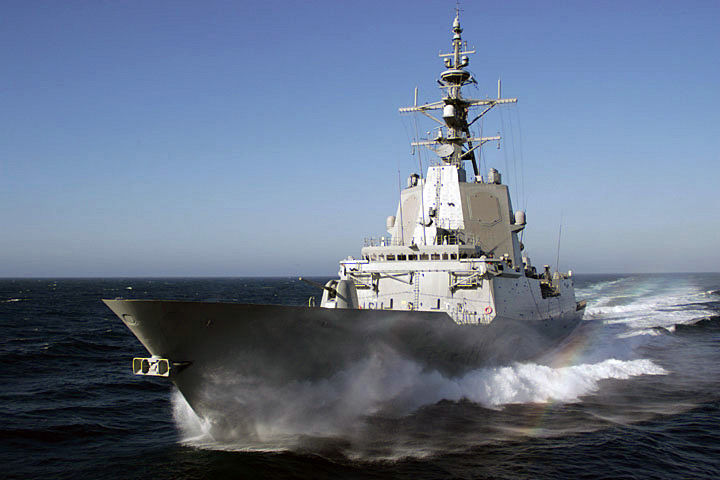
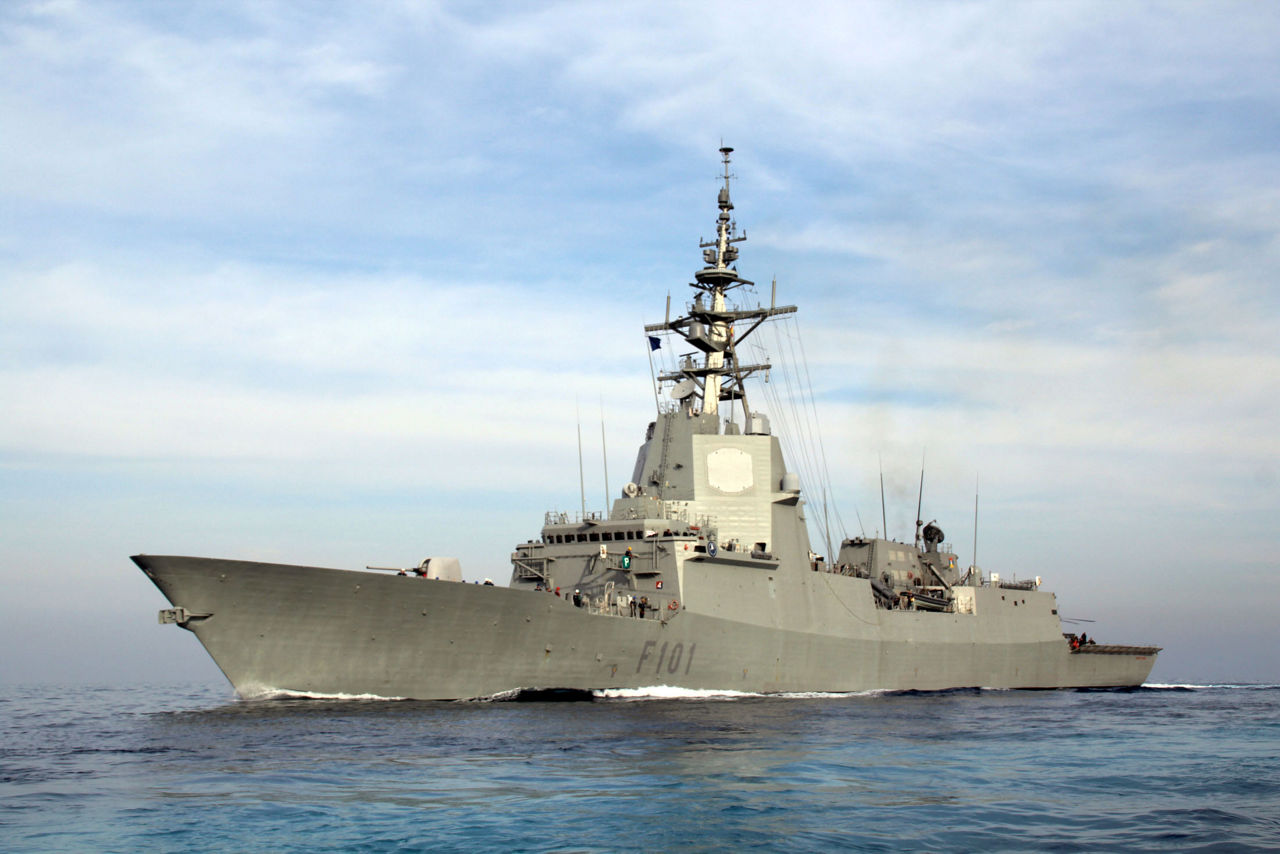
ESPS Cristobal Colon (initially ESPS Alvaro de Bazan) (flagship Spain) |
|
June - December 2013 - SNMG1 |
|
|
Rear Admiral Henning Amundsen (Norway) |
HNoMS Fridtjof Nansen (flagship, Norway) |
|
January - June 2013 - SNMG2 |
|
|
Rear Admiral Antonio Natale (Italy) |
ITS San Marco (flagship, Italy)* |
|
June - December 2012 - SNMG1 |
|
|
Rear Commodore Ben Bekkering (The Netherlands) |
HNLMS Evertsen (flagship. The Netherlands) |
|
January - June 2012 - SNMG2 |
|
|
Rear Admiral Sinan Tosun (Turkey) |
TCG Giresun (flagship, Turkey) |
|
June 2011 - December 2011 - SNMG1 |
|
|
Rear Admiral Gualtiero Mattesi (Italy) |
ITS Andrea Doria (flagship, Italy) |
|
December 2010 - June 2011 - SNMG2 |
|
|
Commodore Michiel Hijmans (The Netherlands) |
HNLMS De Ruyter (flagship – The Netherlands) |
|
August - early December 2010 - SNMG1 |
|
|
Commodore Christian Rune (Denmark) |
HDMS Esbern Snare (flagship, Denmark) |
|
March - August 2010 - SNMG2 |
|
|
12 March-30 June: |
HMS Chatham (flagship, United Kingdom) |
|
1st July-6 August: |
HNLMS De Zeven Provinciën (flagship, The Netherlands) |
|
November 2009 - March 2010 - SNMG1 |
|
|
Commodore Christian Rune |
NRP Álvares Cabral (outgoing flagship, Portugal) |
|
August - November 2009 - SNMG2 |
|
|
Commodore Steve Chick (United Kingdom) |
HS Navarinon (Greece) |
Among NATO’s Maritime Immediate Reaction Forces there are: the Standing NATO Maritime Groups (SNMGs) composed of SNMG1 and SNMG2; and the Standing NATO Mine Counter-Measure Groups (SNMCMG1 and SNMCMG2).
SNMGs are a multinational, integrated maritime force made up of vessels from various Allied countries. Their composition varies and usually comprises between six and ten ships. These vessels (including their helicopters) are permanently available to NATO to perform different tasks ranging from participating in exercises to actually intervening in operational missions. These groups provide NATO with a continuous maritime capability for operations and other activities in peacetime and in periods of crisis and conflict. They also help to establish Alliance presence, demonstrate solidarity, conduct routine diplomatic visits to different countries, support transformation and provide a variety of maritime military capabilities to ongoing missions.
SNMG1 and SNMG2 both come under the command of MARCOM, as do all Standing NATO Forces (i.e., SNMCMG1 and SNMCMG2) since the implementation of the new NATO Command Structure on 1 December 2012.
Operation Allied Protector helped to deter, defend against and disrupt pirate activities in the Gulf of Aden and off the Horn of Africa.
From 24 March until 29 June 2009, the operation was conducted by SNMG1 vessels. SNMG1 is usually employed in the Eastern Atlantic area, but it can deploy anywhere NATO requires. The first phase of Operation Allied Protector was undertaken as the force left for NATO’s first ever deployment to South East Asia. It made a short visit to Karachi (Pakistan) on 26-27 April. However, with the increase in pirate attacks, on 24 April NATO had already decided to cancel the other two port visits to Singapore and Australia. As such, the second phase of the operation, which was meant to take place as SNMG1 made its return journey towards European waters end June, was brought forward to 1 May.
From 29 June 2009, SNMG2 took over responsibility from SNMG1. It had conducted NATO’s first counter-piracy operation – Operation Allied Provider (see below).
|
24th March - 29th June 2009 - SNMG1 |
|
|---|---|
|
Rear Admiral Jose Pereira de Cunha (Portugal) |
NRP Corte Real (flagship, Portugal) |
|
29th June - August 2009 - SNMG2 |
|
|
Commodore Steve Chick (United Kingdom) |
ITS Libeccio (frigate, Italy) |
Operation Allied Provider was responsible for naval escorts to World Food Programme (WFP) vessels and, more generally, patrolled the waters around Somalia. Alliance presence also helped to deter acts of piracy that threatened the region.
While providing close protection for WFP vessels and patrolling routes most susceptible to criminal acts against merchant vessels, NATO ships could use force pursuant to the authorised Rules of Engagement and in compliance with relevant international and national law.
Allied Provider was a temporary operation that was requested by UN Secretary-General Ban Ki-moon on 25 September 2008. NATO provided this counter-piracy capacity in support of UN Security Council Resolutions 1814, 1816 and 1838, and in coordination with other international actors, including the European Union.
NATO Defence Ministers agreed to respond positively to the UN’s request on 9 October, during an informal meeting held in Budapest, Hungary. Following this decision, planning started to redirect assets of SNMG2 to conduct counter-piracy duties.
SNMG2 was already scheduled to conduct a series of Gulf port visits in Bahrain, Kuwait, Qatar and the United Arab Emirates within the framework of the Istanbul Cooperation Initiative (ICI). As such, it started to transit the Suez Canal on 15 October to conduct both duties at the same time.
At the time of the operation, SNMG2 comprised seven ships from Germany, Greece, Italy, Turkey, the United Kingdom and the United States, of which three were assigned to Operation Allied Provider:
The other four ships (FGS Karlsruhe-Germany; FGS Rhön-Germany; TCG Gokova-Turkey; and USS The Sullivans-USA) continued deployment to ICI countries. This was the first time a NATO-flagged force deployed to the Gulf.
At the time of the operation, SNMG2 was commanded by Rear Admiral Giovanni Gumiero, Italian Navy, who was appointed to this post in July 2008. He reported to the Commander of Allied Component Command Maritime (CC-Mar) Naples. CC Mar Naples was one of the three Component Commands of Allied Joint Force Command Naples.
15 December 2016
26 September 2014
20 May 2012
3 December 2008