Close
Back


From now on you can download videos from our website
If you would also like to subscribe to the newsletter and receive our latest updates, click on the button below.
Enter the email address you registered with and we will send you a code to reset your password.
The password must be at least 12 characters long, no spaces, include upper/lowercase letters, numbers and symbols.
Click the button to return to the page you were on and log in with your new password.
Updated: 25 June 2025
NATO summit meetings provide periodic opportunities for the Heads of State and Government of NATO member countries to discuss important issues facing the Alliance and provide strategic direction for its activities. The last NATO summit was held in The Hague, the Netherlands on 24-25 June 2025. The next will be held in Türkiye in 2026.

NATO summit meetings are effectively meetings of the North Atlantic Council (NAC) – the Alliance's principal political decision-making body – at its highest level, that of Heads of State and Government.
Due to the political significance of summit meetings, agenda items typically address issues of overarching political or strategic importance. Items can relate to the internal functioning of the Alliance as well as NATO's relations with external partners.
Many of NATO's summit meetings were milestones in the evolution of the Alliance. For instance, the first post-Cold War summit was held in London, in 1990, and outlined proposals for developing relations with Central and Eastern European countries. A year later, in Rome, NATO Heads of State and Government published a Strategic Concept that reflected the new security environment. This was the first time ever that a NATO Strategic Concept was issued as a public document. At the same summit, NATO established the North Atlantic Cooperation Council – a forum that officially brought together NATO and partner countries from Europe, Central Asia and the Caucasus.
The 1997 Madrid and Paris Summits invited the first countries of the former Warsaw Pact – Czechia, Hungary and Poland – to join NATO, and established partnerships between NATO and Russia and Ukraine, while the 2002 Prague Summit saw major commitments to improving NATO's capabilities and transformed the military command structure.
More recently, since Russia’s full-scale invasion of Ukraine on 24 February 2022, NATO has held a series of summits, including an extraordinary virtual summit the next day, an extraordinary summit at NATO Headquarters in Brussels one month later and summits in Madrid (2022), Vilnius (2023), Washington (2024) and The Hague (2025). At these summits, NATO Allies have reaffirmed their enduring commitments to provide support to Ukraine as it defends itself against Russia’s war of aggression. They have also undertaken the biggest reinforcement of the Alliance’s collective defence since the Cold War, strengthening NATO’s deterrence and defence posture against all threats and challenges.
Typically, the decisions taken at a summit meeting are issued in declarations and communiqués. These are public documents that explain the Alliance's decisions and reaffirm Allies' support for NATO policies. The summit declarations and communiqués are linked below for each NATO summit.
The decisions are then translated into action by the relevant actors within NATO, according to the area of competency and responsibility: the NAC's subordinate committees and NATO's command structure, which cover the whole range of the Organization's functions and activities.
Summits are convened upon approval by the NAC at the level of Permanent Representatives (or Ambassadors) or Foreign and Defence Ministers. They are usually called on an ad-hoc basis, as required by the evolving political and security situation.
From the founding of NATO in 1949 until the end of the Cold War – over 40 years – there were 10 summit meetings. Since 1990, their frequency has increased considerably in order to address the changes brought on by the new security challenges.
Extraordinary summits
Although they do not follow a regular or set schedule, NATO summits are normally planned far in advance. Under exceptional circumstances, however, the Alliance has at times applied exceptional measures. Following Russia's full-scale invasion of Ukraine, which started on 24 February 2022, NATO Leaders held an extraordinary virtual summit on 25 February, hosted via secure videoconference by the NATO Secretary General from NATO Headquarters in Brussels. This was shortly followed by an extraordinary in-person summit meeting on 24 March, where NATO Heads of State and Government met to address the consequences of Russia's war on Ukraine and take measures to further strengthen NATO's deterrence and defence.
In addition to full NATO summits, a number of "Leaders' Meetings" or "Special Meetings" have taken place. These meetings involved the participation of NATO Heads of State and Government, but they are not considered as official NATO summits. These include:
NATO summit meetings are held in one of the member countries (including at NATO Headquarters in Belgium). Members volunteer to host a summit meeting and, after evaluating all offers, the NAC makes the final decision concerning the location.
In recent times, summit locations have held some thematic significance. For example, the summits held in Washington, D.C. in 1999 and 2024 commemorated the 50th and 75th anniversaries of the signing of the North Atlantic Treaty in that city. Istanbul – which hosted a summit meeting in 2004 – connects Europe and Asia and is where the Alliance launched the Istanbul Cooperation Initiative. This initiative is intended to foster linkages between NATO and the broader Middle East.
NATO summits normally involve member countries only. However, on occasion, and provided Allies agree, meetings can be convened in other formats. They include, for instance, meetings of Defence Ministers and Foreign Ministers or meetings of Heads of State and Government from partner countries (for example, Ukrainian President Volodymyr Zelenskyy joined Allied Leaders for sessions of the NATO-Ukraine Council at the 2023 Vilnius Summit and 2024 Washington Summit). They can also include leaders from countries contributing troops to a NATO-led operation (as was the case at the 2010 Lisbon Summit for countries contributing troops to NATO's ISAF mission in Afghanistan) or top representatives from international organisations such as the United Nations, the European Union or the World Bank.
NATO summits are centred on the activities of the North Atlantic Council (NAC or Council). As with all NAC meetings, the Secretary General chairs them and plays an important role in coordination and deliberations to help members reach consensus on the issues at hand.
As with meetings at the levels of Permanent Representatives and Foreign and Defence Ministers, the work of the NAC is prepared by subordinate committees with responsibility for specific areas of policy. The Deputies Committee, which consists of Deputy Permanent Representatives, is responsible for drafting declarations and communiqués after meetings of Heads of State and Government, as well as Foreign and Defence Ministers.
Other aspects of political work may be handled by the Political Committee and the Partnerships and Cooperative Security Committee. Depending on the topic under discussion, the respective senior committee with responsibility for the subject assumes the lead role in preparing Council meetings and following up on Council decisions.
Support to the Council is provided by the Secretary of the Council, who is also Director of the ministerial and summit meeting task forces. The Secretary of the Council ensures that NAC mandates are executed and its decisions recorded and circulated. The Council Secretariat ensures the bureaucratic and logistical aspects of the Council's work, while the relevant divisions of the International Staff support the work of committees reporting to the NAC.
The first time that Heads of State and Government from NATO countries met was at the actual signing ceremony of the North Atlantic Treaty on 4 April 1949, but this was not a summit meeting. The first summit meeting was held eight years later, in Paris in 1957. Subsequent summits have since occurred at key junctures in the history of the Alliance. Below, all official NATO summits are listed in reverse chronological order.
The 2025 NATO Summit in The Hague focused on three key priorities: increasing defence investment and fairer burden-sharing by Allies, strengthening the Alliance’s defence industrial capacity and expanding production lines, and continuing NATO’s unwavering support for Ukraine. Allies committed to investing 5% of Gross Domestic Product annually on defence by 2035, including 3.5% on core defence requirements for Allied militaries and 1.5% on defence- and security-related spending in areas such as critical infrastructure protection, a major increase from the 2% defence investment pledge that Allies made in 2014. At a side event of the summit focused on defence industrial cooperation, Allies discussed practical solutions to strengthen transatlantic cooperation, boost production capacity and support innovation, including by working in close partnership with the European Union and Ukraine. Allies also publicly released new policies to improve the development and procurement of new capabilities, namely an updated Defence Production Action Plan, the first NATO Commercial Space Strategy and a Rapid Adoption Action Plan to accelerate the pace at which Allies develop and integrate new technologies.
Allied Leaders met in Washington, D.C. – the city where the North Atlantic Treaty was signed in 1949 – to commemorate NATO’s 75th anniversary. The landmark summit had three main focuses: strengthening NATO’s deterrence and defence, bolstering long-term support to Ukraine, and deepening NATO’s partnerships. On the first point, Allies reaffirmed their commitment to investing 2% of Gross Domestic Product in defence (noting that two thirds of Allies have reached that threshold) and pledged to expand their defence industrial capacity to urgently deliver the most critical capabilities. They welcomed the progress made since the Madrid and Vilnius Summits on reinforcing and modernising NATO for a new era of collective defence, and agreed to further enhance NATO’s Integrated Air and Missile Defence with new ballistic missile defence assets, and boost NATO’s cyber defence with a new NATO Integrated Cyber Defence Centre. On Ukraine, Allies reaffirmed that they will continue to support Ukraine on its irreversible path to full Euro-Atlantic integration, including NATO membership. Allies agreed to establish NATO Security Assistance and Training for Ukraine (NSATU) to coordinate the provision of military equipment and training for Ukraine by Allies and partners, and confirmed the creation of the NATO-Ukraine Joint Analysis, Training and Education Centre (JATEC) to identify and apply lessons learned and increase Ukraine’s interoperability with NATO. They also announced a Pledge of Long-Term Security Assistance for Ukraine, providing a minimum baseline funding of EUR 40 billion within the next year, and sustainable levels of security assistance in the future. On partnerships, Allies welcomed leaders from Australia, Japan, New Zealand, the Republic of Korea and the European Union to discuss common security challenges and areas of cooperation. They also welcomed Sweden to its first summit as a NATO Ally.
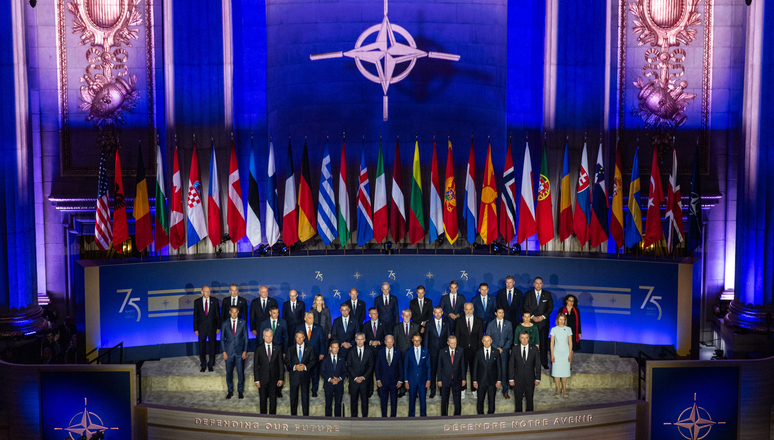
At the 2024 NATO Summit, the Heads of State and Government of the 32 NATO Allies and the NATO Secretary General stand together in the Mellon Auditorium in Washington, D.C. – the same room where the 12 founding Allies signed the North Atlantic Treaty 75 years before.
NATO Leaders met in Vilnius as Russia continues its illegal, unjustifiable and unprovoked war of aggression against Ukraine, which has gravely undermined Euro-Atlantic and global security. In this context, Allies boosted NATO's deterrence and defence by approving new regional plans to counter the two main threats to the Alliance: Russia and terrorism. Allies renewed their pledge to invest a minimum of 2% of Gross Domestic Product annually on defence, and endorsed a Defence Production Action Plan to accelerate joint procurement, boost interoperability and generate investment and production capacity. NATO Leaders agreed a multi-year assistance programme for Ukraine, held the inaugural meeting of the NATO-Ukraine Council, and reaffirmed that Ukraine will become a member of NATO when Allies agree and conditions are met. NATO Leaders also addressed China and the challenges it poses to the rules-based international order, and met with the leaders of Australia, Japan, New Zealand and South Korea, as well as the European Union, to discuss global challenges and their impact on Euro-Atlantic security. Allies welcomed Finland to its first summit as a NATO Ally, and looked forward to welcoming Sweden to the Alliance following Türkiye's agreement to ratify Sweden's accession protocol.
NATO Leaders adopted a new Strategic Concept, agreed a more proactive posture to bolster responsiveness, readiness and combat power, and took measures to strengthen NATO's deterrence and defence in the long term. In the context of Russia's war on Ukraine, they reiterated NATO's continued support to Ukraine and to other partners at risk. They reaffirmed NATO's Open Door Policy and officially invited Finland and Sweden to join NATO. They engaged with partners in the Indo-Pacific region to increase cooperation and focused on challenges from the south, including terrorism and the world food crisis caused by Russia's war on Ukraine. Allies committed to investing more in defence, to boosting resilience and to integrating cross-cutting issues such as technological innovation, climate change, human security and Women, Peace and Security across the Alliance's core tasks.

Ukrainian President Volodymyr Zelenskyy addresses NATO Heads of State and Government at the 2022 Madrid Summit.
Addressing the consequences of Russia's unprovoked war on Ukraine, Allied Leaders agreed to reset NATO's longer-term deterrence and defence posture across all domains – land, sea, air, cyber and space. They reaffirmed the unity and resolve in their determination to oppose Russia's aggression, aid the government and people of Ukraine, and defend the security of all Allies.
NATO Leaders unanimously condemned Russia's full-scale invasion of Ukraine – the gravest threat to Euro-Atlantic security in decades – and reiterated their support to Ukraine. They also stated that they would make all deployments necessary to ensure strong and credible deterrence and defence across the Alliance, now and in the future.

Then Secretary General Jens Stoltenberg chairs the first-ever virtual NATO summit, held by secure videoconference on the day after Russia's full-scale invasion of Ukraine on 24 February 2022.
NATO Leaders agreed a set of proposals under the NATO 2030 reform agenda to strengthen the Alliance as a forum for political consultations; reinforce collective defence through increased readiness, modernised capabilities and more investment; and develop Alliance-wide resilience objectives to make societies less vulnerable to attack and coercion. A plan to boost transatlantic innovation, including with a new "defence accelerator" to foster cooperation, was adopted, as well as measures to uphold the rules-based international order, such as deepening partnerships and plans to step up training and capacity-building for partners. Leaders also agreed to address the security consequences of climate change and develop NATO's next Strategic Concept in time for the next summit in 2022.
Three principal issues: reinforcing the Alliance's deterrence and defence, stepping up the fight against terrorism and fairer burden-sharing between NATO members. Decisions were taken on raising the readiness of NATO forces, modernising the military command structure and setting up a cyberspace operations centre and counter-hybrid support teams. Leaders remained committed to a dual-track approach to Russia – defence and dialogue – and addressed challenges from the Middle East and North Africa. NATO launched a new training mission in Iraq and offered more support to Jordan and Tunisia. The financing for Afghan security forces was also extended until 2024. The government of Skopje was invited for accession talks to become NATO's 30th member.
Focus on two pillars: strengthening NATO's deterrence and defence, and projecting stability beyond NATO's borders. Measures, such as the positioning of four multinational battalions in Estonia, Latvia, Lithuania and Poland in 2017 and the development of a tailored forward presence in the south-eastern part of NATO, were adopted; Initial Operational Capability of NATO's ballistic missile defence declared; pledge to strengthen national cyber defences while cyberspace is recognised as a new operational domain like land, air and maritime; support to be provided to partners, especially in the fields of training and capacity-building; decision to use AWACS aircraft in service until 2035 and use them to provide information to the Global Coalition to Counter ISIL; agreement on changing NATO's counter-terrorism Operation Active Endeavour to a broader Maritime Security Operation; agreement to extend Resolute Support Mission in Afghanistan beyond 2016 and funding for Afghan forces until 2020; endorsement of a Comprehensive Assistance Package for Ukraine; then Secretary General of NATO Jens Stoltenberg signs a Joint Declaration with the Presidents of the European Council and the European Commission.

Allied armed forces carry their national flags in a ceremony honouring NATO military personnel in operational theatres before Heads of State and Government at the 2016 Warsaw Summit.
Renewed commitment to the Transatlantic Bond and to a robust defence capability; Pledge to reverse defence cuts and adoption of a Readiness Action Plan, including a Very High Readiness Joint Task Force; Increased support to Ukraine in the wake of the crisis with Russia; Continued condemnation of Russia's illegal and illegitimate "annexation" of Crimea and destabilisation of eastern Ukraine; Strengthened relations with partners through the Partnership Interoperability Initiative and the Defence and Related Security Capacity Building Initiative; Reassertion of NATO's commitment to Afghanistan through the Resolute Support Mission, financial contributions to the Afghan National Security Forces, and the NATO-Afghanistan Enduring Partnership; Tribute to the Armed Forces as NATO marks its 65th anniversary and two decades of operations on land, sea and air.
NATO Leaders set out a strategy to conclude the transition of security responsibility to Afghan forces by end 2014 and commit to a post-2014 mission to train, advise and assist Afghan forces; Talks on Afghanistan bring together over 60 countries and organisations in Chicago; Approval of the Deterrence and Defence Posture Review and adoption of a Defence Package and new policy guidelines on counter-terrorism; An Interim Ballistic Missile Capability was declared and initiatives taken in other key capability areas (intelligence, surveillance and reconnaissance, and air policing); Commitment to pursue cooperative security and engage with partners across the globe as well as countries that aspire to NATO membership.

General John R. Allen, then Commander of NATO's International Security Assistance Force (ISAF) in Afghanistan, throws out the first pitch at Wrigley Field during the 2012 Chicago Summit. Over the years, host countries have sometimes organised cultural events on the side lines of NATO summits. In Chicago, military and NATO personnel were able to enjoy the Crosstown Classic game between the Chicago Cubs and the Chicago White Sox.
Publication of a new Strategic Concept; Transition to full Afghan security responsibility to start in 2011; Agreement on a long-term partnership with Afghanistan; Decision to develop a NATO missile defence system to protect populations and territory in Europe, in addition to deployed troops; Russia invited to cooperate as part of a "reset" of relations with NATO; Adoption of a comprehensive approach to crisis management, including a greater role in stabilisation and reconstruction and more emphasis on training and developing local forces; Continue to support arms control, disarmament and non-proliferation efforts, and maintain an appropriate mix of nuclear and conventional forces; Adoption of the Lisbon Capabilities Package; Agreement to develop a cyber defence policy and action plan; Reform of NATO's military command structure and agencies; New impetus given to relations with partners and NATO's partnership policy.
Against the backdrop of NATO's 60th anniversary, adoption of a Declaration on Alliance Security calling for a new Strategic Concept; adherence to basic principles and shared values, as well as the need for ongoing transformation; in-depth discussion on Afghanistan; welcoming of two new members: Albania and Croatia, and the pursuit of NATO's open door policy (invitation extended to North Macedonia, known at the time as the former Yugoslav Republic of Macedonia); France's decision to fully participate in NATO structures and the impact of this decision on the Alliance's relations with the European Union; NATO's relations with Russia.

French and German airplanes fly over the 2009 Strasbourg / Kehl Summit venue, displaying the NATO colours in the sky.
Allied Leaders review the evolution of NATO's main commitments: operations (Afghanistan and Kosovo); enlargement and the invitation of Albania and Croatia to start the accession process (the Republic of North Macedonia, known at the time as the former Yugoslav Republic of Macedonia, to be invited as soon as negotiations over its name lead to an agreement); the continued development of military capabilities.
Review of progress in Afghanistan in light of the expansion of the International Security Assistance Force (ISAF) to the entire country and call for broader international engagement; Confirmation that the Alliance is prepared to play its part in implementing the security provisions of a settlement on the status of Kosovo; Measures adopted to further improve NATO's military capabilities; NATO Response Force declared operational; Comprehensive Political Guidance published; Initiatives adopted to deepen and extend relations with partners; Bosnia and Herzegovina, Montenegro and Serbia invited to join the Partnership for Peace programme.

NATO Heads of State and Government attend a show at the Latvian National Opera during the 2006 Riga Summit. Over the years, host countries have sometimes organised cultural events on the side lines of NATO summits. In Riga, NATO Leaders enjoyed a choral performance by the Kamer youth choir.
Leaders reaffirm their support for building stability in the Balkans, Afghanistan and Iraq, and commit to strengthening the partnership between NATO and the European Union.
Summit held at 26, with seven new members; Expansion of NATO's operation in Afghanistan with the establishment of Provincial Reconstruction Teams throughout the country; Agreement to assist the Iraqi Interim Government with the training of its security forces; Maintaining support for stability in the Balkans; Decision to change NATO's defence-planning and force-generation processes, while strengthening contributions to the fight against terrorism, including WMD aspects; Strengthening cooperation with partners and launch of the Istanbul Cooperation Initiative with countries from the broader Middle East region.
Invitation of Bulgaria, Estonia, Latvia, Lithuania, Romania, Slovakia and Slovenia to begin accession talks; Adoption of measures to improve military capabilities (The Prague Capabilities Commitment, the NATO Response Force and the streamlining of the military command structure); Adoption of a Military Concept for Defence against Terrorism; Decision to support NATO member countries in Afghanistan; Endorsement of a package of initiatives to forge new relationships with partners.
NATO Allies and the Russian Federation create the NATO-Russia Council, where they meet as equal partners, bringing a new quality to NATO-Russia relations. The NATO-Russia Council replaces the NATO-Russia Permanent Joint Council.
Commemoration of NATO's 50th anniversary; Allies reiterate their determination to put an end to the repressive actions by Yugoslav President Milosevic against the local ethnic Albanian population in Kosovo; Czechia, Hungary and Poland participate in their first summit meeting; Adoption of the Membership Action Plan; Publication of a revised Strategic Concept; Enhancement of the European Security and Defence Identity within NATO; Launch of the Defence Capabilities Initiative; Strengthening of the Partnership for Peace and the Euro-Atlantic Partnership Council, as well as the Mediterranean Dialogue; Launch of the Weapons of Mass Destruction (WMD) Initiative.

NATO Allies meet in the Mellon Auditorium in Washington D.C., where the 12 founding member countries signed the North Atlantic Treaty in April 1949. The 1999 Washington Summit marked the 50th anniversary of the Alliance. (US Department of Defense photo by R. D. Ward)
Invitations to Czechia, Hungary and Poland to begin accession talks; Reaffirmation of NATO's Open Door Policy; Recognition of achievement and commitments represented by the NATO-Russia Founding Act; Signature of the Charter on a Distinctive Partnership between NATO and Ukraine; First meeting of the Euro-Atlantic Partnership Council at summit level that replaces the North Atlantic Cooperation Council; An enhanced Partnership for Peace; Updating of the 1991 Strategic Concept and adoption of a new defence posture; Reform of the NATO military command structure; Special Declaration on Bosnia and Herzegovina.
Signing of the Founding Act on Mutual Relations, Cooperation and Security between the Russian Federation and the North Atlantic Treaty Organization. The Founding Act states that NATO and Russia are no longer adversaries and establishes the NATO-Russia Permanent Joint Council.
Launching of the Partnership for Peace (PfP) initiative; All North Atlantic Cooperation Council partner countries and members of the Conference on Security and Co-operation in Europe (CSCE) are invited to participate; Publication of the PfP Framework Document; Endorsement of the concept of Combined Joint Task Forces (CJTFs) and other measures to develop the European Security and Defence Identity (ESDI); Reaffirmation of Alliance readiness to carry out air strikes in support of United Nations objectives in Bosnia and Herzegovina.
Publication of several key documents: the Alliance's new Strategic Concept, the Rome Declaration on Peace and Cooperation and statements on developments in the Soviet Union and the situation in Yugoslavia.
Publication of the London Declaration on a Transformed North Atlantic Alliance, outlining proposals for developing cooperation with the countries of Central and Eastern Europe across a wide spectrum of political and military activities including the establishment of regular diplomatic liaison with NATO.

A group of 'Pearly Kings and Queens' – East London residents who sew thousands of buttons into their clothes and raise money for charities – arrives to watch the proceedings at the 1990 London Summit, a landmark summit that helped set NATO's direction after the Cold War.
Against the background of fundamental changes in Central and Eastern Europe and the prospect of the end of the division of Europe, US President Bush consults with Alliance Leaders following his summit meeting with Soviet President Gorbachev in Malta. While the NATO summit meeting is taking place, Warsaw Pact leaders denounce the 1968 invasion of Czechoslovakia and repudiate the Brezhnev Doctrine of limited sovereignty.
Declaration commemorating the 40th anniversary of the Alliance setting out Alliance policies and security objectives for the 1990s aimed at maintaining Alliance defence, introducing new arms control initiatives, strengthening political consultation, improving East-West cooperation and meeting global challenges; Adoption of a Comprehensive Concept of Arms Control and Disarmament.
Reaffirmation of the purpose and principles of the Alliance (reference to the Harmel Report on the Future Tasks of the Alliance published in 1967) and of its objectives for East-West relations; Adoption of a blue print for strengthening stability in the whole of Europe through conventional arms control negotiations.
Special meeting of the North Atlantic Council for consultations with US President Reagan on the positive outcome of the US-USSR Geneva Summit on arms control and other areas of cooperation.
Accession of Spain; Adoption of the Bonn Declaration setting out a six-point Programme for Peace in Freedom; Publication of a statement of Alliance's goals and policies on arms control and disarmament and a statement on integrated NATO defence.

NATO Heads of State and Government – including the Prime Minister of Spain, which had just become NATO's 16th member country – meet at the 1982 Bonn Summit.
Review of interim results of long-term initiatives taken at the 1977 London Summit; Confirmation of the validity of the Alliance's complementary aims of maintaining security while pursuing East-West détente; Adoption of three per cent target for growth in defence expenditures.
Initiation of study on long-term trends in East-West relations and of a long-term defence programme (LTDP) aimed at improving the defensive capability of NATO member countries.
Affirmation of the fundamental importance of the Alliance and of Allied cohesion in the face of international economic pressures following the 1974 oil crisis; Support for successful conclusion of negotiations in the framework of the Conference on Security and Co-operation in Europe (CSCE) (to result in 1975 in the signing of the Helsinki Final Act).
Signature by Heads of State and Government of the Declaration on Atlantic Relations adopted by NATO Foreign Ministers in Ottawa on 19 June, confirming the dedication of Allies to the aims and ideals of the North Atlantic Treaty in the 25th anniversary of its signature; Consultations on East-West relations in preparation for US-USSR summit talks on strategic nuclear arms limitations.
Reaffirmation of the principal purposes and unity of the Atlantic alliance; Improvements in the coordination and organisation of NATO forces and in political consultation arrangements; Recognition of the need for closer economic ties and for cooperation in the spirit of Article 2 of the Treaty, designed to eliminate conflict in international policies and encourage economic collaboration (Report of the Committee of the Three on Non-Military Cooperation in NATO, the so-called report of the Three Wise Men).

NATO's first ever summit brought together the Heads of State and Government at the former NATO Headquarters in Paris in December 1957.
29 October 2025
29 August 2025
18 July 2025
25 June 2025