NATO - North Atlantic Treaty Organisation

NATO’s relations with Kazakhstan

Left to right:  Kanat Saudabayev (Minister of Foreign Affairs of Kazakhstan) shaking hands with NATO Secretary General, Anders Fogh Rasmussen.

NATO and Kazakhstan actively cooperate on democratic, institutional, and defence reforms, and have developed practical cooperation in many other areas. The Individual Partnership Action Plan (IPAP) lays out the overall programme of cooperation between Kazakhstan and NATO. The defence-related fields of cooperation are supported by the Planning and Review Process (PARP).
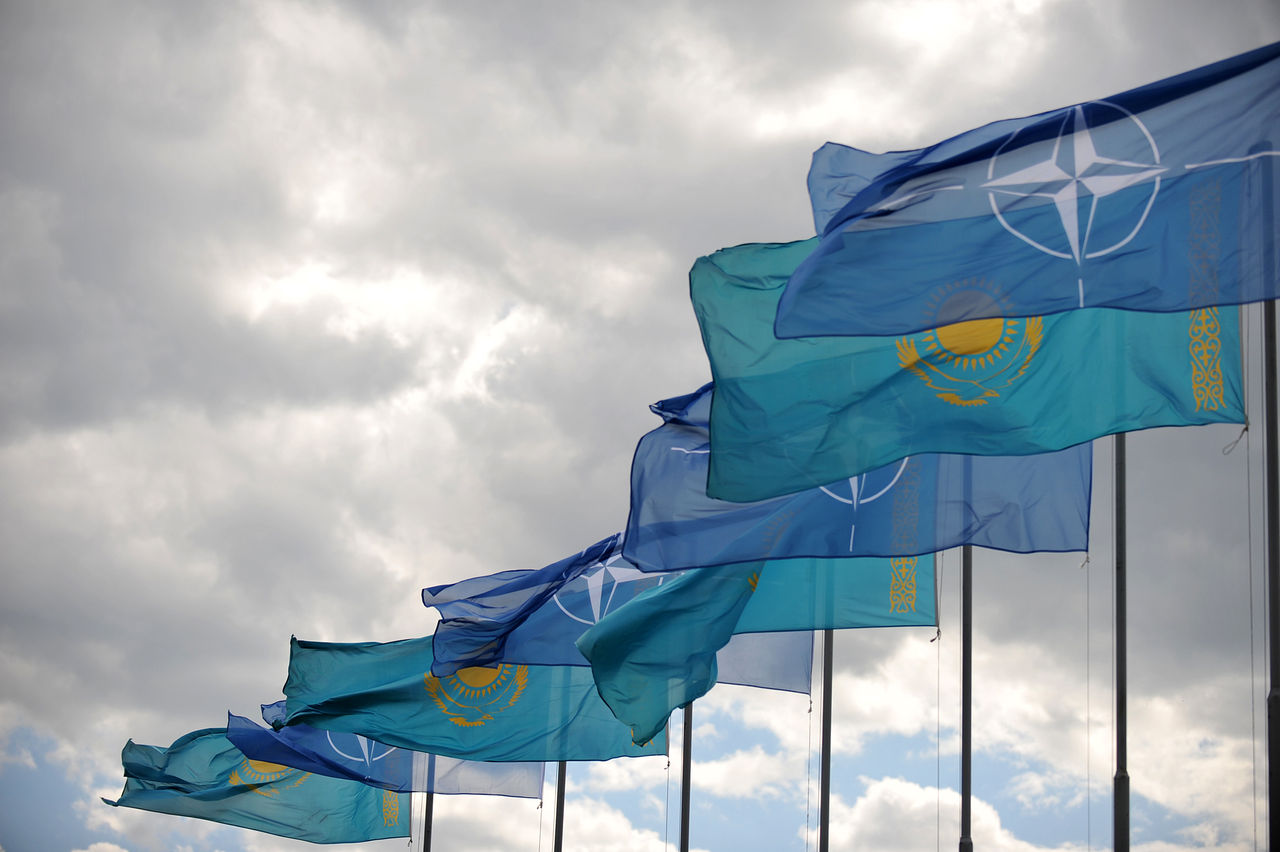
Kazakhstan is an active participant in activities under the Partnership for Peace programme, and joint activities are ongoing. NATO’s cooperation with Kazakhstan has been steadily increasing, and is aimed at assisting the country with its reform process.

How does cooperation work in practice?

Dialogue takes place within the framework of the Euro-Atlantic Partnership Council (EAPC). The NATO Secretary General’s Special Representative for the Caucasus and Central Asia, Ambassador Robert F. Simmons, conducts high-level political dialogue with Kazakh authorities through regular visits to the country. The NATO Liaison Officer in Central Asia also visits Astana regularly and reviews cooperation with the government.

NATO and Kazakhstan are developing practical cooperation in a number of areas through the country’s Individual Partnership Action Plan (IPAP). Kazakhstan sets out its reform plans and timelines in its IPAP, which is agreed for a two-year period.

The current IPAP covers the period 2006-2008. Key areas include political, military and security-sector reforms. NATO agrees to support Kazakhstan in achieving these reforms through providing focused, country-specific advice and assistance. Current priorities for Kazakhstan include transforming its public and private sectors in order to promote democracy human rights and rule of law and sustainable social and economic development. 

Kazakhstan also cooperates with NATO and other Partner countries in a wide range of other areas through the Partnership for Peace (PfP) programme and the Euro-Atlantic Partnership Council.

Kazakhstan tailors its participation in the PfP programme through an annual Individual Partnership Programme, selecting those activities that will help achieve the goals it has set in the IPAP.

Key areas of NATO-Kazakhstan cooperation are highlighted below.

Security cooperation

Kazakhstan has allocated an airborne assault battalion as a peacekeeping battalion for deployment in NATO-led peace support operations, under UN Security Council mandates. Elements of the Peacekeeping battalion have joined NATO Allies in a number of live exercises. In the framework of PARP, one of the major projects is the expansion of this force into a brigade structure (KAZBRIG), giving Kazakhstan the capability to sustain a battalion size contribution through rotation.  Kazakhstan and NATO continue to work towards a transit agreement for ISAF forces in Afghanistan.

Kazakhstan plays an active role in both hosting and participating in PfP training and exercises. In consultation with the Allies, Kazakhstan is working to establish a PfP regional training centre, and continues to work with Allies and regional partners in military and language training techniques.

Kazakhstan contributes to the fight against terrorism through its participation in the Partnership Action Plan on Terrorism (PAP-T). This includes sharing intelligence and analysis with NATO, enhancing national counter-terrorist capabilities and improving border security. Kazakhstan hosted major counter-terrorism exercises, named “Steppe Eagle”, in 2006 and 2007. These contributed to strengthening the interoperability of KAZBRIG with Alliance forces, and lead to the NATO certification of units with a view to possible deployment.

Defence and security sector reform

NATO is supportive of the democratic and institutional reform process underway in Kazakhstan, which is outlined in its IPAP. Specifically in the area of defence and security sector reform, NATO and individual Allies have considerable expertise that Kazakhstan can draw upon.

In consultation with the Allies, Kazakhstan continues to lay the conceptual framework for defence and security sector reform and in advancing key reform projects within the Ministry of Defence. Kazakhstan’s subscription to the objectives of the Partnership Action Plan on Defence Institution Building initiative (PAP-DIB) is reinforcing these efforts. The programme aids in creating effective judicial oversight and appropriate command arrangements for Defence and security sector institutions.

Kazakhstan’s participation in the PfP Planning and Review Process (PARP) since 2002 has helped develop the ability of its forces to work with NATO. Kazakhstan seeks to attain interoperability between elements of its armed forces and those of NATO Allies. The current emphasis is on its Air-Mobile Forces and the Navy. Joint work continues on the further development of a peacekeeping battalion to work alongside NATO Allies.

The Allies and Kazakhstan are cooperating on a major project to develop the Kazakh navy in the Caspian Sea. Work on the creation of broad naval strategic documents continues, alongside preparations for Kazakh naval personnel to be fully trained to NATO standards and NATO tactical procedures.  

Civil emergency planning

Kazakhstan is enhancing its national civil emergency and disaster-management capabilities in cooperation with NATO, and through participation in activities organised by the Euro-Atlantic Disaster Response Coordination Centre (EADRCC).

Science and environment

Under the Science for Peace and Security (SPS) Programme, Kazakhstan has received grant awards for over 20 cooperative projects for collaborate scientific and environmental projects. Projects include collaboration on studies into radiological risks in Central Asia, integrated water resources management and new technology exploration for seismic resistant construction.

Kazakhstan also participates in the Virtual Silk Highway project, which aims to improve internet access for academics and research communities in the countries of the Caucasus and Central Asia through a satellite-based network. At present, numerous institutions in Almaty use the network. Preparations are underway to expand connectivity to a number of other cities across the country.

Public information

Increasing the public awareness of NATO and the benefits of its relations with Kazakhstan is also an important area of cooperation. Several NATO depository libraries are being constructed in Almaty and Astana. A joint NATO-Kazakhstan workshop was conducted to contribute to training the Kazakh press and public information officials in 2007.
Joint work on establishing a wider public information strategy is ongoing.

How did relations with Kazakhstan evolve?

NATO-Kazakhstan relations began in 1992, when Kazakhstan joined the North Atlantic Cooperation Council (later renamed the Euro-Atlantic Partnership Council in 1997). Cooperation increased and Kazakhstan joined the Partnership for Peace in 1995. In 2002 Kazakhstan deepened military and defence related cooperation in military by joining the PARP. The focus on supporting Kazakhstan’s domestic reform processes has intensified since the development of Kazakhstan’s first IPAP in 2005.

Key milestones

1992 Kazakhstan joins the North Atlantic Cooperation Council, renamed the Euro-Atlantic Partnership Council in 1997.
1995 Kazakhstan officially joins the Partnership for Peace (PfP).
2002 Kazakhstan is connected to the Virtual Silk Highway.
  Kazakhstan joins the PfP Planning and Review Process (PARP).
2004 At the Istanbul Summit, Allied leaders place special focus on Central Asia – a special NATO representative and a liaison officer are assigned to the region.
2005 Kazakhstan delivers its IPAP presentation document to NATO
2006 Kazakhstan and NATO agree on Kazakhstan’s first IPAP, covering the 2006-2008 period, and on its current set of 2006 Partnership Goals in the PARP.
  Kazakhstan hosts the exercise “Steppe Eagle”
2007 The President of Kazakhstan, Nursultan Nazarbayev, visits NATO HQ
  The 2007 PARP Assessment documents the state of implementation of Partnership Goals.
  Kazakhstan hosts the exercise “Steppe Eagle 2007”