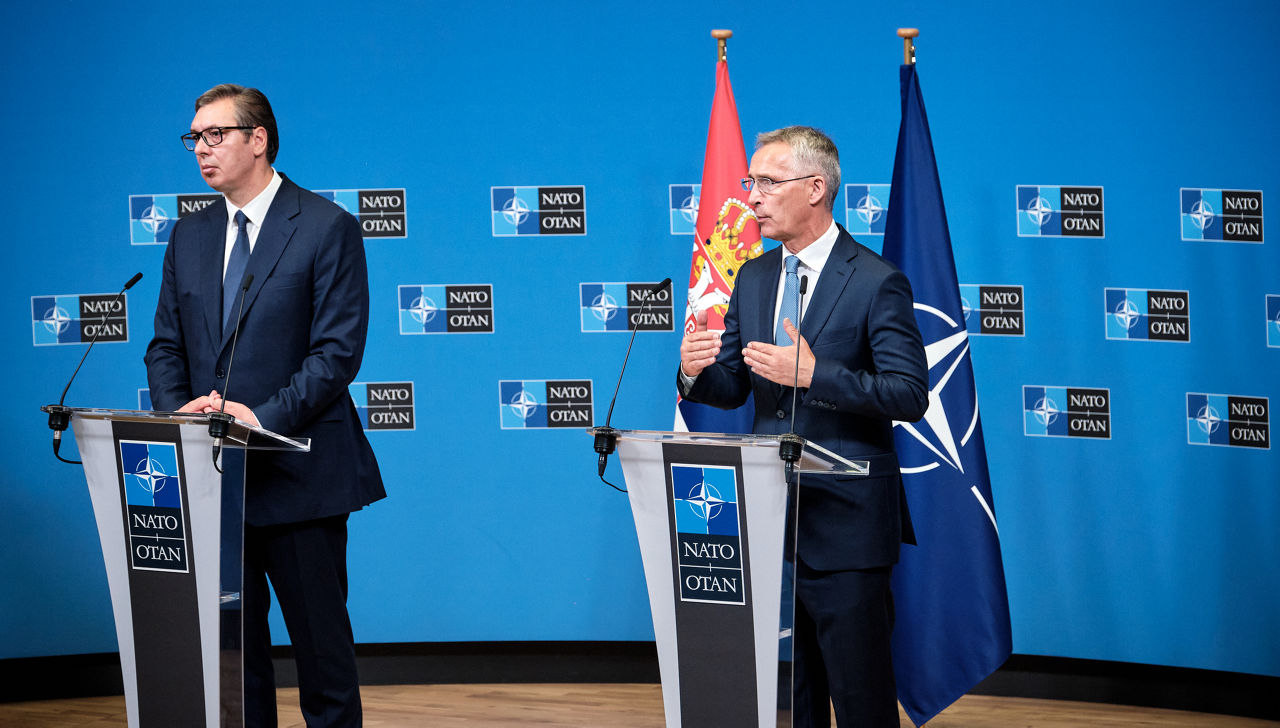
In its PfP Presentation Document submitted to NATO in September 2007, Serbia indicates its intention to become an active participant in the Partnership for Peace. NATO stands ready to further develop an ambitious and substantive relationship with Serbia, making full use of its PfP membership. The country is expected to cooperate fully with the International Criminal Tribunal for the former Yugoslavia.
Kosovo is of course a key subject in NATO's dialogue with Serbia. The Alliance intervened militarily in early 1999 to bring an end to ethnic repression in Kosovo, subsequently deploying the NATO-led Kosovo peacekeeping force (KFOR) to provide a safe and secure environment and facilitate reconstruction. KFOR remains crucial to guarantee security in Kosovo and will remain in Kosovo on the basis of United Nations Security Council Resolution 1244 to ensure a safe and secure environment, including freedom of movement for all people, unless the United Nations Security Council decides otherwise.
Framework for cooperation
Serbia submitted its first Individual Partnership Programme (IPP) to NATO in early 2009. Areas of cooperation and specific events in which Serbia wishes to participate are detailed in this document, which is jointly agreed with NATO.
Already prior to becoming a formal Partner, Serbia conducted limited security and defence reform cooperation with NATO, and military officers and civilians were allowed to participate in a number of NATO PfP courses. The Serbian armed forces have also cooperated with KFOR for many years through the Joint Implementation Council (JIC), based on the 1999 Military Technical Agreement between KFOR and the Serbian Armed Forces (Kumanovo Agreement).
Serbia is considering establishing a diplomatic mission at NATO Headquarters as well as a liaison office at the Supreme Headquarters Allied Powers Europe (SHAPE). In October 2008, the authorities in Belgrade signed an agreement on sharing classified information with the Allies and other Partners.
Key areas of cooperation
Security cooperation
In July 2005, the country signed a transit agreement with NATO to allow Allied forces serving as part of KFOR to pass through Serbian territory. This agreement between NATO and Serbia mirrors similar arrangements between NATO and other countries across and beyond Europe. It also provided for the establishment of the NATO Military Liaison Office in Belgrade. Established in December 2006, this office liaises with the Serbian military authorities on the practical aspects of the implementation of the transit agreement, in order to improve the logistics flow through Serbia for Allied contingents in Kosovo.
The Alliance and Serbia worked together in 2000 and 2001 on halting the violence and finding a solution in southern Serbia, an area of the country with a significant ethnic Albanian population. As a result, the Alliance relaxed the Air Safety Zone which had been established on both sides of the boundary between Serbia and Kosovo at the end of the Kosovo air campaign. Over the years, KFOR and the Serbian military have also established good and close relations.
Serbia aims to increase security cooperation within the PfP framework.
Defence and security sector reform
Defence and security sector reforms are core elements of cooperation. A vehicle for this has been the Serbia-NATO Defence Reform Group. The group was established in February 2006, to provide advice and assistance to the Serbian authorities on reform and modernization of Serbia’s armed forces, and to build a modern, affordable and democratically-controlled defence structure. Serbia also joined the PfP Planning and Review Process (PARP) in 2007.
The Alliance as a whole and individual Allies have considerable expertise which Serbia can draw upon in this area. An important priority will be working together to establish full democratic control over the armed forces.
NATO’s Military Liaison Office in Belgrade was opened in December 2006, to support the implementation of the NATO / Serbia transit agreement. It also supports work with Serbia on defence reform.
The Military Liaison Office also facilitates Serbian participation in activities in the framework of the Partnership for Peace Programme and provides assistance to NATO’s public diplomacy activities in the region.
The Allies have supported a number of NATO/PfP Trust Fund projects in Serbia. These include a project for the safe destruction of landmines and ammunition, executed by the NATO Maintenance and Supply Agency (NAMSA). The project, which ended in June 2007, was led by Canada and Austria. Currently, a Norwegian-led Trust Fund project is being implemented to develop alternative livelihoods for former members of the Serbian armed forces. The implementing agent for this project is the International Organisation for Migration (IOM).
Science and environment
Under the Science for Peace and Security (SPS) Programme, Serbia has received grant awards for a number of cooperative projects. Projects include seismic risk-hazard reduction studies, the future of regional cooperation, and counter-terrorism workshops.
Serbia and NATO aim to increase scientific cooperation. Key areas for development could be further regional security issues and environmental initiatives.
Public information
Serbia and NATO aim to improve public access to information on the benefits of cooperation with NATO. A broad and effective communications strategy will be an important aspect of PfP cooperation. The Military Liaison Office in Belgrade will play a role in this process.
Evolution of relations
Relations with Serbia have steadily improved since the Kosovo crisis. In 2001, the Allies worked with the new democratic government of the Federal Republic of Yugoslavia in stemming the violence in southern Serbia.
In 2003, Belgrade formally applied to join the Partnership for Peace (PfP). Cooperation continued, and a transit agreement for forces operating in Kosovo was signed by the country in July 2005. The Allies invited Serbia to join the PfP at the November 2006 Riga Summit. The country formally joined the Partnership in December of that same year and the Allies opened a new Military Liaison Office in Belgrade.
Key milestones
| 1999 | A 78-day NATO air campaign is triggered by ethnic repression in Kosovo. |
|---|---|
| The NATO-led Kosovo peacekeeping force (KFOR) is deployed to maintain security and support reconstruction efforts. KFOR and Serbian Armed Forces sign Military Technical Agreement (Kumanovo Agreement) | |
| 2001 | NATO and the newly elected government of the Federal Republic of Yugoslavia cooperate in crisis-management operations in southern Serbia |
| 2003 | Belgrade formally applies for PfP membership. |
| The Federal Republic of Yugoslavia is replaced by a looser state union of Serbia and Montenegro. | |
| NATO completes a PfP trust fund project to destroy 28,000 surplus small arms and light weapons in Serbia | |
| 2005 | Serbia hosts a PfP trust fund workshop ‘Together reducing unsafe surplus tools of war’ in Belgrade. |
| Serbia and NATO sign a transit agreement for KFOR forces. | |
| NATO launches a PfP trust fund project to develop alternative livelihoods for former Serbian armed forces personnel as the service is downsized | |
| 2006 | Serbia joins the Partnership for Peace. |
| NATO opens a military liaison office in Belgrade. | |
| 2007 | Serbia joins the PfP Planning and Review Process (PARP). |
| NATO completes a PfP trust fund project that safely removed 1.4 million anti-personnel landmines from Serbian territory. | |
| In September, Serbia submits its PfP Presentation Document to NATO. | |
| 2009 | Serbia agrees its first Individual Partnership Programme with NATO. |