Close
Back


From now on you can download videos from our website
If you would also like to subscribe to the newsletter and receive our latest updates, click on the button below.
Enter the email address you registered with and we will send you a code to reset your password.
The password must be at least 12 characters long, no spaces, include upper/lowercase letters, numbers and symbols.
Click the button to return to the page you were on and log in with your new password.
Updated: 20 June 2025
The European Union (EU) is an essential partner for NATO. The two organisations share common values, strategic interests and a majority of member countries. They work side by side in crisis management, on capability development, in addressing hybrid threats and challenges posed by growing strategic competition, as well as in building the capacities of their common partners in the east and south.

NATO and the EU have 23 members in common: Belgium, Bulgaria, Croatia, Czechia, Denmark, Estonia, Finland, France, Germany, Greece, Hungary, Italy, Latvia, Lithuania, Luxembourg, the Netherlands, Poland, Portugal, Romania, Slovakia, Slovenia, Spain and Sweden.

Strengthening the NATO-EU partnership is particularly important in the current security environment, in which both organisations and their members are facing similar threats and challenges to the east and south.
The range of subjects discussed between NATO and the EU has grown considerably over the past few years. Political dialogue covers the full spectrum of issues relevant to both organisations, including strategic challenges posed by Russia and China, the security situation in the Western Balkans and the Middle East, strengthening resilience, and fighting cyber, hybrid and information threats. Since Russia’s illegal annexation of Crimea in 2014, and especially since Russia’s full-scale invasion of Ukraine in 2022, both organisations have clearly demonstrated their political unity and complementarity of efforts in solidarity with and commitment to supporting Ukraine.
NATO-EU cooperation stretches back for more than two decades. In January 2001, an exchange of letters between the NATO Secretary General and the EU Presidency defined the scope of cooperation and modalities of consultation on security issues between the two organisations. Cooperation further developed with the signing of the NATO-EU Declaration on European Security and Defence Policy (ESDP) in December 2002, affirming the EU’s access to NATO’s planning capabilities for its own military operations, and the agreement, in March 2003, of a framework for cooperation. As part of this framework, the so-called “Berlin Plus” arrangements provide the basis for NATO-EU cooperation in crisis management in the context of EU-led military operations that make use of NATO's collective assets and capabilities, including command arrangements and assistance in operational planning.
NATO-EU cooperation has significantly expanded in recent years, building on three Joint Declarations (in 2023, 2018 and 2016), as well as the NATO Strategic Concept and EU Strategic Compass in 2022. In addition to the 2003 framework for cooperation, these declarations have outlined a series of actions for the two organisations to take together in concrete areas, strengthening and expanding the NATO-EU strategic partnership in light of common challenges. In December 2016, NATO Foreign Ministers endorsed 42 specific measures to advance how NATO and the EU work together in seven key areas of common interest: countering hybrid threats; cooperation in operations, including in the maritime domain; cyber security and defence; development of defence capabilities; defence industry and research; exercises; and defence and security capacity building for partners. In December 2017, further steps were taken to boost NATO-EU cooperation through the addition of 32 new measures, including in three new areas: military mobility to facilitate the movement of forces and equipment across Europe; information-sharing in the fight against terrorism and coordination of counter-terrorism support in partner countries; and promoting the role of women in peace and security.
The most recent Joint Declaration was signed by the NATO Secretary General, the President of the European Council and the President of the European Commission on 10 January 2023 at NATO Headquarters. The heads of the two organisations resolved to address growing geostrategic competition, resilience issues and the protection of critical infrastructure. Other priority areas of work include emerging and disruptive technologies, space-related issues, the security implications of climate change, and countering foreign information manipulation and interference.
NATO and the EU meet on a regular basis to discuss issues of common interest. Meetings take place at different levels including at the level of Defence and Foreign Ministers, Ambassadors, military representatives and defence advisors. There are regular staff-to-staff talks at all levels between NATO’s International Staff and International Military Staff, and their respective EU interlocutors (the European External Action Service, the European Commission, the European Defence Agency and the European Parliament).
Permanent military liaison arrangements have been established to facilitate cooperation at the operational level. A NATO Permanent Liaison Team has been operating at the EU Military Staff since November 2005 and an EU Cell was set up at SHAPE (NATO’s strategic command for operations in Mons, Belgium) in March 2006.
The NATO Secretary General and the EU High Representative for Foreign Affairs and Security Policy/Vice President of the European Commission regularly report to NATO Allies and EU member states on progress in cooperation. (See progress reports under Official Texts.)
Non-EU European Allies make a significant contribution to EU defence efforts, and their full involvement is essential to the strategic partnership between NATO and the EU.
Twenty-three NATO Allies are also EU member states, each of which has finite resources and a single set of forces. Ensuring the interoperability of NATO and EU defence capabilities is therefore a priority for both organisations. Work is under way to ensure consistency between the output of the EU’s Capability Development Plan (CDP), Headline Goal Process (HLGP) and Coordinated Annual Review on Defence (CARD), and the respective NATO processes – such as the NATO Defence Planning Process (NDPP) and the Planning and Review Process (PARP) – in particular through cross-participation in meetings and staff-to-staff contacts.
NATO and EU staff also work together on capability development within the EU’s defence initiatives and NATO’s multinational High Visibility Projects. In view of Russia’s brutal war of aggression against Ukraine, cooperation on munitions – particularly in the land and air domains – and replenishing stocks have become more urgent priorities.
NATO-EU cooperation on military mobility is also essential. Both organisations strive to ensure that their respective approaches are coherent and seek synergies wherever possible. A Structured Dialogue on Military Mobility, bringing together key stakeholders of both organisations, has proved crucial in this respect. Set up in 2018, it allows staffs to discuss shared priorities such as military requirements, transport infrastructure, the transportation of dangerous goods, customs as well as cross-border movement permissions and relevant exercises. Since then, NATO has been contributing to the development and updates of the EU’s military requirements for military mobility within and beyond the EU, in particular with regard to critical transport infrastructure.
NATO and the EU continue to improve their cooperation on countering hybrid threats. Staff-to-staff consultations have intensified in order to complement the work of the two organisations and avoid duplication. The European Centre of Excellence for Countering Hybrid Threats located in Helsinki, Finland functions as a forum for exchanges between NATO and the EU, bringing the two organisations closer together.
NATO and EU staff regularly engage on developments impacting cyber security and defence policy to ensure shared situational awareness. They also communicate on cyber crisis management and response mechanisms in addition to cyber capacity building initiatives for partners.
NATO and EU staff also observe and participate in each other’s cyber defence exercises, including exercises organised by the NATO Cooperative Cyber Defence Centre of Excellence (CCDCOE) in Tallinn, Estonia. Exchanges continue on concepts and doctrines as well as training and education, including between the EU Military Staff and NATO International Military Staff. The Technical Arrangement on Cyber Defence between the NATO Computer Incident Response Capability (now known as the NATO Cyber Security Centre) and the Computer Emergency Response Team for the EU institutions, bodies and agencies (CERT-EU) provides a framework for exchanging information and sharing best practices between emergency response teams.
The current security environment has led to a renewed focus on civil preparedness and resilience. Modern societies are highly complex, with integrated and interdependent sectors and vital services. They rely on critical infrastructure, such as power or Internet-based communication, to function. While such a high level of interconnectedness is more efficient, greater interdependencies also increase the risk of cascading effects in the event of a disruption. This makes critical infrastructure attractive targets for hybrid tactics.
NATO and the EU have stepped up their cooperation to address vulnerabilities in critical infrastructure as well as to improve transport and regulatory aspects of military mobility. This has meant an increased focus on coordinated border-crossing legislation, regulations and procedures, including for the transportation of dangerous goods.
In January 2023, the NATO Secretary General and the President of the European Commission agreed to create a Task Force on resilience and critical infrastructure protection. The Task Force focused on mapping out current security challenges and the particular importance of resilience in energy, transport, digital infrastructure and space. It released its Final Assessment Report in June 2023, making a number of key recommendations to deepen NATO-EU cooperation, including through more information exchanges, work to identify alternate transport routes for civilian and military mobility, and closer ties in security research.
NATO and the EU have strengthened their interaction in the field of crisis management exercises, which help increase the resilience and preparedness of both organisations. For example, in 2022-2023, NATO and the EU followed the Plan for Implementation of Parallel and Coordinated Exercises (PACE). This saw NATO staff participating in the relevant planning and conduct phases of the EU Integrated Resolve Exercise (under PACE22). In a reciprocal fashion, staff from the European Commission, the Council of the European Union and the European External Action Service participated in the planning and conduct of NATO’s crisis management exercise in 2023 (under PACE23). The PACE for 2024-2025 was agreed in February 2024.
Both NATO and the EU are committed to combatting terrorism and the proliferation of weapons of mass destruction (WMD). They have exchanged information on their activities in the field of protection of civilian populations against chemical, biological, radiological and nuclear attacks.
NATO Defence Ministers decided on 11 February 2016 to launch the Alliance’s Aegean Activity, deploying ships to the Aegean Sea to support Greece and Türkiye, as well as the European Union's border agency Frontex, in their efforts to tackle the refugee and migrant crisis. Standing NATO Maritime Group Two (SNMG2) is conducting reconnaissance, monitoring and surveillance in the territorial waters of Greece and Türkiye as well as in international waters. The deployment in the Aegean Sea aims to support international efforts to cut the lines of human trafficking and illegal migration. NATO ships are providing real-time information to the coastguards and relevant national authorities of Greece and Türkiye, as well as to Frontex, helping them in their efforts to tackle this crisis.
In October 2016, Defence Ministers extended NATO's deployment in the Aegean Sea and decided that NATO's new Operation Sea Guardian would support the EU's Operation Sophia in the Central Mediterranean with NATO ships and planes to help increase the EU's situational awareness and provide logistical support. Operation Sophia ended on 31 March 2020.
In July 2003, the EU and NATO published a "Concerted Approach for the Western Balkans". Jointly drafted, it outlines core areas of cooperation and emphasises the common vision and determination both organisations share to bring stability to the region.
February 1992: The EU adopts the Maastricht Treaty, which envisages an intergovernmental Common Foreign and Security Policy (CFSP) and the eventual framing of a common defence policy (ESDP) with the WEU as the EU's defence component.
Close cooperation is established between NATO and the WEU.
June 1992: In Oslo, NATO Foreign Ministers support the objective of developing the WEU as a means of strengthening the European pillar of the Alliance and as the defence component of the EU, that would also cover the “Petersberg tasks” (humanitarian search and rescue tasks, peacekeeping tasks, crisis-management tasks including peace enforcement and environmental protection).
January 1994: Allied Leaders agree to make collective assets of the Alliance available, on the basis of consultations in the North Atlantic Council, for WEU operations undertaken by the European Allies in pursuit of their CFSP. NATO endorses the concept of Combined Joint Task Forces, which provides for “separable but not separate” deployable headquarters that could be used for European-led operations and is the conceptual basis for future operations involving NATO and other non-NATO countries.
June 1996: In Berlin, NATO Foreign Ministers agree for the first time to build up a European Security and Defence Identity (ESDI) within NATO, with the aim of rebalancing roles and responsibilities between Europe and North America. An essential part of this initiative was to improve European capabilities. They also decide to make Alliance assets available for WEU-led crisis-management operations. These decisions lead to the introduction of the term "Berlin Plus".
December 1998: At their summit in St Malo, France and the United Kingdom make a joint statement affirming the EU's determination to establish a European Security and Defence Policy (ESDP).
April 1999: At the 1999 NATO Summit in Washington, NATO Heads of State and Government decide to develop the “Berlin Plus” arrangements.
June 1999: A European Council meeting in Cologne, Germany decides "to give the European Union the necessary means and capabilities to assume its responsibilities regarding a common European policy on security and defence".
December 1999: At the Helsinki Council meeting, EU member states establish military "headline goals" to allow the EU to deploy up to 60,000 troops by 2003 for ‘Petersberg tasks'. EU members also create political and military structures including a Political and Security Committee, a Military Committee and a Military Staff. The crisis-management role of the WEU is transferred to the EU. The WEU retains residual tasks.
September 2000: The North Atlantic Council and the EU’s interim Political and Security Committee meet for the first time to take stock of progress in NATO-EU relations.
December 2000: Signature of the EU's Treaty of Nice containing amendments reflecting the operative developments of the ESDP as an independent EU policy (entry into force February 2003).
January 2001: Beginning of institutionalised relations between NATO and the EU with the establishment of joint meetings, including at the level of Foreign Ministers and ambassadors. Exchange of letters between the NATO Secretary General and the EU Presidency on the scope of cooperation and modalities for consultation.
May 2001: First formal NATO-EU meeting at the level of Foreign Ministers in Budapest. The NATO Secretary General and the EU Presidency issue a joint statement on the Western Balkans.
November 2002: At the 2002 NATO Summit in Prague, NATO members declare their readiness to give the EU access to NATO assets and capabilities for operations in which the Alliance is not engaged militarily.
December 2002: The EU-NATO Declaration on European Security and Defence Policy (ESDP) is agreed on 16 December 2002. It reaffirms the EU assured access to NATO’s planning capabilities for its own military operations and reiterates the political principles of the strategic partnership: effective mutual consultation; equality and due regard for the decision-making autonomy of the EU and NATO; respect for the interests of EU and NATO member states; respect for the principles of the Charter of the United Nations; and coherent, transparent and mutually reinforcing development of the military capability requirements common to the two organisations.
March 2003: Agreement on the framework for cooperation on 17 March 2003. As part of the framework for cooperation, the so-called “Berlin Plus” arrangements provide the basis for NATO-EU cooperation in crisis management in the context of EU-led military operations that make use of NATO's collective assets and capabilities, including command arrangements and assistance in operational planning. In effect, they allow the Alliance to support EU-led operations in which NATO as a whole is not engaged.
Entry into force of a NATO-EU security of information agreement. Transition from the NATO-led Operation Allied Harmony to the EU-led Operation Concordia in the Republic of North Macedonia (then known as the former Yugoslav Republic of Macedonia).
May 2003: First meeting of the NATO-EU Capability Group.
July 2003: Development of a common strategy for the Western Balkans.
November 2003: First joint NATO-EU crisis-management exercise.
February 2004: France, Germany and the United Kingdom launch the idea of EU rapid-reaction units composed of joint battle groups.
December 2004: Beginning of the EU-led Operation Althea in Bosnia and Herzegovina.
October 2005: Agreement on Military Permanent Arrangements establishing a NATO Permanent Liaison Team at the EU Military Staff and an EU cell at SHAPE.
November 2005: A permanent NATO Liaison Team is set up at the EU Military Staff.
2005 - 2012: Transatlantic informal NATO-EU ministerial dinners are held in New York (Sep. 2005 and Sep. 2006); Sofia (Apr. 2006); Brussels (Jan. 2007); Oslo (April 2007); New York (Sep. 2007); Brussels (Dec. 2007); New York (Sep. 2008); Brussels (Dec. 2008); Brussels (March 2009); and New York (Sep. 2010, 2011 and 2012).
March 2006: An EU cell is set up at SHAPE.
November 2010: At the 2010 NATO Summit in Lisbon, the Allies underline their determination to improve the NATO-EU strategic partnership and welcome recent initiatives from several Allies and ideas proposed by the Secretary General in this regard.
11 February 2013: Then President of the European Commission José Manuel Barroso visits NATO Headquarters.
May 2013: The NATO Secretary General addresses the European Parliament’s Committee on Foreign Affairs and Subcommittee on Security and Defence.
June 2013: The NATO Secretary General participates in an informal meeting of EU Foreign Ministers.
December 2013: The NATO Secretary General addresses the European Council in Brussels.
5 March 2014: NATO and EU Political and Security Committee (PSC) ambassadors hold informal talks on Ukraine during Russia’s illegal annexation of Crimea. A second round of talks takes place on 10 June 2014.
10 February 2016: A Technical Arrangement on Cyber Defence was concluded between the NATO Computer Incident Response Capability (now known as the NATO Cyber Security Centre) and the Computer Emergency Response Team of the European Union (CERT-EU), providing a framework for exchanging information and sharing best practices between emergency response teams.
11 February 2016: At the request of Germany, Greece and Türkiye, NATO Defence Ministers agree that the Alliance should join international efforts to stem human trafficking and illegal migration in the Aegean Sea, cooperating with the European Union's border management agency, Frontex.
10 March 2016: Visiting the European Commission to meet former Commission President Jean-Claude Juncker, former NATO Secretary General Jens Stoltenberg stresses the vital importance of the NATO-EU relationship and welcomes the organisations’ deepening ties.
12-13 May 2016: An informal EU-NATO Directors General Conference takes place at NATO Headquarters to enhance staff-to-staff interaction between the organisations’ respective military staffs on topics of current relevance and common interest related to security and defence.
20 May 2016: Then EU High Representative for Foreign Affairs and Security Policy Federica Mogherini visits NATO Headquarters for a meeting with NATO Foreign Ministers to discuss areas for expanded NATO-EU cooperation ahead of upcoming EU and NATO summit meetings.
July 2016: At the 2016 NATO Summit in Warsaw, a Joint Declaration expresses the determination to give new impetus and new substance to the NATO-EU strategic partnership in light of common challenges. Areas for strengthened cooperation include: countering hybrid threats; operational cooperation including at sea; cyber security and defence; defence capabilities; defence industrial cooperation; exercises; and building the defence capabilities of partners to the east and south.
27 October 2016: NATO Defence Ministers meet with then EU High Representative Federica Mogherini and the Defence Ministers of then-partners Finland and Sweden (now NATO members) to discuss ways to deepen NATO-EU cooperation in the areas of countering hybrid threats, cyber defence, coordinated exercises and supporting partners. Ministers agree to extend NATO’s deployment in the Aegean Sea in support of the efforts of Greece, Türkiye and the EU’s border agency Frontex to break the lines of human trafficking. They also decide that NATO’s new Operation Sea Guardian will support the EU’s Operation Sophia in the Central Mediterranean with NATO ships and planes, ready to help increase the EU’s situational awareness and provide logistical support.
15 November 2016: The NATO Secretary General meets with EU Defence Ministers for talks on European defence and closer NATO-EU cooperation. He stresses that efforts to strengthen European defence can contribute to a stronger NATO, through better defence capabilities and higher defence spending in Europe.
7 December 2016: NATO Foreign Ministers approve a series of more than 40 measures to advance how NATO and the EU work together including on countering hybrid threats, cyber defence, and making their common neighbourhood more stable and secure.
15 December 2016: The NATO Secretary General meets with EU leaders for talks on European defence and closer NATO-EU cooperation.
10 February 2017: NATO convenes an informal workshop on how to reinforce security dialogue in the Euro-Atlantic region, focusing on the importance of NATO, the European Union and the Organization for Security and Co-operation in Europe (OSCE) supporting each other to improve existing arms control mechanisms.
24 March 2017: The North Atlantic Council and the EU’s Political and Security Committee meet to discuss NATO-EU cooperation, in particular the implementation of the Joint Declaration signed in Warsaw in July 2016, which led to a common set of proposals endorsed by the respective Councils of both organisations in December 2016.
19 June 2017: A first progress report on NATO-EU cooperation – authored jointly by former NATO Secretary General Jens Stoltenberg and former EU High Representative / Vice-President of the European Commission Federica Mogherini – concludes that the two organisations are making substantial progress in complementing each other’s work since the agreement in Warsaw in July 2016 to work more closely together in areas ranging from resilience to hybrid threats, through greater coherence on capability development to helping build the defence capacities of partner countries.
5 December 2017: In a meeting with then EU High Representative Federica Mogherini, NATO Foreign Ministers agree to step up NATO’s cooperation with the European Union through an additional common set of 32 new proposals on the implementation of the Joint Declaration signed by the President of the European Council, the President of the European Commission and the Secretary General of NATO. Joint work will include three new areas: military mobility, information-sharing in the fight against terrorism, and promoting women’s role in peace and security. A second progress report on NATO-EU cooperation is issued.
8 June 2018: A third progress report on NATO-EU cooperation is released to the public and highlights the qualitative and quantitative increase in cooperation between NATO and the EU.
10 July 2018: In the second Joint Declaration on EU-NATO Cooperation, the President of the European Council, the President of the European Commission and the NATO Secretary General underline the importance of continued EU-NATO cooperation to address multiple and evolving security challenges as well as steps being taken by both organisations to strengthen capabilities in defence and security.
11 July 2018: At the 2018 NATO Summit in Brussels, Allied Leaders underline that the European Union remains a unique and essential partner for NATO. They welcome tangible progress made in a range of areas as well as the second Joint Declaration about taking further steps to implement the common set of 74 proposals, emphasising the importance of the commitment to improving military mobility.
17 June 2019: A fourth progress report on NATO-EU cooperation is published.
16 June 2020: A fifth progress report on NATO-EU cooperation is published.
3 June 2021: A sixth progress report on NATO-EU cooperation is published.
14 June 2021: At the 2021 NATO Summit in Brussels, Allied Leaders emphasise unprecedented levels of NATO-EU strategic cooperation that includes addressing challenges such as resilience issues, emerging and disruptive technologies, the security implications of climate change, information threats, and the growing geostrategic competition. They reaffirm their commitment to the full implementation of the common set of 74 proposals and highlight the importance of the development of coherent, complementary and interoperable defence capabilities.
27 November 2021: The joint visit of the NATO Secretary General and the President of the European Commission to Latvia and Lithuania demonstrates solidarity with NATO Allies and EU member states in the Baltic region, as well as further strengthening of the cooperation between NATO and the EU.
3 February 2022: NATO and EU PSC Ambassadors hold an informal meeting to discuss Russia’s military build-up in and around Ukraine and the implications for European and international security. The meeting formed part of a series of meetings, preceded by an exchange on Afghanistan in September 2021 and one on Operation Althea in Bosnia and Herzegovina in December 2021.
24-25 February 2022: The NATO Secretary General meets with the President of the European Commission and the President of the European Council to discuss Russia’s full-scale invasion of Ukraine. NATO and the EU stand united in condemning Russia's actions, and in supporting Ukraine’s sovereignty, territorial integrity and right to self-defence. On 25 February, the Presidents of the European Council and European Commission take part in an extraordinary virtual summit of Heads of State and Government of NATO Allies, plus then-partners Finland and Sweden (now NATO members).
20 June 2022: A seventh progress report on NATO-EU cooperation is published.
29-30 June 2022: The Presidents of the European Council and European Commission participate in talks at the 2022 NATO Summit in Madrid, as well as at the transatlantic dinner hosted by the Spanish government and with the participation of NATO and EU Heads of State and Government. NATO and the EU underline the importance of further strengthening their essential strategic partnership, and reaffirm their common resolve in responding to Russia’s war against Ukraine.
10 January 2023: The NATO Secretary General and the Presidents of the European Council and European Commission meet at NATO Headquarters to sign the third Joint Declaration on EU-NATO Cooperation. The meeting underlines the importance of NATO-EU cooperation in the context of the changed security environment following Russia’s full-scale invasion of Ukraine, and the upcoming increase of shared members.
21 February 2023: Former NATO Secretary General Jens Stoltenberg, former EU High Representative for Foreign Affairs and Security Policy Josep Borrell and then Ukrainian Foreign Minister Dmytro Kuleba agree to convene NATO, EU and Ukrainian procurement experts to see what more can be done together to ensure Ukraine has the weapons it needs to defend itself against Russia’s aggression.
17 March 2023: The NATO Secretary General visits the Troll A offshore natural gas platform off the west coast of Norway, together with the Norwegian Prime Minister, the European Commission President and the CEO of Equinor. The joint visit demonstrates the unity between NATO and the EU and the shared commitment of both organisations to boosting the resilience of their societies, infrastructure and supply chains.
23 March 2023: A ceremony is held to mark the initial operational capability of the new Multi Role Tanker Transport (MRTT) fleet developed by the NATO Support and Procurement Agency, the European Defence Agency and the Organisation for Joint Armament Cooperation.
16 June 2023: An eigth progress report on NATO-EU cooperation is published.
29 June 2023: The NATO Secretary General participates in the European Council meeting for discussions with the EU leaders about NATO-EU cooperation in the context of Russia’s aggressive war against Ukraine, as well as on broader common challenges.
11-12 July 2023: The Presidents of the European Council and the European Commission participate in the NATO Summit in Vilnius, including the session with partners in the Indo-Pacific region.
13 June 2024: A ninth progress report on NATO-EU cooperation is published.
9-11 July 2024: The President of the European Council and the EU High Representative for Foreign Affairs and Security Policy/ Vice-President of the European Commission participate in the NATO Summit in Washington D.C., including the session with partners in the Indo-Pacific region.
18 November 2024: NATO Secretary General Mark Rutte participates in the EU Foreign Affairs Council (Defence).
3 December 2024: The EU High Representative for Foreign Affairs and Security Policy/ Vice-President of the European Commission – Kaja Kallas – participates for the first time in the NATO-Ukraine Council in the margins of the meeting of NATO Ministers of Foreign Affairs.
13 January 2025: The NATO Secretary General participates in the joint meeting of the European Parliament’s Committee on Foreign Affairs and Subcommittee on Security and Defence, where he gives an overview of NATO priorities, including defence spending and production, and support to Ukraine.
31 January 2025: The NATO Secretary General participates in a gathering of the EU College of Commissioners, hosted by President of the European Commission Ursula von der Leyen, to discuss enhancing defence readiness, boosting defence production and aligning strategic priorities between the two organisations.
3 February 2025: The NATO Secretary General joins the informal EU leaders’ retreat to discuss European defence.
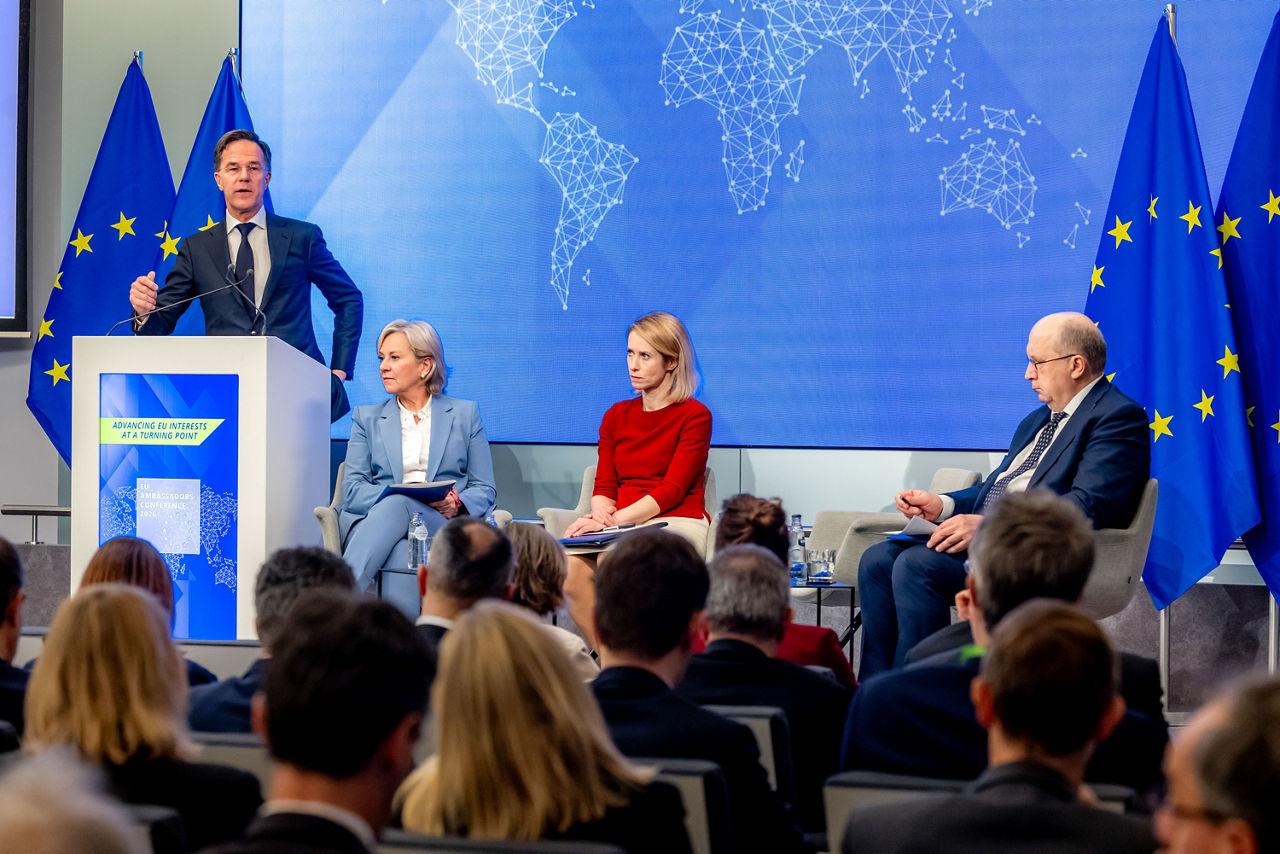
6 February 2025: The NATO Secretary General participates in a panel discussion followed by an exchange of views at the EU Ambassadors Conference.
13 February 2025: The EU High Representative for Foreign Affairs and Security Policy participates in the NATO-Ukraine Council in the margins of the meeting of NATO Ministers of Defence.
3-4 April 2025: The EU High Representative for Foreign Affairs and Security Policy has an exchange, following the publication of the “White Paper for European Defence – Readiness 2030”, in the meeting of NATO Ministers of Foreign Affairs. She also participates in the NATO-Ukraine Council.
5 June 2025: A 10th progress report on NATO-EU cooperation is published.