Security cooperation
Kazakhstan has designated an infantry battalion called KAZBAT for potential deployment in NATO-led peace support operations, under UN Security Council mandates. KAZBAT became operable as planned and elements of this battalion have joined NATO Allies in a number of live exercises. In the framework of PARP, the expansion of this force into a full brigade organisation – KAZBRIG – is a major project aimed to give Kazakhstan the rotational capability to continuously sustain a battalion-sized contribution.
In 2010, Kazakhstan, along with Russia, Ukraine, Uzbekistan and Belarus completed an agreement with NATO allowing the transportation of non-lethal ISAF cargo to Afghanistan by rail. As of 2012, NATO also has an agreement with Kazakhstan (as well as with several other Central Asian countries and with Russia) for the redeployment of non-lethal ISAF cargo from Afghanistan. Kazakhstan plays an active role in both hosting and participating in PfP training and exercises. In consultation with the Allies, Kazakhstan has established a PfP regional training centre, and continues to work with Allies and regional partners in military and language training techniques.
Kazakhstan contributes to the fight against terrorism through its participation in the Partnership Action Plan on Terrorism (PAP-T). This includes sharing information and analysis with NATO, enhancing national counter-terrorist capabilities and improving border security. In 2010, Kazakhstan hosted an Advanced Training Course, conducted by the Defence Against Terrorism Centre of Excellence based in Ankara, Turkey. The course addressed the dimensions of terrorism and strategies for countering it, as well as the importance of international and interagency cooperation in the fight against terrorism.
Since 2006, Kazakhstan, in cooperation with NATO Allies and regional partners, has hosted annual military exercises, named “Steppe Eagle”. These exercises have contributed to strengthening the interoperability of KAZBAT with Alliance forces. The 2012 exercise was conducted by Kazakhstan “in the spirit of Partnership for Peace”; the 2013 “Steppe Eagle” exercise is currently being planned.
Defence and security sector reform
NATO is supportive of the democratic and institutional reform process underway in Kazakhstan, which is outlined in its IPAP. Specifically in the area of defence and security sector reform, NATO and individual Allies have considerable expertise that Kazakhstan can draw upon.
Kazakhstan’s participation in the PfP Planning and Review Process (PARP) since 2002 has helped develop the ability of its forces to work with NATO. Kazakhstan seeks to attain interoperability between elements of its armed forces and those of NATO Allies. The current emphasis is on its Air-Mobile Forces. Joint work continues on the further development of a peacekeeping battalion to work alongside NATO Allies.
Kazakhstan’s PfP Training Centre (KAZCENT) was accredited by NATO as a Partnership Training and Education Centre in December 2010. KAZCENT offers annual courses open to Allies and Partners on military English, NATO staff procedures, and a 5-day familiarisation course on the history, economy, and culture of Central Asia and Afghanistan.
Civil emergency planning
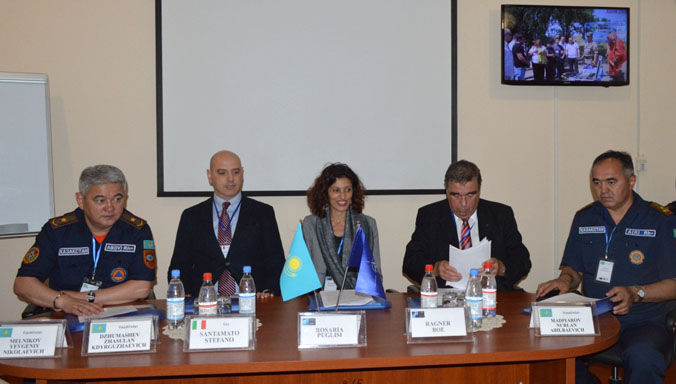
Kazakhstan is enhancing its national civil emergency and disaster-management capabilities in cooperation with NATO, and through participation in activities organised by the Euro-Atlantic Disaster Response Coordination Centre (EADRCC).
Kazakhstan has previously sent a representative to the EADRCC; in 2009, the country hosted the EADRCC “ZHETYSU” exercise near Almaty.
Science and environment
Under the Science for Peace and Security (SPS) Programme, Kazakhstan has received grant awards for over 20 cooperative projects for collaborate scientific and environmental projects. Projects include collaboration on studies into radiological risks in Central Asia, integrated water resources management and new technology exploration for seismic resistant construction.
In October 2009, participants from Kazakhstan attended an advanced training course on countering the proliferation of weapons of mass destruction through enhanced border security.
In May 2010, scientists and engineers from Kazakhstan, as well as other countries from the Commonwealth of Independent States (CIS) region, took part in a NATO science programme designed to train participants in securing cyber networks. The primary goal of the training was to strengthen the cyber networks of the educational and scientific communities in the CIS region.
Public information
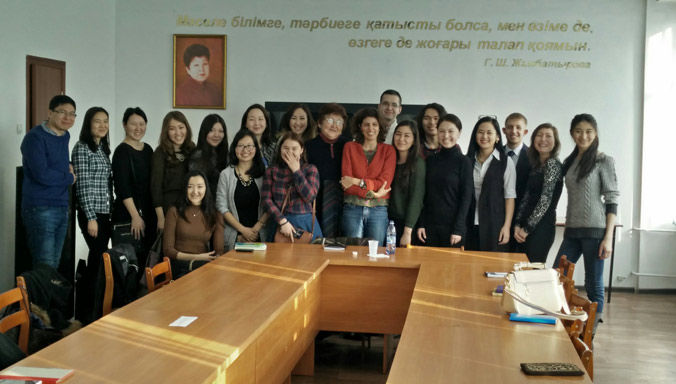
Increasing public awareness of NATO and the benefits of its relations with Kazakhstan is also an important area of cooperation. A joint NATO-Kazakhstan workshop was conducted to contribute to training the Kazakh press and public information officials in 2007. The Resource and Information Centre on NATO at the Al Farabi Kazakh National University in Almaty, which opened in 2007, hosts a number of NATO-themed events and visits from NATO representatives annually. In addition, a NATO Depository Library was inaugurated in Astana in 2008. Joint work on establishing a wider public information strategy is ongoing.
In every partner country, an embassy of one of the NATO member states serves as a contact point and operates as a channel for disseminating information about the role and policies of the Alliance. The current NATO Contact Point Embassy in Kazakhstan is the embassy of Latvia.