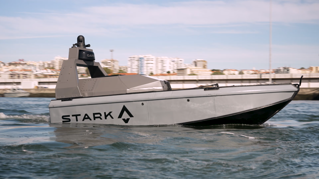
(00:00) VARIOUS SHOTS - STARK VANTA UNCREWED SURFACE VESSEL (USV)
(00:46) KRAKEN K3 SCOUT USV
(00:58) VARIOUS SHOTS - PROXFLYER SEASHADOW USV
(01:44) VARIOUS SHOTS – LUXBIO BIOLUMINESCENT PRODUCT BEING MIXED WITH WATER
(02:12) VARIOUS SHOTS – LUXBIO BIOLUMINESCENT PRODUCT BEING TESTED UNDERWATER
(02:25) VARIOUS SHOTS – RECONIS ROBOTIC SENTRY DOG
(02:42) VARIOUS SHOTS – UNPLUGGED WIRELESS CHARGING AND DATA TRANSFER TECHNOLOGY
(03:05) SOUNDBITE IN ENGLISH –
Sandeer Saask, Kraken Technology Group
‘Bold Machina itself is a NATO SOFCOM operational experimentation, and it offers a great platform for companies like ours, for example, to show off and work with different special operations teams. So it's a great opportunity to talk to them, learn what needs to be iterated, what is already good, but at the same time also show and prove that this platform can be used.
So what you can see behind me is the Kraken K3 Scout. It's a high-performance, highly capable uncrewed surface vessel, which can do very fast speeds and also offers modular mission payloads. What an unmanned or an uncrewed surface vessel does is you can send it out to the open sea or a lake, operated by itself. It can be remotely controlled, and it can also conduct certain mission sets autonomously.
NIF honestly is a great investor, because they obviously have their own connections to the wider, NATO network. So, you know, for example, we've been working with them to participate here, and some other adoption milestones.
Yeah, there are so many positives to it, actually, because first of all, you get to see what other people are doing, what we need to be doing better, where we need to improve. And then also you get immediate feedback from the actual operators, the end users. That's, I think, that's the biggest thing.
You come here, show up with your platform, and they can give you immediate feedback on what they like, what they don't like, what else needs to be added, what kind of other payloads do we need to work on, etc..’
(04:59) SOUNDBITE IN ENGLISH –
Max, Maritime domain, Stark Defence
‘Yeah, one of the most benefits is that we are able to try and test our systems among other USV’s and of course, among the Special Operations Forces here in Lisbon. Our STARK USV that we are operating here is a six-metre uncrewed surface vessel. So it sits above the surface and it can go up to 46 knots.
We have a loitering ammunition payload. So a UAV coming out of the USV for striking targets in the distance of up to 80 km.
Yeah, that's I think, a big advantage, big difference we can make. And of course, you can use it for ISR missions, approaching harbours and facilitating dive operations.
We are really working on systems, on technology which is cutting-edge, which is leading into the future. And I think we have to get that stuff done because manned systems come not to an end, but probably we need more unmanned systems to facilitate the operations.’
(06:06) SOUNDBITE IN ENGLISH
Tomas Meyer, Unplugged
‘Here we are today at Bold Machina 2026, we’re demonstrating our capability for divers to connect and disconnect systems together wirelessly, obviously.
Today, if you want to have autonomy at sea and if you want to connect one system to another systems, you need to have a mechanical connection with hands, meaning that you need a human, but with wireless technology the system can just touch or just be barely in contact with each other or some centimetre away from each other and then be able to communicate and recharge and vice versa. So we allow that, via this connection, we allow autonomy at sea.
We are a small company of 10 people about and we had no background in military whatsoever. And I said, you know, I'm going to send this application into this DIANA, see what happened. We just, you know, our application got accepted and we put our fingers in something which is absolutely enormous. The world of military. The result of DIANA, the first year that we grow the company, in terms of people by 23%, we expect to grow the company by 50% next year. That is also very directly linked to the growth into the military. We got some contract with DIANA. We opened or closed one military contract, demonstration, all these kind of things every month since we started. So that has been an extremely positive journey for us.’
(07:33) SOUNDBITE IN ENGLISH
Torry Sirdevan, Luxbio
‘So Lux Bio is a biotech company based out of Canada, Vancouver, Canada, and we make emergency and stealth lighting using nature, using protein. So we use firefly protein. We use the genetic code from that insect and we put it into a different, a different organism, a microbe that produces the protein en masse, which we then extract and we put into our chem light replacements, into search and rescue applications, into all these new use cases we're testing here at BOMA.
So with SOF here at BOMA, we are looking to keep their signature as low as possible. So at this cold light low zero heat, zero noise, keeping them super stealthy, undetectable until they do want to be seen, if they do. We're working towards helping them serve those needs.
We just finished NATO DIANA, and it was absolutely transformative for the company. It propelled us into this new space for the company. This defence industry. And we learned so, so much.’