Security cooperation
From 2002 onwards Uzbekistan played a key role in supporting Allied operations in Afghanistan. Uzbekistan permitted Germany the use of its airfield at Termez. Uzbekistan also allowed overflight and transit permission for Allied forces and supplies. Uzbekistan continues to be a main transit route for humanitarian supplies to Afghanistan, the majority of which is delivered via the Hairaton Bridge. Specialists from Uzbekistan have also assisted in implementing tangible infrastructure projects in Afghanistan, including the reconstruction of ten bridges connecting the northern part of the country with Kabul.
In 2009, Uzbekistan, along with Russia, Ukraine, Kazakhstan and Belarus, completed an agreement with NATO allowing the transportation of non-lethal ISAF cargo to Afghanistan by rail. The first trial shipment was successfully completed in June 2010.
Defence and security sector reform
NATO supports the democratic and institutional reform processes in Uzbekistan. Specifically in the area of defence and security sector reform, NATO and individual Allies have considerable expertise that Uzbekistan can draw upon.
Uzbekistan’s participation in the PfP Planning and Review Process (PARP) since 2002 aims at attaining interoperability between elements of its armed forces and those of NATO Allies. While there was a pause in PARP cooperation following the events in Andijan in 2005, Uzbekistan reaffirmed its participation in the programme in 2010.
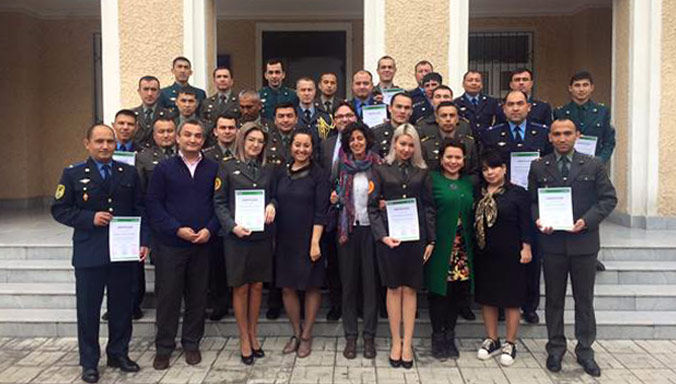
Along with several other countries in Central Asia, Uzbekistan has received counter-terrorism training through NATO-funded courses. In May 2010, officials from Uzbekistan attended an Advanced Training Course, funded through NATO’s Science for Peace and Security Programme, to learn the latest counter-terrorism methods and strategies. Uzbekistan has also benefited from counter-narcotics training. In 2008, Uzbek officers were able to put to use the counter-narcotics training they received through an initiative of the NATO-Russia Council, when they seized nearly 600 kilograms of heroin that was being smuggled through the country.
Uzbekistan continues to participate in seminars and workshops on defence policy and strategy within the PfP framework, as well as military education of Uzbek officers, with an emphasis on English language training. Work has also begun on the establishment of a PfP Training Centre in Tashkent.
Civil emergency planning
Civil emergency planning and disaster-relief coordination are significant areas of cooperation. Uzbekistan hosted the first EAPC exercise held in Central Asia in April 2003. Exercise “Ferghana 2003” simulated an international response to a major earthquake in the region.
NATO and Uzbekistan are continuing cooperation in this area today. Uzbekistan is developing its civil response capacity for natural and man-made emergency situations in consultation with the Allies. This includes updating planning procedures and organization methods for rescue operations.
Science and environment
Under the Science for Peace and Security (SPS) Programme, Uzbekistan has received grant awards for over 50 projects for scientific and environmental collaboration, while scientists and experts from Uzbekistan have had leading roles in 164 activities, including in various cooperative activities as participants and key speakers.
In May 2010, scientists and engineers from Uzbekistan, as well as other countries from the Commonwealth of Independent States (CIS) region, took part in a NATO science programme designed to train participants in securing cyber networks. The primary goal of the training was to strengthen the cyber networks of the educational and scientific communities in the CIS region.
Uzbekistan also participates in the Virtual Silk Highway project, which aims to improve internet access for academic and research communities in countries of the Caucasus and Central Asia through a satellite-based network.
Public Information
In every partner country an embassy of one of the NATO member states serves as a contact point and operates as a channel for disseminating information about the role and policies of the Alliance. The current NATO Contact Point Embassy in Uzbekistan is the embassy of Italy.